Sales prospecting. A plan your team can actually run.
Sales prospecting is the work of finding relevant potential customers and starting a useful sales conversation. A practical B2B plan separates 2 workloads: account research and contact preparation. ReplyLead runs cold email and LinkedIn within an agreed scope; your team owns the sales conversation and close. Plan the work before treating a large contact list as a pipeline.
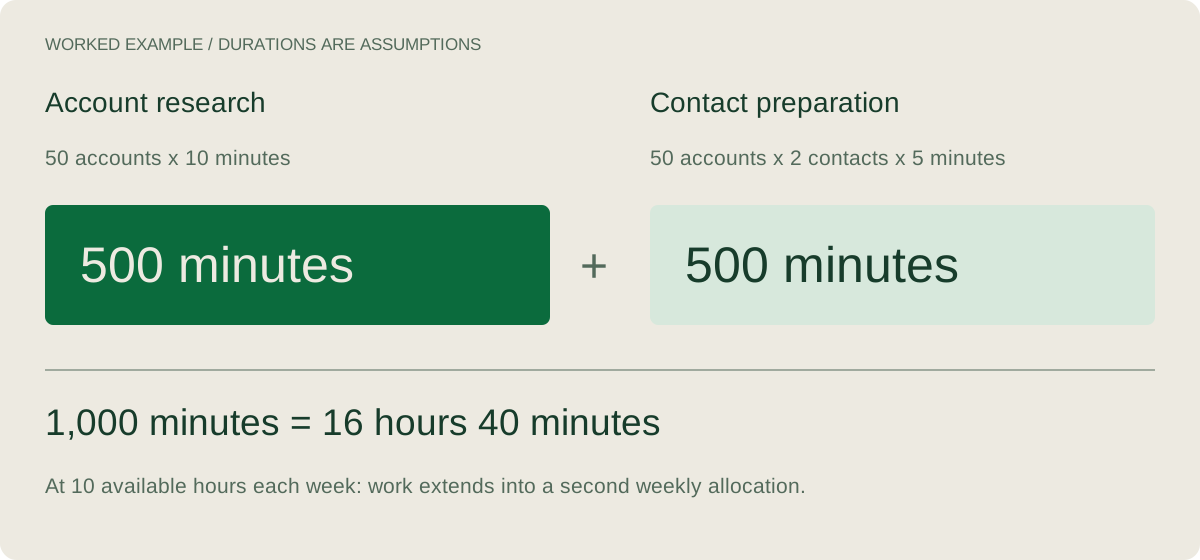
Account research is shared work. Contact preparation repeats for each person. Separating the two makes it easier to see what changes when you add more accounts or more people at each account.
WORKED EXAMPLE / ASSUMPTIONS, NOT A BENCHMARK
50 accounts. 16 hours and 40 minutes of planned work.
Account researchContact preparation
Account research
500 minutes
Contact preparation
500 minutes
At 10 hours a week
2 weekly allocations
50 accounts x 10 minutes + 50 accounts x 2 contacts x 5 minutes = 1,000 minutes. At 600 minutes available each week, the workload extends into a second week. Unfinished work carries forward.
This is research capacity, not a forecast of reachable contacts, qualified prospects, messages, meetings or revenue. Inputs are not independently verified.
How the workload is calculated
Total minutes equal accounts multiplied by research minutes, plus accounts multiplied by contacts per account and preparation minutes per contact. Divide the total by weekly hours multiplied by 60, then round up to count weekly time allocations. A zero-hour week has no available capacity for a positive workload.
Time the same tasks across a representative sample before using the result for staffing. Include the source check, role check and message preparation you actually perform. If a complex account takes longer, use a separate batch or a documented average. A shorter time assumption reduces the displayed workload; it does not establish that the work can be done well in less time.
One account task plus repeated contact tasks. The example durations are assumptions for demonstrating the calculation, not ReplyLead delivery times.
A sales prospecting process with a usable handoff
01
Define the business situation
Start with the problem your service can address and the type of organization that experiences it. Write the geography, delivery constraints, exclusions and purchasing unit in plain language. A group headquarters, a local site and a subsidiary may have different responsibilities. Agree what counts as an account before counting the list.
For an already approved list, retain the qualification work and its evidence. Refresh a missing fact or resolve a contradiction; do not restart the entire assessment merely because the record enters a new workflow.
02
Research once, then map the responsibilities
Save the relevant public source and the date it was checked. Separate what the source states from the question you still need to ask. A hiring page can describe an open role; it does not confirm a project budget. A product launch can establish a new product; it does not establish dissatisfaction with a supplier.
Identify the people responsible for the task, evaluation and commercial decision where that information is available. Several contacts at one company are several contact records, not several independent buying opportunities. The list-building guide covers sourcing, fields and verification in more detail.
03
Match the message to the evidence
Give the recipient a clear reason the conversation could be relevant. Connect a verified observation to a concrete capability and a proportionate question. Keep unknowns as questions. Do not convert a company-level activity signal into a claim about something the individual personally did.
A template can preserve structure, but the observation still needs to be correct. Use the existing personalization and evidence guide for the checks behind personalized copy, and the intent-data guide for anonymous or account-level signals.
04
Let the reply change the plan
An automatic reply, a referral and a request for a discussion require different actions. Retain the original conversation and any stated timing. If the recipient supplies a colleague, establish the new person's role without representing the referral as purchase approval. If they ask to stop, preserve that request.
Use a shared reply-category definition so reporting and the next action agree. A calendar invitation is not attendance. Hand off the stated reason for the meeting, the relevant thread and the unresolved questions to the sales owner.
For the sales owner taking the conversation, the discovery call agenda planner turns that handoff into a focused discussion. Keep confirmed facts, unresolved questions, the next-action owner and agreed timing distinct.
Before planning contacts per account, use the B2B buyer persona responsibility map to distinguish the roles from the people who hold them. One person can hold several responsibilities; unresolved assignments remain questions rather than extra leads.
The same workflow, different buying units
The business context determines what is useful to research. These are planning examples, not customer results or evidence that the organizations described are ready to buy.
Industrial suppliers
A plant requirement may involve engineering, operations and purchasing. Establish the site, specification question and vendor process before treating a job title as the buying authority. A relevant first discussion may be a technical-fit review rather than a commercial proposal.
The recruiting workflow, payroll workflow and workforce-scheduling workflow lead to different discussions. Prepare the product task, data dependencies and evaluation participants. A requested demo should answer a specific operational question.
Distinguish the independent owner from a group marketing team. A new location can support a scope question, but does not prove a marketing problem. Keep business prospecting separate from patient acquisition.
An acquisition target and a buyer for a business are different audiences. The mandate, company ownership and confidentiality boundary matter before outreach. A company match does not establish that its owner wants to sell.
For other sectors, start with the existing industry playbooks. Choose the relevant purchasing situation rather than copying another sector's contact titles.
For logistics service providers, the logistics marketing and capacity plan connects the target market to existing commitments, operational reserve and a proposed group of new accounts. It helps separate the work operations can support from a forecast of business won.
Measure progress at the right stage
Different records answer different questions
Record
What it establishes
What still needs evidence
Account researched
The agreed research task was completed
Current need and willingness to discuss it
Contact prepared
A person or contact record has the required context
Reachability, response and decision responsibility
Interested reply
The actual response states interest
Fit, an accepted next step and meeting attendance
Accepted opportunity
The sales owner accepted the opportunity under agreed rules
Closed revenue and attributable value
Use a stable account identifier and contact identifier, keep event dates and record the campaign source. Count duplicated records once at the level you are reporting. Compare cohorts with similar observation windows; do not compare last week's new conversations with an older cohort that has already had time to close.
The workload calculator deliberately ends before outreach. Sending infrastructure, channel constraints, conversation quality and your team's sales capacity are separate inputs. Use closer capacity planning when you need to assess the meetings a sales owner can handle.
Keep the campaign source, original discovery and converting visit distinct. The lead-source history explorer shows why those records can differ and why a missing source should remain unknown instead of being filled from an earlier visit.
WHEN YOU NEED SOMEONE TO RUN THE WORK
Managed prospecting, with a clear division of responsibility
ReplyLead's documented workflow covers targeting, list work, sending infrastructure, messaging, reply handling, qualification and booking through cold email and LinkedIn. Your team supplies the commercial context, approved claims and exclusions, then handles the sales conversation and close.
A new marketYou need to test a defined business audience with a service your team can deliver.
An overloaded teamYour sellers can take relevant conversations, but account research and prospecting execution need an owner.
An unclear handoffYou need the meeting reason, conversation and next step to reach the sales owner together.
Scope the audience, research depth, approved messages, qualification criteria and reporting before launch. Infrastructure readiness and reputation-building affect launch conditions; the workload calculator is not a launch-date promise. Your sales calendar and response coverage need to support the campaign.
The commercial model is a monthly technology/infrastructure fee plus an agreed share of attributable closed revenue. The infrastructure amount remains due when nothing closes. See the current pricing explanation and agree the attribution terms. This page does not include an unlisted data provider, partner or additional marketing service.
The calculator is useful for an explicit research batch with known tasks. It does not validate contact data, decide whether outreach is appropriate in a jurisdiction, predict response, or calculate revenue. Unknown time requirements need observation before they become a staffing plan.
If the need is consumer acquisition, hiring candidates, event production or complete outsourced sales closing, clarify the service scope separately. If the team's problem starts after meetings are held, adding more prospecting work may not address it. Resolve the handoff or sales constraint before increasing volume.
Sales prospecting questions
What is sales prospecting?
Sales prospecting is finding relevant potential customers and starting a useful sales conversation. In B2B work, separate the account, the contact and the conversation so a researched company does not automatically become an interested buyer.
How is prospecting different from lead generation?
Lead generation is a broader description of creating potential customer interest or inquiries. Prospecting focuses on identifying and researching people or organizations and initiating relevant contact. Teams use the labels differently, so define the stage and counting rule in reporting.
How many accounts can one person research each week?
There is no universal number on this page. Enter the account research time, contact preparation time and weekly hours available for the work. The calculation uses those assumptions and does not verify their quality or predict campaign results.
Why does adding contacts change the workload?
The account research task is shared, while each planned contact needs preparation. In the worked example, 50 accounts with two contacts each create 100 contact preparation tasks. Those records are not necessarily 100 unique people or qualified buyers.
What does a weekly allocation mean?
It is the amount of working time you entered for one week. The calculator divides total planned work by that time and rounds up. Unfinished work can continue in the next week, and the final allocation can be partial. It is not a promised launch date.
Can the calculator tell me how many meetings I will book?
No. It estimates research and preparation workload only. Reachability, channel constraints, responses, qualification and sales conversion need separate evidence. No meeting or revenue forecast is produced.
What does ReplyLead handle in managed prospecting?
ReplyLead runs the agreed targeting, list work, infrastructure, messaging, reply handling, qualification and booking through cold email and LinkedIn. Your team provides the commercial context and handles sales conversations and closing. Confirm the scope and attribution terms before launch.
Sources and definitions
Sources checked 17 October 2026. The worked example and calculator use explicit hypothetical inputs, not a market benchmark or client performance claim.