Observation
What activity was recorded?
B2B DATA / EVIDENCE BEFORE OUTREACH
Intent data describes observed activity that may indicate interest in a topic or solution. For B2B outreach, keep 3 units separate: the observation, the company it is associated with and any identified person. ReplyLead's cold email and LinkedIn planning should preserve those distinctions. Company-level research is not confirmation that a named contact wants to buy.
What activity was recorded?
Which organization was associated?
Is an individual actually identified?
A product-page view, category comparison or recorded topic interest can help a team decide where to investigate. A direct request for a relevant conversation supplies different information: someone has actually asked for something. Do not flatten these records into a single label that sounds like confirmed purchase intent.
G2's product documentation describes signals from activities such as product and category page views and competitor comparisons. Its service is an example of a research-signal source. Those descriptions do not establish the identity, authority or buying commitment of a contact you separately find at the company. See G2's description of its buyer-intent data.
Your own forms, event records or conversations can document a direct interaction when the identity and event are established. An anonymous website visit remains anonymous unless a reliable record resolves it. Use the actual request or action; do not add a motive the person did not state.
A provider may associate research activity with an organization using its own collection and matching process. Check what the record represents, how recent it is and what the matching limitations are. A provider's score is not interchangeable with your sales team's opportunity acceptance.
Compare this layer with firmographic company attributes and technographic system observations. Company characteristics, observed technology and research activity answer different questions. None by itself supplies a verified address, a buying project or permission to contact a person.
AN EXPLICIT INTERPRETATION CHECK
Keep the record's scope and freshness visible before deciding the next action. The reviewer organizes your selections; it does not verify a data provider or the underlying event.
EVIDENCE BOUNDARY
Identify what was observed, when it occurred and whether the record refers to a company or a person. An unknown match is not a confirmed buyer.
Repeated records are not automatically independent evidence. No outreach or CRM action is performed by this tool.
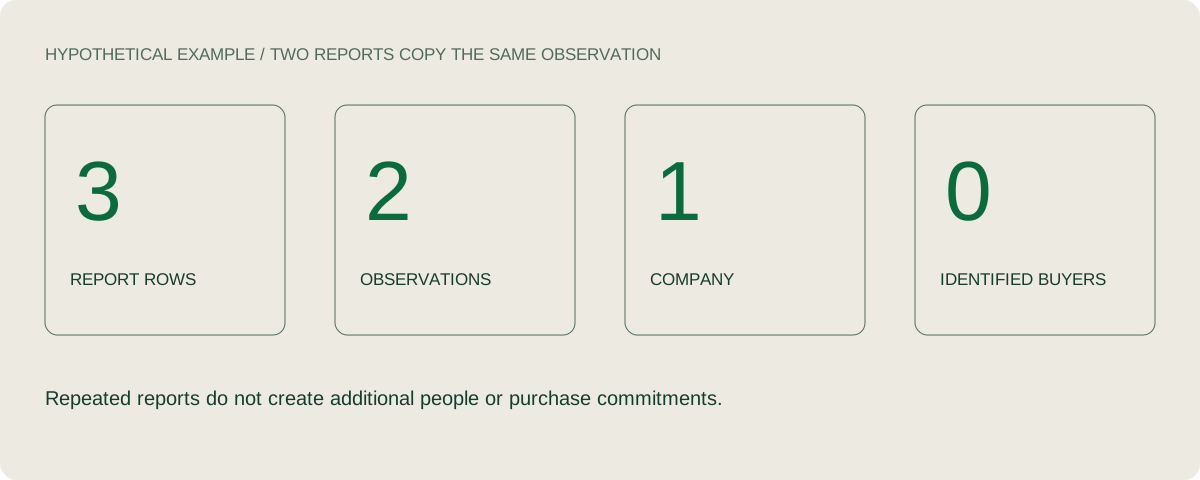
Suppose one provider reports topic research at Example Company. A second feed republishes that same observation. A separate record reports a category-page interaction associated with the same company. You now have three report rows and two underlying observations about one company. The records identify no individual who asked for a sales discussion.
Keep the duplicate report for lineage if needed, but do not count it as independent corroboration. Record the original source, observation date, reported account identifier and matching limitation. Contact research can identify relevant responsibilities at that company; it cannot retroactively identify who performed an anonymous action.
Do not replace established customer-fit work with a high activity score. If the list has already been qualified, reuse that decision. A new signal can add context; it is not a reason to restart the assessment or remove all exclusions.
Determine whether the event belongs to an account, an identified person or an unresolved match. Keep the observation date separate from the date the vendor delivered the file. A freshly downloaded record can describe old activity.
Identify the team that might own the business problem. Ask a relevant scope question. Do not tell a named contact that you saw them researching a product when the record only identifies an organization.
A direct request, referral, later-timing response or refusal changes the next action. Use the B2B qualification checklist for the handoff. An opt-out or suppression instruction is not cancelled by a later provider score.
Plan the work behind the research with the sales prospecting workload calculator. It separates shared account research from the preparation needed for each contact, using your own working-time assumptions.
For HR software, the workflow-focused demo planner shows why a technology observation still leaves integration and buying-project questions open. For event engagement, the webinar cohort guide separates attendance from a request to meet.
| Check | Evidence to request | What it prevents |
|---|---|---|
| Collection and meaning | A definition of the event, topic classification and relevant collection process. | Treating a broad topic visit as a direct buying request. |
| Entity matching | The unit identified, matching method and known ambiguity. | Assigning account activity to a particular employee without evidence. |
| Recency and coverage | Observation timestamps, refresh cadence and coverage for your actual market. | Calling old or sparsely covered activity current market demand. |
| Source overlap | Original source identifiers and whether feeds share underlying observations. | Counting syndicated copies as independent signals. |
| Use and suppression | Applicable usage terms, permitted workflows and your suppression process. | Assuming a subscription removes contact restrictions or an existing stop request. |
| Downstream value | Matched campaign and CRM cohorts, including rejected handoffs and attendance. | Reporting more flagged accounts as proven revenue growth. |
A useful pilot compares a defined audience and observation window. Keep the baseline selection process visible and report differences in account coverage, relevant conversations, held meetings and accepted opportunities. Do not attribute a sales result entirely to the signal when targeting, copy, timing or delivery also changed.
ReplyLead manages cold email and LinkedIn, including agreed audience research, infrastructure, messaging, reply handling and the sales handoff. Your team defines the commercial market, exclusions, permitted evidence and acceptance criteria. A specific intent-data feed or provider integration must be confirmed in scope; this guide does not claim one is included. See how the managed process works.
The published model includes a monthly technology and infrastructure fee plus an agreed share of attributable closed revenue. The fixed cost remains when nothing closes. Confirm any separate data cost and usage restrictions before launch, alongside attribution and existing-relationship exclusions. Review current pricing.
Do not turn a database's record count into a count of unique, reachable or interested buyers. Those units require their own definitions and evidence. No dataset size or intent-driven ReplyLead performance benchmark is asserted on this page.
The reviewer does not validate identity, legal permission, source accuracy, budget, authority or buying probability. Your selected "current" status means the observation is within the window you report; the tool has not checked the provider. Scores and classifications do not replace the prospect's own response.
This guide is about interpreting B2B commercial signals. Do not use it to infer sensitive personal characteristics or to claim that an anonymous visitor is a named person. A refusal must remain visible even when an older or unrelated research signal appears promising.
A recorded refusal takes precedence. Otherwise, unknown identity, unknown activity and stale observations require clarification before activation. Research activity supports a research question, not a confirmed purchase statement. An identified person's explicit current request can be routed for a relevant response while qualification and meeting acceptance remain separate.
Duplicate-source status is reported independently. It does not erase a real request, and it does not multiply the number of buyers. These are transparent operational rules, not a statistical model or confidence score. The tool stores no prospect data and sends no outreach.
Intent data describes activity that may indicate interest in a topic or solution. Check what was observed, when it happened and whether the record identifies a company, a person or an unresolved match. Activity does not itself confirm a buying commitment.
Not by itself. A company-level record does not establish which employee performed the activity. Finding a relevant contact at the organization is a separate research task and does not retroactively identify an anonymous visitor.
Firmographic data describes company characteristics. Technographic data concerns observed technology. Intent signals describe activity associated with possible interest. Keep their sources and limitations separate rather than treating one as a substitute for the others.
No. Providers or feeds can share underlying observations. Establish source lineage before treating repeated rows as independent corroboration. A copied record does not create another buyer.
No. Keep the observation date separate from the delivery date. Evaluate the documented observation window and any contradictory evidence. Unknown recency should remain unknown.
No. Preserve the stop request and apply it to the person covered by it. A high activity score or another copy of a record does not cancel the request. Resolve identity uncertainty without inventing a broader company-wide instruction.
This guide does not claim a particular provider feed or integration is included. Confirm any data source, usage terms, separate costs and workflow in the agreed campaign scope.
The reviewer and counting example are original operational guidance. Source descriptions are not independent validation of a provider's data quality or commercial outcomes.
Bring your target market, approved account criteria and available sources. We can discuss the research and handoff needed for a relevant outbound campaign.
Discuss account research