Define the account and buyer
Set the company profile, relevant roles, markets and exclusions. Start with a sample your sales team can accept or reject, with reasons.
ReplyLead builds and runs cold email and LinkedIn campaigns, from account research to meeting booking. Your team handles the sales conversation and closing. The LinkedIn channel is the LinkedIn lead generation agency page. Paid Message Ads and Conversation Ads are on the LinkedIn Sponsored Messaging services page.
Lead generation services help businesses identify and engage potential customers. ReplyLead's managed outbound scope covers 6 workstreams below. Inspect company examples here, then reveal 3 business emails without signup, subject to shared-network limits. A contact match is a starting point for qualification, not a sales opportunity.
01 / What you are buying
ReplyLead handles the campaign work described below. You approve the target and qualification criteria, take sales calls, make proposals and close. Match the written scope to the work your team needs to delegate. See the delivery process.
Set the company profile, relevant roles, markets and exclusions. Start with a sample your sales team can accept or reject, with reasons.
Source and enrich contacts against that profile. Check role fit and addresses before sending. Database presence alone does not establish current relevance.
Configure dedicated domains, mailboxes, authentication and monitoring for the agreed campaign. Sender preparation is a separate job from list building.
Develop messaging and follow-up for the selected audience. Cold email and LinkedIn are channels to scope deliberately; agree the work and approvals for each.
Respond to interest, clarify the request and apply your acceptance criteria. An information request and a request for a sales call are different outcomes.
Carry the context into meeting booking and sales follow-up. Your team owns discovery, proposals and closing. Review held and accepted outcomes separately.
ReplyLead handles replies, qualification and meeting booking; your team runs sales calls and closes. This is the split in our published delivery process. Agree the qualification criteria with your sales owner before launch, then carry the conversation context into each booked meeting. Use booked, held and sales-accepted meetings as separate reporting fields.
See who owns each step of reply handling and meeting delivery.
Plus an agreed revenue share. This is not the total engagement price. Confirm volume, attribution, the share percentage and any other contracted charges in your proposal. Published pricing checked 25 September 2026.
Compare the billing unit before the headline price. A monthly retainer pays for agreed work; pay-per-lead depends on a defined accepted lead; pay-per-appointment depends on the meeting and replacement terms; revenue share depends on attributed revenue. Ask which setup, infrastructure and variable charges sit alongside that unit.
Compare lead generation pricing models | Compare pay-per-appointment and retainer costs | Calculate in-house SDR versus outsourced costs
Our fit recommendation: a defined B2B customer, a specific reason to buy, workable deal economics and someone ready to run the sales calls. If these are unresolved, settle them before committing to campaign volume.
02 / Try the targeting
Choose an industry to explore selected company examples, with business descriptions checked against their own websites. Pick one to look for business contacts, or enter a company you already want to reach.
Step 1 / Explore company examples
64 selected examples across 8 industry groups. This browses a published example set, not the entire database. Company websites reviewed 25 September 2026. Browsing uses no contact-search credits.
Manufacturing
Recommended research checks, not verified company attributes.
Each Find contacts action starts a company search, subject to the shared limit of 5 searches per 24 hours. A security check may be required. Browsing examples uses no searches.
Manufacturing
Makes precision turned components for energy, aerospace and transportation businesses.
Manufacturing
Manufactures and distributes solvents and chemical products for industrial and domestic uses.
Manufacturing
Produces ready-to-eat foods, airline snacks and meals, including contract manufacturing.
Showing 1-3 of 8 selected manufacturing examples. These are not clients or qualified leads.
Step 2 / Find a business contact
Select an example company or enter a website, then press Find contacts.
Matching contacts will appear here.
You have 1 contact left.
Your bonus status will appear here.
Contact records come from ReplyLead's database. Current role and email verification dates are unavailable in this sample. Check them before outreach. This uses the same allowance as our company contact finder.
Not seeing your market? This example set does not establish database coverage. Ask us to review your target segment and explain the customer profile, location and relevant roles.
Match the market
A useful prospect list starts with why an account fits. Use these recommended qualification questions to inspect the sample, then open the relevant playbook for a worked example. They are checks to perform, not attributes already verified for each company.
Start with the plant, production process and purchasing route.
Manufacturing lead generation playbookExplore manufacturing company examplesTrailerSteps product-business case study
Connect the product use case to a team, workflow and workable acquisition economics.
B2B SaaS outbound playbookExplore software company examplesCampaigner and LGX campaign accounts
Match the supported systems, service boundary and internal owner.
IT services lead generation playbookExplore it services company examples
Separate shippers, carriers, brokers and software buyers before selecting contacts.
Logistics lead generation playbookExplore logistics company examplesLGX shipping software and services account
Separate employer acquisition from candidate sourcing, then check the hiring route.
Recruiting and staffing lead generation playbookExplore staffing and recruiting company examples
Match the project stage, trade and procurement route to your work.
Construction lead generation playbookExplore construction company examples
Name the buying decision and separate the sponsor from the operating owner.
Consulting lead generation playbookExplore consulting company examplesCEO Coaching International: related professional-service case
Define the institution, buying function and vendor-review route.
B2B financial services lead generation playbookExplore financial services company examples
Browse all industry lead generation playbooks. The company examples are potential research starting points; case studies are separately linked client accounts.
03 / Inspect the evidence
A useful case study connects the customer, audience and measured outcome. These examples report different units. They are not a forecast for your campaign.
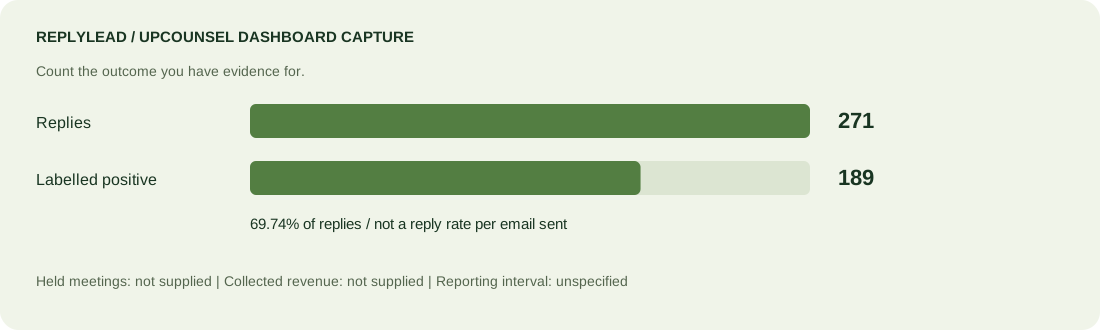
189 / 271
The published campaign dashboard capture shows 271 replies, of which 189 are labelled positive: 69.74% of replies, calculated as 189 divided by 271. This is not a reply rate per sent email.
The capture does not supply a reporting interval, held meetings or collected revenue. Read the source image and definitions before comparing it with another provider's meeting count. Inspect the UpCounsel evidence.
60+ leads / month
ReplyLead reports this figure in its TrailerSteps programme account. The public profile does not supply a bounded monthly series or qualification rules, and does not establish held meetings or revenue.
For a manufacturing buyer, use the account to discuss audience, scope and handoff. Do not treat the figure as a typical result. Read the TrailerSteps account and manufacturing outreach guide.
For broader context, our separate campaign benchmark dataset covers 429,763 sends across 115 campaigns. Its reply metrics include automated replies; they do not establish a qualified-meeting benchmark or validate these named accounts. Keep the unit and cohort attached to any number you use in a forecast.
04 / Compare the work
Lead generation services, software and appointment setting are related purchases with different scope. Use this buying framework to request a written division of responsibility; actual contracts vary.
If you are still deciding whether to outsource at all, outsourced lead generation puts the four pricing structures side by side with the year-one cost of an in-house SDR and a quote comparison tool.
| Model | Work to specify | What your team retains | Evidence to request |
|---|---|---|---|
| ReplyLead managed outbound | Targeting, data, campaign infrastructure, cold email and LinkedIn scope, reply handling and booking. | Target approval, sales calls, proposals and closing. | Accepted target sample, campaign reporting and separate booked, held and accepted outcomes. |
| Data or software vendor | Records, filters, credits, enrichment or workflow access. | Who operates the tools, validates fit, sends and handles replies. | A sample against your actual criteria; fields, provenance and verification dates. |
| Appointment setting | Channels, qualification rules, booking and rescheduling. | Sales attendance, discovery and closing; clarify the handoff. | Booked versus held meetings, acceptance rules and exclusions. |
| Outsourced SDR team | Assigned people, research, outreach, management and reporting. | Sales leadership decisions and the responsibilities outside the contract. | Team allocation, account work, qualification records and ownership. |
| Pay-per-lead provider | What a billable lead means, sourcing and exclusivity. | Follow-up, acceptance review and sales conversion. | Duplicate rules, rejection rights, consent or source evidence and usable contact details. |
| Demand generation agency | Content, distribution, paid media or other agreed demand work. | Sales follow-up and any channels outside the scope. | Attribution method, total media costs and progress beyond form submissions. |
For named providers and their documented terms, use our existing B2B lead generation company comparison, appointment setting company comparison or outsourced SDR company comparison. ReplyLead publishes these comparisons; they are not independent rankings.
05 / Before you sign
You have a defined B2B market and someone who can sell, but need help researching and operating outbound. Start with scope, an acceptable sample and the economics of a won customer.
If you need consumer enquiries, immediate local demand or software access for an existing prospecting team, evaluate those specific channels or tools. If nobody can run sales calls, meeting generation alone will not fill that operational gap.
The scope can include account research, contact sourcing, campaign setup, outreach, reply qualification and meeting booking. ReplyLead describes a managed cold email and LinkedIn service. Your team runs sales calls and closes deals. Confirm the target market, channel scope and acceptance criteria in the proposal; a contact record by itself is not a qualified lead.
ReplyLead publishes infrastructure pricing from US$2,023 per month, plus an agreed revenue share. That infrastructure amount is not the total engagement price. Volume, attribution, the revenue-share percentage and any additional contracted charges need a written proposal. Pricing checked 25 September 2026.
Yes. Browse the selected company examples by industry without a form. Select a company or enter your own target website, then run a contact search. The finder permits three distinct email reveals without signup, with five more once after a short form. Shared IP networks share the allowance, and up to five company searches are allowed per 24-hour window.
No such relationship or buying intent is implied. They are selected organization examples, with business descriptions based on their own websites. They are not a representative market sample. A matching business email is not proof of purchase authority, consent, deliverability or a current need.
Consider who will operate the process. Software can help your own team find data and run workflows. A managed service assigns more execution work to a provider. Before choosing, specify who researches accounts, checks contacts, writes messages, responds to replies and hands opportunities to sales. Compare scope and total cost, rather than a software subscription with a partial service fee.
Agree the definition with the sales owner before launch. A useful definition names company fit, relevant role, the expressed need and a next action. Track positive replies, booked meetings, held meetings, accepted opportunities and closed revenue separately. The definition and evidence should follow the record into your sales process.
This page does not establish a universal time to meetings. Target approval, data checks, infrastructure preparation, message review and your market affect the launch plan. Ask for readiness milestones and an agreed review date. Launching a campaign and confirming a qualified meeting are separate events.
From a sample to a campaign
Tell us who you sell to, what problem you solve and what makes an account worth pursuing. Review the targeting, scope and commercial model before deciding.
Discuss my outbound campaignThe 64 organization examples were selected on 25 September 2026 from candidates in ReplyLead's stored company records. We checked for domain presence in the private contact index, then reviewed each selected company's own website for its business identity and what it sells or does. The descriptions summarize those company statements; they are not independent endorsements. Examples that described a different business from the stored industry label were excluded.
Domains are normalized and deduplicated. Display names use the business name shown on its website where the stored company field was inaccurate. The public dataset contains organization names, domains, business descriptions, source industry labels and website references. It excludes individual contact names, emails and phone numbers. We do not publish a country filter because the underlying location field does not reliably establish company headquarters.
The initial availability check required HTTPS status 200 and a redirect staying on the same base domain. The subsequent website review checked business fit rather than accepting an industry keyword by itself. Selection is deliberate and is not a representative market survey. Contact search applies the existing suppression and allowance controls before disclosure. Records can change and some searches may return no contacts.
Download the company examples, descriptions and source websites (JSON). The website review date does not establish contact accuracy, current role or email deliverability. No personal contact information is included in sample-share links.
This sample does not estimate database coverage, unique people, market size, buying intent or the likelihood of a reply. A job-title match does not establish purchasing authority. Current email verification dates are unavailable here. Check suitability, current role and address before outreach.
The service description is ReplyLead's account of its work. The client examples carry their own evidence limits; neither demonstrates a typical result or causal lift. Pricing is subject to the scope and signed terms. This page does not rank unrelated providers or claim the example companies are ReplyLead customers.
Checked 25 September 2026: ReplyLead delivery process supports the work and sales ownership; ReplyLead pricing supports the infrastructure and revenue-share model; the case-study collection supports the UpCounsel dashboard counts and documented LinkedIn activity; the TrailerSteps programme account supplies the operator-reported lead figure and limitations.
ReplyLead campaign benchmarks is a separate dataset with its own denominators. Google's email sender guidelines describe sender requirements such as authentication; finding a contact does not establish compliance with those requirements or inbox placement. The company sample methodology and primary website references are published above.
Continue with industry-specific outreach playbooks, B2B lead list building or the ReplyLead tools directory.