REPLYLEAD / INDUSTRY FIELD GUIDE
IT services lead generationSell the service.
Define the boundary.
Turn a broad technology list into a defined service scope, an accountable buyer, and a reviewable next step.

THE BUYING PROBLEM
IT services is a market.
What is the decision?
IT services lead generation works at the intersection of account fit and service boundaries. Managed support, security consulting, and implementation projects require different qualification. Start with the systems you support, delivery geography, service hours, and the internal team you complement. A technology mention is a research lead; confirm its current use before writing as though you know the environment.
The costly targeting mistake
Do not treat an exposed technology tag or a public job description as evidence of a vulnerability. A security pitch should invite a scoped business conversation, not imply a breach, failed audit, or urgent risk that has not been established.
01 / WORK THE PROBLEM
IT support-responsibility matrix.
An MSP opportunity becomes useful when both teams know who owns the work. Find gaps and overlaps before an assessment becomes an unlimited support promise.
Illustrative inputs loaded. Edit them to build your own brief.
Calculations run in your browser. This tool makes no live account lookup. Our tool events record action names, not your field values.
YOUR WORKING BRIEF
Resolve the service boundaries
| Requirement | Decision |
|---|---|
| Endpoint support | Service provider |
| Identity and access | Internal team |
| Incident escalation | Shared without split |
| Backup and recovery | Unassigned |
Next actions
- Assign an owner for backup and recovery.
- Define the internal/provider split for incident escalation.
- Reconcile required hours (24/7) with confirmed coverage (Business hours).
- Document escalation, access, transition and acceptance responsibilities.
02 / FOLLOW THE REASONING
Watch the evidence
change the next step.
ILLUSTRATIVE CASE / NOT A CLIENT RESULT
The prospect has an internal IT team
In this example, the team owns identity and access but wants endpoint support. A blanket replacement pitch would misunderstand the requirement.
Build the responsibility matrix
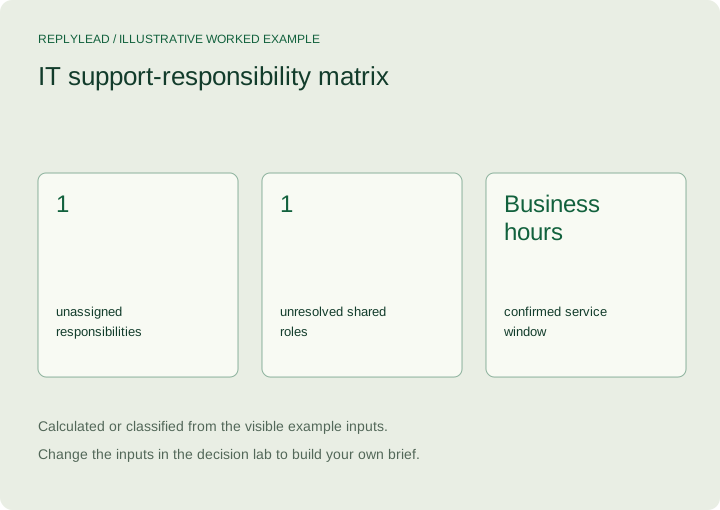
Endpoint support is assigned to the provider. Escalation remains shared without a split, and recovery has no owner. The buyer also requires 24/7 coverage while the proposed service is business-hours only.
Make discovery specific
Resolve escalation, recovery ownership and coverage before pricing. The useful deliverable is a responsibility map with named owners, not a speculative security diagnosis.
03 / SELECT THE COMMERCIAL ROUTE
Different buyers.
Different first conversations.
Three adaptable it services plays. Each connects a buying role, a verifiable reason to research, a useful asset and a handoff rule.
01Managed IT support
+
- Who buys
- Operations leadership and the internal IT owner at organizations within your support footprint.
- A reason to research
- A dated office expansion or IT hiring announcement makes responsibility and coverage worth checking.
- Leave out
- Companies outside service hours or geography, unsupported environments, and firms whose internal team already covers the proposed scope.
- Bring something useful
- A responsibility checklist for onboarding, help desk, endpoint management, and escalation.
- Start the conversation
- Would it be useful to compare who owns each support responsibility as the team grows?
- Accept the handoff when
- The buyer confirms a coverage question and includes the person responsible for IT operations.
02Security services
+
- Who buys
- Security or IT leadership with a defined business sponsor.
- A reason to research
- A prospect publicly describes a security program, customer-assurance process, or relevant vendor review.
- Leave out
- Claims of hidden vulnerabilities, inferred incidents, and requests for sensitive technical information in first-touch outreach.
- Bring something useful
- A scope matrix mapped to business responsibilities and a clearly bounded assessment process.
- Start the conversation
- Is an outside review of this part of the program within your current scope?
- Accept the handoff when
- The sponsor confirms scope, authority, and an appropriate secure channel for further information.
03Implementation projects
+
- Who buys
- Application owners, operations leadership, and the technical project manager.
- A reason to research
- A confirmed platform adoption, migration announcement, or integration initiative names the system you support.
- Leave out
- Unverified stack assumptions, unsupported versions, and projects already covered by an exclusive delivery partner.
- Bring something useful
- A dependency map showing data migration, integrations, user acceptance, and ownership.
- Start the conversation
- Who owns the integration workstream, and would a dependency review help define the project?
- Accept the handoff when
- A project owner describes the desired outcome and agrees which dependencies to review.
ReplyLead recommendations. Adapt the message to the actual evidence; these are not tested winning scripts. Download the three-play worksheet.
04 / KNOW WHAT THE SOURCE PROVES
Useful evidence.
Clear boundaries.
The source should change the account decision. Record its date and the field it actually supports; keep the missing information visible.
| Source or artifact | Use it for | Still needs confirmation |
|---|---|---|
| NIST CSF | A common structure for cybersecurity risk-management discussions | Does not identify a prospect's vulnerabilities or certify a service provider. |
| Service documentation | Your actual service hours, supported systems and escalation boundaries | Separate documented commitments from proposed changes. |
| Discovery confirmation | Current internal responsibilities and transition constraints | A job posting is insufficient proof of the live environment. |
Reference: NIST Cybersecurity Framework. Account-specific sources in this table are evidence to collect, not claims that a prospect has been verified.
FIRST-PARTY MEASUREMENT
2.12%Median unique replies per contacted lead.
81 campaigns with at least 500 contacted leads.
Know what the number measures.
ReplyLead's frozen August 12, 2026 extraction includes automatic replies and mixes client and internal programmes. It is a cross-campaign reference, not an industry target, positive-reply rate or meeting forecast.
For an industry cohort, separate human replies, positive replies, booked meetings, held meetings and sales-accepted opportunities. Keep the contacted-person denominator and maturity window consistent. A result from a different audience is not a substitute for your segment's evidence.
Inspect the benchmark definitions and datasetSource: ReplyLead campaign benchmark, checked 24 September 2026.
BEFORE YOU LAUNCH
The questions that
change the brief.
What does the it support-responsibility matrix produce?
An MSP opportunity becomes useful when both teams know who owns the work. Find gaps and overlaps before an assessment becomes an unlimited support promise. It exports your entered inputs, the resulting decisions and the next actions as a CSV working brief.
What qualifies a it services lead for a sales handoff?
Capture environment facts supplied by the prospect, support boundaries, internal owner, transition constraints, security requirements, and the agreed discovery agenda. Record assumptions separately from confirmed systems.
Are the examples measured ReplyLead client results?
The annotated examples are illustrative planning cases. The 2.12% benchmark is separately identified first-party mixed-programme evidence with automatic replies included. No industry conversion rate is inferred from it.
How to use this field guide.
Choose a buying situation, work through the decision lab, and attach a source and date to the facts that drive the result. Confirm unresolved requirements with the appropriate owner before launch. The tool rules are visible in the worked example and produce a planning brief from your inputs; they do not verify accounts or predict campaign outcomes.
ReplyLead runs cold email and LinkedIn. Review the operating process, commercial terms and documented client examples when evaluating a managed program.
Where judgment still matters.
Do not treat an exposed technology tag or a public job description as evidence of a vulnerability. A security pitch should invite a scoped business conversation, not imply a breach, failed audit, or urgent risk that has not been established.
The playbooks address B2B account acquisition. They do not establish contact permission or a legal determination. Apply your organization's contact, suppression and jurisdiction review before outreach.
Sources behind the method.
Checked 24 September 2026. Public references support the stated definitions. Account-specific facts still need a dated record from the buyer or an appropriate primary source. The planning choices and examples are ReplyLead recommendations.
- NIST Cybersecurity Framework: A framework for discussing cybersecurity risk management; not evidence that a prospect has a deficiency.
- ReplyLead benchmark and methodology: the scoped cross-campaign statistic above.
- ReplyLead operating process: cold email and LinkedIn program context.
- Google sender guidelines: Authentication and sender requirements for personal Gmail recipients. Checked 24 September 2026.
- Yahoo sender best practices: Yahoo-specific requirements to review before a campaign; separate from account fit. Checked 24 September 2026.
- RFC 5321: SMTP: Transport acceptance is separate from inbox placement or a human response. Checked 24 September 2026.
- Census NAICS: Classification describes establishments; verify the actual business activity and buying unit. Checked 24 September 2026.
BUILD WITH REPLYLEAD
Bring the market.
Leave with a sharper brief.
Bring your target buyer, delivery boundaries and the working brief. Define the account evidence, message and sales handoff for your industry.
Discuss your it services program