B2B webinar lead generation. What happens after registration?
B2B webinar lead generation connects a relevant audience, a useful event and a clear next conversation. ReplyLead manages cold email and LinkedIn within an agreed campaign scope. Measure 4 distinct stages: eligible registrants, attendees, attendees who book a sales meeting, and those whose sales meeting happens. Registration alone does not establish a qualified opportunity.
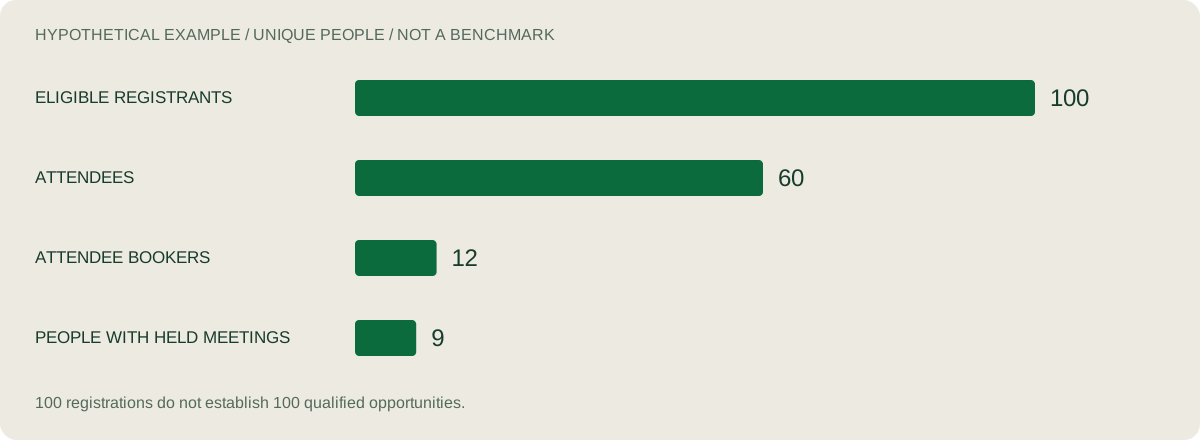
Hypothetical example: 100 eligible registrants, 60 attendees, 12 attendee bookers and 9 people whose sales meetings occurred. These are sample inputs, not a benchmark or client result.
Start with a question your intended buyer needs to resolve. Name the role, business situation and decision the event can help with. A broad educational topic can attract an audience while producing few suitable sales conversations. Reach and buying relevance are different objectives.
Before the invitation
Agree the account criteria, countries, languages and exclusions. Reuse an already-qualified list where one exists. Check that the event description, speakers, timing and registration destination are accurate. Do not imply a speaker relationship, customer result or promised takeaway without evidence.
Use a concise invitation tied to the buyer's role and the session's actual subject. A job title is a reason to assess relevance, not proof that the person needs your service.
Before the event
Define who owns registration, reminders, hosting, accessibility, the recording and technical support. State the time zone clearly. Test the registration and event-access journey using designated internal records.
Choose a follow-up window and the sales handoff before results arrive. Changing the denominator after seeing the outcome makes the comparison harder to trust.
COUNT PEOPLE CONSISTENTLY
Where does your event cohort narrow?
This calculator follows unique eligible people who registered for one event. The booker and held-meeting groups are subsets of the attendees. Meetings from nonattendees belong in a separate cohort. Count each person once at each stage within the same follow-up window.
HYPOTHETICAL EXAMPLE / NOT YOUR RESULTS
100 registrants. 9 people with a held sales meeting.
These percentages describe the example inputs. They are not targets, qualified-opportunity rates or a revenue forecast.
Calculations stay in this browser tab. Analytics records tool actions, not the counts you enter. No attendee names or contact details are collected here.
Attendance changes the follow-up. It does not settle the buying question.
Recommended post-event follow-up paths
What is known
Useful next action
Keep separate
Registered, did not attend
Provide the promised material when appropriate and ask whether the topic is still relevant.
A registration is not attendance, interest in a sales call or a reason to pretend they heard the presentation.
Attended, no expressed buying interest
Follow up on the event's actual topic with a relevant resource or a specific question.
Time in a session is not a confirmed need, budget or purchase project.
Asked a substantive question
Answer the question using supported information. Clarify whether a separate discussion would help.
A question may be educational, technical, vendor-related or a buying signal. Do not decide from attendance alone.
Requested a sales conversation
Confirm the scope, appropriate participant and agreed time. Send a useful handoff to sales.
Booking, attendance, qualification and opportunity acceptance remain different stages.
Declined further contact
Record the request and follow the agreed suppression process.
Do not restart the same approach on another channel because the person registered earlier.
Reference the actual event and what the person said. Do not claim to have noticed attendance, a question or a specific interest unless the relevant record supports it. Use separate reply categories for interest, information requests, later timing and refusals.
Microsoft documents attendance and engagement reporting for Teams meetings and events, subject to the applicable settings and capabilities. A platform report is evidence about participation, not a sales outcome. Check your own platform's available records and definitions; see Microsoft's attendance-report documentation.
Sales should receive the context behind the meeting.
Record the event, the person's stated question or need, their relevant responsibility, timing and the next step they accepted. Preserve uncertainty. If the person has not said there is a buying project, do not add one to the handoff.
Use the B2B qualification checklist after the reply. A good event can educate people who will never become customers. That does not make it a failed event, but it does mean educational engagement should not be reported as qualified demand.
HYPOTHETICAL COUNTING EXCEPTION
Two attendees from one company are not automatically two opportunities.
The calculator counts unique people. If two people attend from the same organization, both may belong in its attendance count. If sales opens one shared buying project, that is one opportunity in the CRM. Keep the person-to-opportunity relationship visible instead of forcing these totals to match.
If a nonattendee books after receiving the recording, record that conversion in the nonattendee cohort. Do not place the person inside the attendee-only booking rate. The additional conversation still matters; it simply has a different denominator.
Agree outbound support separately from event production.
ReplyLead manages cold email and LinkedIn prospecting, targeting, research, sending infrastructure, reply handling and the agreed handoff. Event invitations and follow-up must be explicitly scoped within that work. Your team owns the topic, speakers, presentation, registration platform, event delivery and sales conversations unless a separate agreement says otherwise. No event-production partner is named here.
Prepare accurate event details and a working destination before outreach. Launch also depends on infrastructure readiness and approved messaging; new sending domains may need weeks of reputation-building. A near-term event date does not remove those conditions. See the managed outbound process.
ReplyLead's published model is a monthly technology and infrastructure fee plus an agreed share of attributable closed revenue. The fixed cost remains when nothing closes. Confirm scope, attribution and exclusions through current pricing. Webinar registrations are not treated here as attributable closed revenue.
If another business will co-host a session or contribute a resource, agree the audience, each contribution, review, distribution and inquiry handoff before promoting the event. The professional partnership email template helps open that scope conversation without implying an existing arrangement.
Use your own baseline before setting a target.
For each event, record the topic, audience criteria, invitation sources, event date and follow-up window. Remove duplicates and classify existing clients, vendors, job seekers and support requests separately from new-business demand. Reuse already-confirmed account qualification; do not rescore the list merely to make reporting look stricter.
Review both counts and rates. A higher attendance rate from a much smaller audience may still produce fewer relevant discussions. A larger audience can dilute fit. Compare events with similar targeting, maturity and observation windows, and record material changes in topic or distribution.
No universal attendance, booking or opportunity benchmark is asserted on this page. The calculator supplies arithmetic for your cohort; it does not determine whether an event caused the meeting or how much revenue should be attributed to it. Later sales acceptance and closed revenue require CRM records.
Where these numbers do not apply.
Do not combine live-event attendance with on-demand recording views unless you define a separate, consistent cohort. Do not enter total meeting events where the field asks for unique people. Repeat meetings, reschedules, multiple devices and duplicate registrations require deduplication in the source records.
The calculator cannot validate your underlying data, identify people or establish consent. It does not host an event, send reminders, create meetings or update a CRM. If the counts are not comparable, reconcile the definitions before using the rates.
The calculation rules are visible.
Attendance rate equals attendees divided by eligible registrants. Attendee-booking rate equals attendee bookers divided by attendees. Booker meeting completion equals people with a held sales meeting divided by attendee bookers. Overall registrant-to-held-meeting rate equals that final group divided by eligible registrants.
Multiply each ratio by 100 for its percentage. A zero denominator returns "Not available", rather than an invented zero rate. Blank, fractional, negative, oversized or out-of-order counts are rejected. The cohort confirmation is required before calculating. Rates are displayed to one decimal place where needed; rounding does not change the underlying counts.
Questions about B2B webinar lead generation.
How do you generate B2B leads from a webinar?
Choose a topic relevant to a defined business audience, invite appropriate contacts and agree the follow-up before the event. Use actual responses to establish whether a sales discussion is useful. Registration and attendance do not by themselves establish qualification.
Should webinar registrants be counted as qualified leads?
No. A registration establishes a registration record. Account fit, responsibility, a stated buying need and an accepted next step require separate evidence. Keep existing clients, vendors and support requests separate from new-business demand.
What is a good webinar attendance rate?
This guide does not assert a universal benchmark. Establish a baseline from comparable events with consistent audience criteria, counting rules and observation windows. The displayed 100/60/12/9 example is hypothetical, not a target.
How should nonattendees be followed up?
Reference the event accurately and provide promised materials where appropriate. Do not say they attended. If a nonattendee books a sales meeting, track that result in its own cohort rather than the attendee-only booking rate.
Why can the calculator reject apparently valid numbers?
Each later field must be a subset of the previous group of unique people. Counts from different events, periods or populations can violate that rule. Reconcile the definitions instead of changing the figures to force a result.
Does ReplyLead produce or host the webinar?
This page describes targeted outbound within an agreed scope. Your team owns the event content, registration platform, hosting and sales conversations unless separately agreed. No event-production service or partner is included here.
Can the calculator calculate revenue attribution?
No. It calculates rates from nested people counts. It does not connect to registration, calendar or CRM systems, verify your data or establish causal revenue attribution.
Sources and evidence boundaries.
ReplyLead: how it works - managed outbound responsibilities and infrastructure conditions. Checked 17 October 2026.
ReplyLead: pricing - monthly technology cost and agreed revenue share. Checked 17 October 2026.
The cohort framework is ReplyLead's operational recommendation. The 100/60/12/9 example is hypothetical. No ReplyLead webinar performance result is claimed.
Build the audience and the next conversation together.
Bring the event topic, target companies, date and sales capacity. We can discuss whether a targeted outbound scope fits your event and timeline.