Sales email reply categories. Give each response the right next step.
Sales email reply categories connect what a prospect says with the action your team should take. This guide separates 9 practical categories, including meeting intent, information requests, referrals, later timing, automatic responses and refusals. ReplyLead manages cold email and LinkedIn conversations; a category is a routing decision, not proof of qualification, a booking or revenue.
Use the actual response and previous thread to decide what the prospect means. The examples below are hypothetical. They show why "positive, neutral, negative" alone may not tell an operator what to do next.
Recommended sales-response taxonomy. Confirm labels and stage definitions for your own CRM.
Category and example
Next action
CRM disposition
Reporting treatment
Meeting intent Can we talk next Wednesday afternoon?
Resolve the exact time and time zone from the thread, confirm the purpose and arrange the agreed next step.
Meeting requested; booked only after a specific slot is agreed and recorded.
Relevant interest can be recorded; a request is not a confirmed booking.
Relevant interest This could help with our supplier search.
Acknowledge the stated need and resolve the next missing qualification question.
Interested; retain the actual problem and open questions.
Count one interested prospect under your agreed definition, not one per message.
Information request Please send the details.
Answer the request with relevant information and clarify the next useful question.
Information requested; meeting interest remains unconfirmed.
Keep separate from accepted meetings; do not infer interest from a document request alone.
Question or objection How would this work with our existing process?
Answer the specific concern in context. Preserve any explicit timing or refusal elsewhere in the message.
Concern to resolve; record the actual issue.
An objection is not automatically positive interest or a rejection.
Referral Our operations lead handles this.
Clarify the responsible person and introduction context. Keep the referred contact separate.
Referral pending or routed; do not copy qualification to the new contact.
A referral is a distinct routing outcome, not a booked meeting.
Later timing Please try us again next quarter.
Record the stated timing and whether a later follow-up is welcome.
Deferred with a dated next action where agreed.
Keep later timing separate from an immediate opportunity.
Automatic response I am away until Monday.
Handle the return-date context without treating the message as a human expression of interest.
Automatic response; no new qualification evidence.
Exclude from interested-reply counts; retain separately as a message event.
Refusal or opt-out Please remove me from your list.
Stop the proposed outreach and apply the relevant suppression instruction.
Declined or suppressed, with the actual instruction preserved.
A refusal is not positive interest, regardless of prior activity.
Ambiguous or unrelated A signature-only message or a reply without a clear request.
Read the thread and clarify what is missing. Do not invent a request from a name or signature.
Needs contextual review; no inferred positive stage.
Keep unresolved classification visible; do not silently count it as positive or negative.
FROM LABEL TO NEXT ACTION
Check the route before changing the stage.
The explorer uses the category and flags you choose. It does not read your inbox or classify a real message. Its result is a planning recommendation, not a system action.
RECOMMENDED NEXT STEP
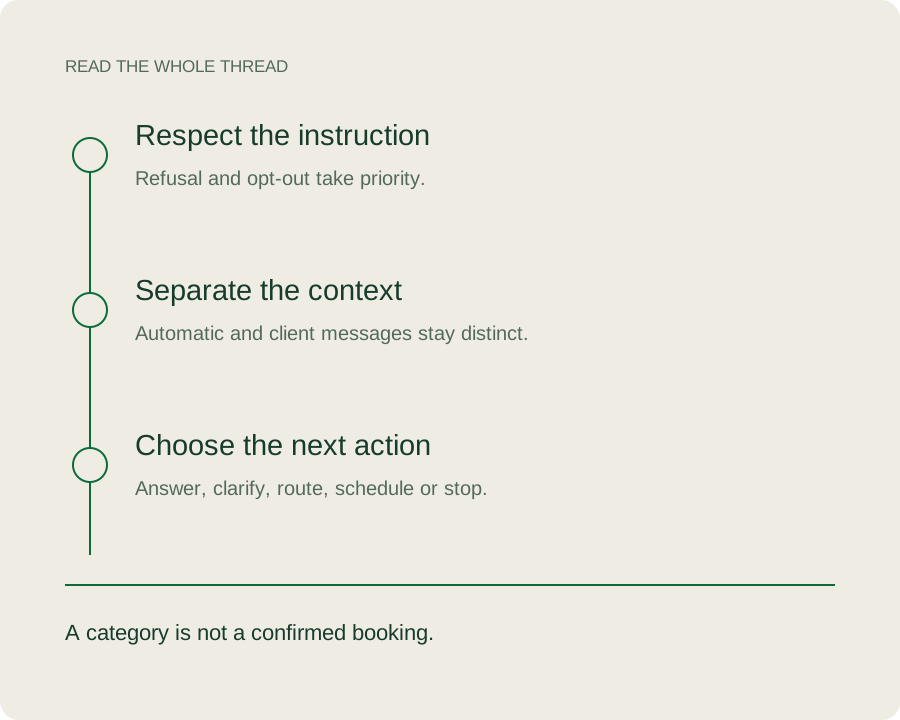
Read the thread before assigning a commercial stage.
Keep an ambiguous response unresolved until its meaning is established. A signature or a name by itself does not establish a request, a refusal or buying interest.
No message was sent, no CRM record was updated and no meeting was booked.
One message can contain more than one intent.
A meeting request with a question
"Can we talk Thursday, and what does it cost?" contains scheduling intent and a pricing question. Preserve both. Answer the question and resolve the slot using the existing thread. A primary label should not erase the second request.
A referral with a refusal
A person can decline involvement and name a possible colleague. Respect the sender's instruction and keep any new-contact research separate. Do not copy the sender's history or qualification status onto the referred person as though they had replied.
An automatic response with a return date
The date is context for a later action, not a declaration of interest. A vacation responder can contain a colleague's name without authorizing a sales approach or proving that colleague owns the buying decision.
A signature-only response
A name, company or email address may be all that appears in the message. Review the thread and attachments before deciding what it means. Do not assume acceptance, a request to sign an agreement, or a refusal from the signature alone.
Keep secondary intent as context even when the system needs one primary category. Suppression instructions take priority over a favorable commercial label. Existing-client support belongs in its own workflow and should not inflate new-lead reporting.
Keep opt-outs in the suppression record before a later list import. The email list cleaning workbench reviews repeated addresses and supplied exclusions locally. It does not connect to an inbox or update the sending system.
Six messages can represent four people and one interested prospect.
This hypothetical example shows why message counts and prospect counts are different. It is not campaign performance evidence.
Illustrative conversation history, with one record per prospect for the cohort summary.
Prospect
Messages received
Latest relevant interpretation
Counting treatment
A
Information request, then a meeting request: 2 messages.
Relevant meeting interest; exact booking still to confirm.
1 interested prospect, not 2 leads.
B
Automatic response, then a refusal: 2 messages.
Refusal controls the next action.
1 prospect; automatic message separate; no positive interest inferred.
C
Referral: 1 message.
Another responsibility needs clarification.
1 referring prospect; no new lead attributed to an uncontacted colleague.
D
Question about scope: 1 message.
Question to answer; interest not yet established.
1 prospect with unresolved interest.
The totals are 6 messages, 4 distinct prospects and 1 prospect expressing relevant meeting interest. A confirmed booking is not established by this example. Store the message history and the prospect-level status separately so later replies can update the next action without creating duplicate leads.
Agree the time window, identity key and stage definitions before comparing campaigns. Keep unknown classifications and unmatched CRM records visible. Do not turn a technical processing failure into a negative reply or a qualification failure.
Test the action, not just the label.
A reply-handling workflow needs examples that challenge its interpretation: negation, quoted earlier messages, mixed requests, automatic responders, timezone ambiguity, referrals and changed decisions. Review whether the next action fits the whole conversation, whether the CRM status is correct and whether the reporting event is deduplicated.
A human correction should record the original label, corrected label and reason. Keep useful test cases for later checks. Do not treat a model's confidence score as evidence that the prospect requested a meeting. If context is missing, identify the missing fact rather than forcing every reply into a positive or negative bucket.
Before the reply arrives, the message itself needs a truthful premise. The manufacturing subject-line examples show how to connect a buying responsibility with evidence you can support.
After relevant interest is established, use the separate B2B qualification and sales-handoff checklist. Categorization determines the route; qualification checks the evidence needed for the next commercial step.
Where managed reply handling fits.
ReplyLead manages cold email and LinkedIn outreach, including response handling, qualification against agreed criteria and meeting coordination. Your team supplies the commercial boundaries and takes the sales conversation. Agree which requests can be resolved from approved facts, which need a specialist and what must stop outreach.
Before launch, name the responsible owner, scheduling rules, suppression handling, CRM fields and escalation reasons. "Needs review" should identify a real missing fact or decision. It should not become a permanent destination for every reply.
This is a local planning tool, not an inbox integration. It does not verify a prospect, send a reply, schedule a follow-up, book a meeting or modify a CRM. Selected flags are visitor-provided assumptions. The result cannot establish what a real person intended.
No response-volume, reply-rate or meeting benchmark is claimed. Use your own labeled conversations and downstream sales outcomes to evaluate an operational system. Do not copy a public example into a prospect's record as if it were their message.
How the routing rules work.
An explicit refusal or opt-out takes priority. Automatic responses remain outside human-interest reporting. Existing-client and support messages stay outside new-prospect counts. The remaining category supplies a next action, CRM disposition and reporting note. Missing or unsupported categories return to contextual review rather than a guessed positive stage.
The categories draw on ReplyLead's published reply-handling method. The detailed matrix and explorer are original operational recommendations. Tool events contain selected category and flags, not message text. A tool interaction is not counted as an inquiry or meeting.
Questions about sales response categorization.
What are the main sales email reply categories?
A practical taxonomy separates meeting intent, relevant interest, information requests, questions or objections, referrals, later timing, automatic responses, refusals and unresolved or unrelated messages. Each needs a next action and a reporting rule, not just a sentiment label.
Is a request for information a positive lead?
It establishes that information was requested. It does not by itself establish a relevant problem, meeting interest or an accepted opportunity. Keep the request and the unresolved qualification facts separate.
How should an out-of-office reply be counted?
Keep it as an automatic message event, separate from human buying interest. A return date may inform a later action, but it is not a meeting request or a positive lead.
What happens if a reply contains both interest and an opt-out?
Preserve the whole context and apply the explicit refusal or opt-out instruction. A prior favorable label does not override a request to stop. Keep any separate referral or client-service context distinct.
Does a meeting request count as a booked meeting?
No. A request or proposed window shows scheduling intent. Confirm the specific slot, time zone, participants and purpose, then record the booking. Attendance and opportunity acceptance remain later stages.
Does this tool classify my inbox or send replies?
No. It uses the category and flags you select to show a planning recommendation. It does not read messages, verify intent, send outreach, change your CRM or create a meeting.
How do reply categories differ from lead qualification?
Categorization determines what the response means and where it should go. Qualification checks whether the evidence meets the agreed requirements for a sales handoff. Keep both records rather than treating a label as proof of qualification.
Sources and definitions.
ReplyLead methodology - interested, objection, referral, timing, automatic and refusal handling. Checked 17 October 2026.
How ReplyLead works - managed outreach and sales responsibilities. Checked 17 October 2026.
ReplyLead pricing - fixed infrastructure costs and revenue share. Checked 17 October 2026.
How to qualify B2B leads - subsequent evidence checks and handoff workflow. Published and checked 17 October 2026.
Give the inbox a defined path forward.
Discuss your target market, the replies you receive and the next actions your sales team needs. We can assess the managed workflow and its handoff requirements.