Skip to content

INDUSTRIAL OUTREACH / WORDS YOU CAN SUPPORT

B2B email subject line examples for manufacturing.

These 12 B2B email subject line examples for manufacturing connect a buyer's responsibility with a fact the sender can support. Each includes the evidence needed, a possible opening and a claim to avoid. ReplyLead runs cold email and LinkedIn; the purpose of the subject is to introduce a relevant conversation, not to manufacture urgency or imply an existing relationship.

By Mark Glazer / Updated 17 October 2026

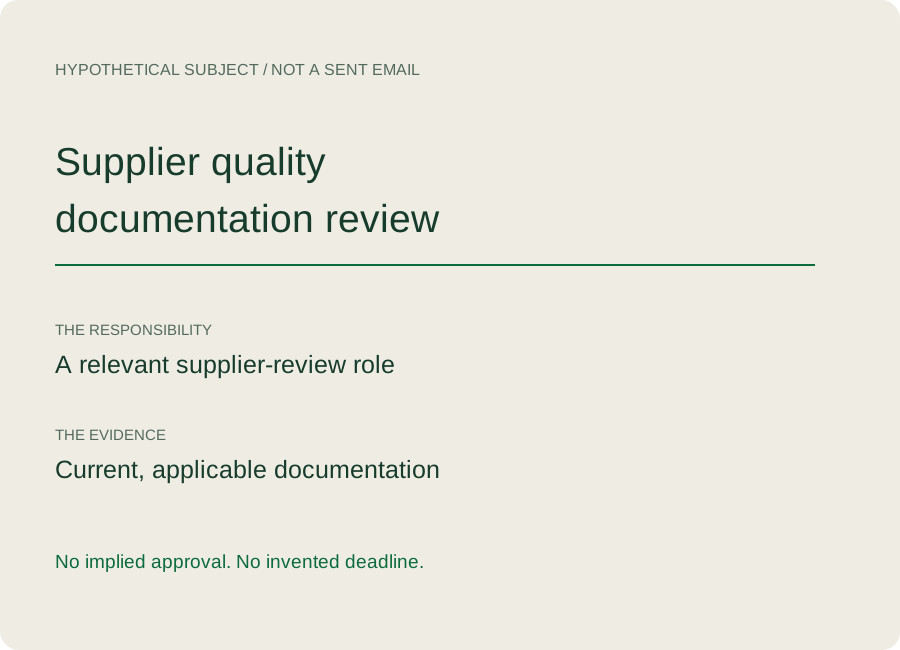
A hypothetical subject, Supplier quality documentation review, is connected to a relevant responsibility and current documentation. The subject does not imply prior approval.
A schematic example, not a sent message. The words need to match the work and evidence behind them.

12 conditional examples

4 buying responsibilities

3 evidence contexts

Make the first line worth answering.Discuss your target market

BUYER ROLE + AVAILABLE EVIDENCE

Start with the person and the fact.

These are hypothetical starting points. Use an example only when its condition is true for your business and the recipient. The opening must deliver what the subject suggests.

12 examples. Choose only wording your actual capability and evidence can support.

01 / Procurement / Capability

Alternative source for machined components

Use when: You actually supply the component category and can substantiate the relevant process.

Possible opening: We manufacture machined components. Is supplier evaluation for this category part of your remit?

Avoid: Do not imply their current supplier is failing or that you are already approved.

02 / Procurement / Public event

Supplier planning for the new facility

Use when: A dated public announcement confirms a relevant facility project; its scope and location fit your delivery.

Possible opening: Your announcement describes a new facility. Who handles supplier planning for the component category we support?

Avoid: Do not turn an expansion announcement into a claim that a purchase is underway.

03 / Procurement / General

Who reviews new component suppliers?

Use when: You have a relevant account and a plausible procurement role, but no confirmed active project.

Possible opening: We supply this component category and would like to understand your supplier-review process.

Avoid: Do not invent an RFQ, purchase order or previous conversation.

04 / Engineering / Capability

Manufacturability review for precision parts

Use when: Your team can perform the specific review described and explain its limitations.

Possible opening: Our team supports manufacturability reviews for precision parts. Is that relevant to a project your team is evaluating?

Avoid: Do not promise to fix a design you have not seen.

05 / Engineering / Public event

Engineering contact for the product launch

Use when: The recipient's company has publicly announced the product and your capability is relevant.

Possible opening: I saw your product announcement. Who evaluates manufacturing partners for the relevant component work?

Avoid: Do not claim knowledge of confidential specifications or the development schedule.

06 / Engineering / General

Component specifications and supplier fit

Use when: Your capability statement accurately identifies the processes and materials you support.

Possible opening: I would like to check whether our manufacturing capability fits the component work your team owns.

Avoid: Do not use a certification, tolerance or material claim that your team cannot support.

07 / Operations / Capability

Contract assembly capacity review

Use when: You provide contract assembly and have current, documented capacity for the work being discussed.

Possible opening: We support contract assembly. Would a discussion about your evaluation process be relevant?

Avoid: Do not imply guaranteed capacity, a lead time or a cost reduction without checking the actual scope.

08 / Operations / Public event

Production support for the announced expansion

Use when: A public expansion announcement is current and relevant to your actual production services.

Possible opening: Your expansion announcement prompted a question about who reviews external production support.

Avoid: Do not assume the expansion created a bottleneck or an outsourcing requirement.

09 / Operations / General

External production support: right contact?

Use when: The account fits your delivery scope, but the responsibility for external production is unknown.

Possible opening: Who is the appropriate person to discuss how you evaluate external production support?

Avoid: Do not describe a contact lookup as an urgent operational issue.

10 / Quality / Capability

Supplier quality documentation review

Use when: You can provide the current documentation and certifications relevant to the exact work.

Possible opening: We can share our current supplier quality documentation for the processes we support. Who reviews it?

Avoid: Do not claim customer approval or certification beyond its actual scope.

11 / Quality / Public event

Quality requirements for the new site

Use when: A public new-site announcement is verified; you are asking about requirements, not claiming to know them.

Possible opening: Your new-site announcement raised a question about the quality requirements for relevant suppliers.

Avoid: Do not imply that a public announcement reveals their internal audit findings.

12 / Quality / General

New supplier review requirements

Use when: You want to understand an appropriate supplier evaluation process at an in-scope account.

Possible opening: Could you point me to the person responsible for new supplier review requirements in this category?

Avoid: Do not fabricate an audit notice, compliance deadline or existing vendor relationship.

A useful subject does not need a dramatic claim.

When you have account fit only

Make a relevant, modest introduction. A role-based question can help identify the correct person. Do not pretend that a database category proves an active project. Check that your component, process or service belongs in the recipient's operating context.

When you have a documented capability

Name the work precisely enough to be useful. Your technical team should be able to support any process, material, certification or capacity statement. Keep a capability statement separate from an assertion that the recipient needs it.

When you have a verified public event

Use the event as context for a question, not as proof of demand. Confirm the date, location and relevance of a product launch or site expansion. An announcement about another subsidiary may not belong in this contact's inbox.

When the next step is unclear

Decide what you want the recipient to answer before writing the subject. An introduction, a supplier-review question and a technical scoping call are different asks. The subject and opening should lead to the same one.

For the wider targeting and handoff process, see the manufacturing lead-generation playbooks. For general message rules, see ReplyLead's cold-email copywriting guide. This library addresses the subject-line decision, not the whole campaign.

Avoid subjects that create the wrong expectation.

Wording checks before a manufacturing email is sent.
Tempting shortcutWhy it is a problemBetter direction
A fabricated "Re:" or "Fwd:"It implies a thread or forwarded message that does not exist.Use an accurate new subject for a new conversation.
An invented RFQ or purchase orderIt can make an introduction look like an operational document the recipient must process.Ask about the supplier-review process or a relevant capability.
An unsupported savings or lead-time promiseThe subject claims a result before the actual specification and delivery conditions are known.Name the process or evaluation topic without promising the outcome.
A false audit or compliance deadlineIt creates pressure based on a duty the sender has not established.Ask about relevant supplier documentation or review requirements.
A certification without its scopeA true certificate can still be misleading if it does not cover the site, process or work being discussed.Have the technical owner confirm the exact claim before using it.

Google's sender guidance for personal Gmail recipients says subjects and message elements should represent the message accurately; it specifically cautions against false reply and forward prefixes. See Google's email sender guidelines. This is one provider's guidance, not a claim that a particular subject guarantees delivery.

Test for relevant conversations, not a catchy score.

Compare subject variants within a sufficiently similar audience and keep the underlying proposition, sender conditions and observation window visible. If you change the buyer role, list source, body copy and subject at once, you cannot confidently attribute a difference to the subject alone.

Review the replies themselves. A subject that produces confusion, wrong-person responses or complaints is not a useful commercial winner merely because it gets attention. Separate requests for information from interest in a meeting, and follow the relevant cohort through booked and held conversations.

No open-rate, reply-rate or meeting uplift is assigned to these examples. There is no universally best subject line for manufacturers. The useful comparison is between truthful variants in your own defined campaign, with enough observations to avoid choosing a winner from a few unusual replies.

When replies arrive, use the sales email reply categories and routing rules to distinguish interest, information requests, referrals and automatic messages before comparing subject variants.

Keep the version, audience, send period, evidence source and outcome definitions with the test record. Record losing and inconclusive variants too. Read how ReplyLead approaches evidence and campaign testing.

The subject is one part of managed manufacturing outreach.

ReplyLead manages targeting, list building, infrastructure, messaging, reply handling and meeting coordination through cold email and LinkedIn. Your team supplies the accurate capability context, exclusions and qualification requirements, then owns the technical sales conversation and close. A strong subject cannot repair an unsuitable account list or a claim the sales team cannot support.

Before launch, agree which processes and markets you can serve, who should receive a reply, what evidence defines a useful meeting and which accounts must be excluded. Use the existing managed outbound process and current pricing to discuss scope. The published model includes a monthly technology and infrastructure fee plus an agreed share of attributable closed revenue; the fixed cost remains when nothing closes.

Use the examples within their limits.

The library does not verify a prospect, review a certificate, confirm capacity or send an email. A filter match means the example belongs to the selected category; it does not mean the wording is safe to use for your actual facts. These are B2B supplier-conversation examples, not consumer marketing, operational notices or replies to an existing customer thread.

Do not insert company names, event dates or technical specifications unless the evidence supports them. If you are continuing a real thread, preserve its context instead of treating a new subject-line example as permission to restart the conversation.

How this library is organized.

The 12 examples cover four responsibilities across three evidence contexts. Each pairs a subject with a condition, an opening and a claim to avoid. The examples are original editorial guidance, not a sample of sent campaigns or a ranking of measured winners. The filters use these explicit labels; no hidden score or generative model determines suitability.

Tool events record filter choices and reset actions without prospect information. Filtering is not an inquiry or booking. Every example remains in the initial HTML and is available when JavaScript is disabled.

Manufacturing subject-line questions.

What is a good B2B email subject line for a manufacturing company?

A useful subject introduces a relevant capability or question for the buyer role. It must match the message and facts you can support. The examples here are conditional starting points, not measured winners or promises of response.

What subject should I use for procurement?

Use the component category, supplier-review process or a relevant documented capability. If a public event is the reason for writing, verify it first. Do not imply an RFQ, purchase order or approved supplier relationship that does not exist.

How should a subject for engineering differ from one for operations?

Engineering examples focus on component requirements, manufacturability or technical fit. Operations examples focus on production support and the appropriate review process. Confirm the actual responsibility rather than assuming a job title proves ownership.

Can I put Re: in a cold email subject?

Use a reply prefix only for an actual reply. Google sender guidance cautions against false reply and forward prefixes. A new introduction should have an accurate new subject.

Which manufacturing subject line has the highest open rate?

No open-rate ranking is established for these examples. Test truthful variants within a comparable campaign and inspect the resulting conversations. Do not treat a small sample or attention without relevant interest as a commercial win.

Does the library send emails or verify the examples for my company?

No. Filters organize original examples by role and evidence context. You must confirm the conditions for your actual business and recipient. The tool sends no message and does not verify capacity, certifications or prospect facts.

Sources and evidence.

Build the conversation around real capability.

Tell us what you manufacture, who buys it and which markets you can serve. We can discuss the targeting, messaging and handoff for that campaign.

Discuss manufacturing lead generation