An email format for medical supply wholesale should make 3 things clear: the product category, the relevant purchasing route and one useful next step. Write for the organizational buyer. Keep pack sizes, quote currency and supported product claims explicit before comparing prices.
This guide is for wholesalers and distributors approaching relevant organizations about medical supplies. It addresses supplier introductions and quotation conversations. It does not address patient recruitment, treatment advice, prescribing or consumer health promotions.
A practice, hospital department, central procurement team and distribution partner can have different responsibilities. Establish which organization evaluates the supply category before addressing a message to a clinician or assuming every facility buys separately. The existing healthcare purchasing-unit guide covers that account-mapping task.
A useful opening states the supply category and why the question belongs with that recipient. A useful close asks for one specific next step. Avoid a broad catalog pitch that makes the reader work out the relevance, and avoid claiming that you replace a current supplier without knowing the buying context.
01 / THREE DIFFERENT CONVERSATIONS
Medical-supply email formats with a clear job.
These are original, fictional examples for editing. Example Supply, Maya and Jordan are illustrative names, not clients or actual recipients. Replace the facts only with information your team can support. No example is a tested winning email or permission to contact anyone.
FIRST CONTACT
Find the purchasing route.
Use when you have a relevant supply category but have not established who evaluates it. Do not imply an existing relationship or active tender.
Subject Purchasing route for clinic consumables
Hello Jordan,
I'm Maya at Example Supply. We distribute clinic consumables, and I would like to establish the appropriate purchasing route before sending product details.
Does your team review this category, or is there a central supplier-registration process we should follow?
Thank you, Maya Example Supply
What the format does: identifies the sender and category, keeps the buying route unresolved and asks a routing question. It does not invent a stock shortage, claim clinical benefits or imply that a catalog listing grants purchasing access.
REQUESTED QUOTATION
Make the pack basis clear.
Use only after a real request. Reply in the existing conversation and retain the requested item references, quantities and delivery destination.
Subject Reply in the existing quotation thread
Hello Jordan,
Thank you for the quotation request. The quote lists the requested item references, quantities and pack sizes, with currency and the treatment of delivery and tax shown separately.
Please confirm the required pack configuration and delivery destination before we finalize the comparison. If an alternative specification is relevant, we can review its documentation separately.
Thank you, Maya Example Supply
What to verify before using it: a quotation was actually requested and the quoted document contains every field the email describes. Attach or link the real approved document through the channel the buyer requested. Do not say an attachment is present when it is not.
AGREED FOLLOW-UP
Resume the actual next step.
Use when the buyer agreed to review a quote. Refer to that conversation without inventing urgency, scarcity or a changed requirement.
Subject Continue the existing review thread
Hello Jordan,
Following up on the quotation review we discussed. Is the pack configuration clear, or would a line-by-line comparison help your team?
If the purchasing timetable has changed, please let me know so we can update the next step.
Thank you, Maya Example Supply
What stays with the thread: the prior quote, requested scope, current version and any changed conditions. Stop on a refusal or opt-out. A follow-up should reflect the conversation, not automatically claim that the buyer agreed to a meeting.
02 / A PRICE NEEDS A UNIT
Compare pack prices before writing a savings claim.
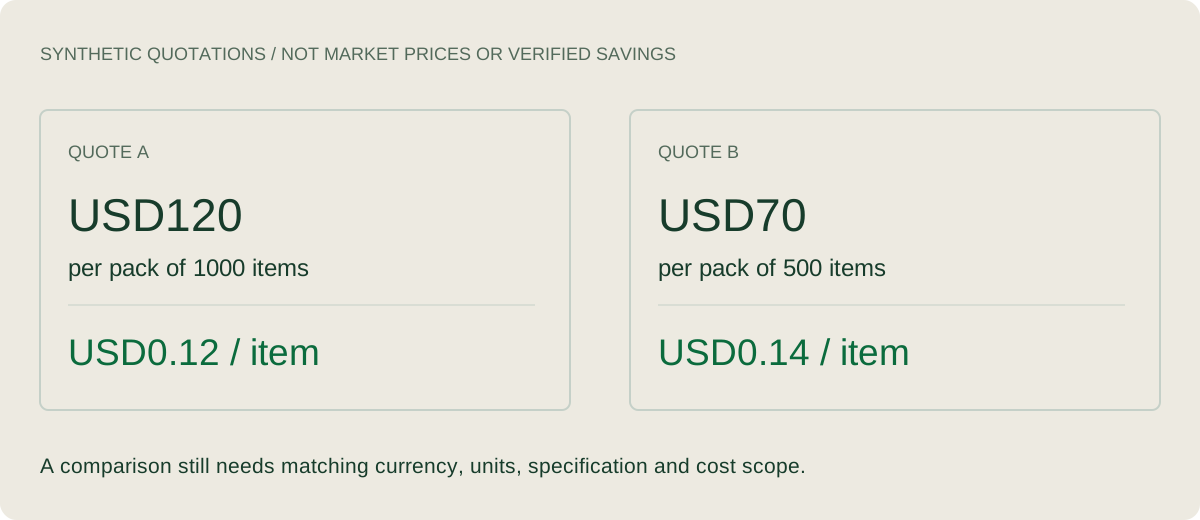
A carton price and a box price can look very different while representing the same unit price. Enter the number of items, pairs or sets in the quoted pack. The tool performs arithmetic only; it cannot confirm product equivalence or a supplier's quotation.
This is your confirmation, not verification by ReplyLead. Unit counts must refer to the selected basis. Include all relevant costs consistently before making a commercial comparison.
Entries stay in this tab and are not sent to analytics. No exchange rates, market prices, supplier records or patient information are requested.
Enter both quotes and compare their unit prices. No supplier, product or price is verified.
YOUR ENTERED QUOTES / NOT VERIFIED
QUOTE AQUOTE B
Synthetic arithmetic example, not a market price: 120 / 1,000 = 0.12; 70 / 500 = 0.14. The lower pack price does not automatically mean a lower unit price.
For the example, the numerical difference is USD 0.02 per item. That is not evidence of a delivered saving. Specification, usable quantity, expiry, shipping, tax, minimum order, payment terms and availability may change the comparison. Keep those questions with the quotation rather than reducing the purchase to one number.
03 / SUPPORT THE SENTENCE
Which claims need evidence before sending?
Product and specification
Use the exact product reference and current approved documentation. A similar name, image or packaging size does not establish interchangeability. Route product suitability questions to the responsible technical or clinical reviewer.
Stock and delivery
State availability or lead time only when the responsible team has confirmed it for the required quantity and destination. A historic shipment or a general catalog entry is not a current delivery commitment.
Price and saving
Name the currency, unit basis and included costs. Compare like-for-like scope over the same period. Do not turn a lower carton price into a percentage saving without checking its contents and the comparison denominator.
Certification and approval
Use only wording supported for the actual product, organization and market. A certificate held by one manufacturer does not automatically establish a distributor's status or the eligibility of every product it carries.
The writing task is to describe supported facts clearly. It is not a substitute for product, regulatory or purchasing review. No clinical outcome, certification, delivery performance or customer result is asserted for ReplyLead or the fictional supplier in these examples.
04 / USE THE BUYER'S ROUTE
An introductory email does not replace procurement.
Some buyers evaluate a supplier locally. Others use central procurement, an approved catalog, a framework or a formal tender. Confirm the route for the organization and category you are approaching. The title of an individual contact is a research clue, not permission to bypass a published process.
For one concrete UK example, NHS Supply Chain publishes a supplier hub and a contract-and-tender process. Its process explains the route into its catalog and links its procurement calendar and supplier portal. Follow the current published requirements for that route. This example does not establish the process for every NHS organization, another country or a private buyer. Read NHS Supply Chain's process.
For cross-border conversations, establish the delivery market, currency, language and responsible importing or distribution parties. Do not infer worldwide service coverage from a currency selector. The calculator supports selected currencies as labels; it performs no foreign-exchange conversion and blocks a direct comparison when the quote currencies differ.
Where a formal solicitation restricts communication, use its stated channel. Where the route is unknown, ask how the category is evaluated. A registration confirmation, catalog request, quotation request and accepted commercial opportunity are different stages.
05 / LEAVE A USEFUL RECORD
What should reach the sales team?
Buying organization: facility, parent and confirmed purchasing route where known.
Supply scope: product references, relevant specification, quantities and pack basis.
Commercial context: delivery destination, currency, requested timing and the buyer's stated next step.
Evidence and open questions: current documents, quote version and any unresolved condition.
Keep the original request and quotation with the conversation. A person asking for a catalog has not necessarily requested a quote or accepted a meeting. Record each stage as it occurs and retain uncertainty instead of turning it into a positive sales event.
For measurement, separate relevant replies, requested quotes, confirmed meetings, held meetings and accepted opportunities. Define the contacted-person or contacted-account denominator before comparing campaigns. This guide provides no healthcare reply-rate benchmark or predicted meeting volume.
Where ReplyLead supports the search.
ReplyLead manages B2B cold email and LinkedIn: targeting, list building, sending infrastructure, messaging, reply handling, qualification and meeting coordination within the agreed scope. A supplier provides its actual capabilities, approved claims, commercial boundaries and delivery markets. Its team handles the product discussion, quotations and close.
Agree the target buying organizations, exclusions, procurement routes and sales-handoff criteria before launch. Preparation depends on source data, approved messaging and sending readiness. This page does not promise a launch date or establish a medical-supply client result.
ReplyLead's published model combines a monthly technology and infrastructure fee with an agreed share of attributable closed revenue. The fixed cost remains when nothing closes. Review current pricing, the methodology and B2B healthcare marketing context before discussing a campaign.
Each unit price equals the entered quoted-pack price divided by the entered units in that pack. Prices must be positive, use a decimal point, have at most six decimal places and be no more than 1,000,000,000. Counts must be whole numbers from 1 to 1,000,000. These are tool-input limits, not commercial recommendations.
The two unit prices are compared only when currency and unit basis match and the visitor confirms comparable specifications and cost basis. A difference is an absolute amount per selected unit, not a percentage saving. An unconfirmed comparison still displays the separate arithmetic, with its unresolved conditions.
The tool cannot inspect documents, certify equivalence, identify a supplier or establish delivery availability. It applies no tax, duty, freight, exchange rate or regional regulatory model. Displayed values are rounded to eight significant digits; inputs and arithmetic use browser-number precision. It does not send emails, submit an inquiry, update a CRM or qualify a lead.
Examples are original writing recommendations and synthetic calculations. The cited procurement pages establish only their stated institutional process. We have not tested these emails in a campaign or measured a conversion gain from them.
Medical-supply wholesale email questions.
What should a medical-supply wholesale email include?
State the relevant product category, the buying question and one next action. For a quotation conversation, retain the actual item references, quantities, pack basis, currency and delivery requirements. Use only approved facts and the purchasing channel the buyer specifies.
Who should receive a medical-supply sales email?
Establish the organization and responsibility involved in evaluating the category. A facility contact, clinician, procurement team and distribution partner are different records. Use an appropriate routing question when the buying owner is unknown rather than assuming authority from a title.
Can I use these examples without changing them?
No. The sender, recipient and company names are fictional. The quotation and follow-up examples assume a real prior request or agreed review. Edit them to match the actual conversation and verify every statement about products, documents, timing and attachments.
How do I compare a carton price with a box price?
Divide each quoted pack price by the number of items, pairs or sets in that pack. Compare only the same unit basis, currency, product specification and cost scope. The calculator uses your entries and cannot verify equivalence, availability or total delivered cost.
Does the pack calculator work across countries?
Its arithmetic works with the listed currencies as labels, but it does not convert currencies or model tax, duties, freight or regional requirements. Different currencies or unit bases block a direct comparison. Establish the relevant buying route and delivery conditions separately.
Does a supplier introduction replace a tender submission?
No. A buyer may use a formal registration, framework or tender process. Follow the current process and communication channel for that organization. The NHS Supply Chain reference is one specific example, not a universal healthcare purchasing rule.
What does ReplyLead do for a medical-supply campaign?
ReplyLead manages the agreed B2B cold email and LinkedIn workflow, including targeting, list building, messaging, replies, qualification and meeting coordination. The supplier owns product documentation, quotations, commercial commitments and the sales close. Scope and delivery markets are agreed before launch.