What is B2B healthcare marketing?
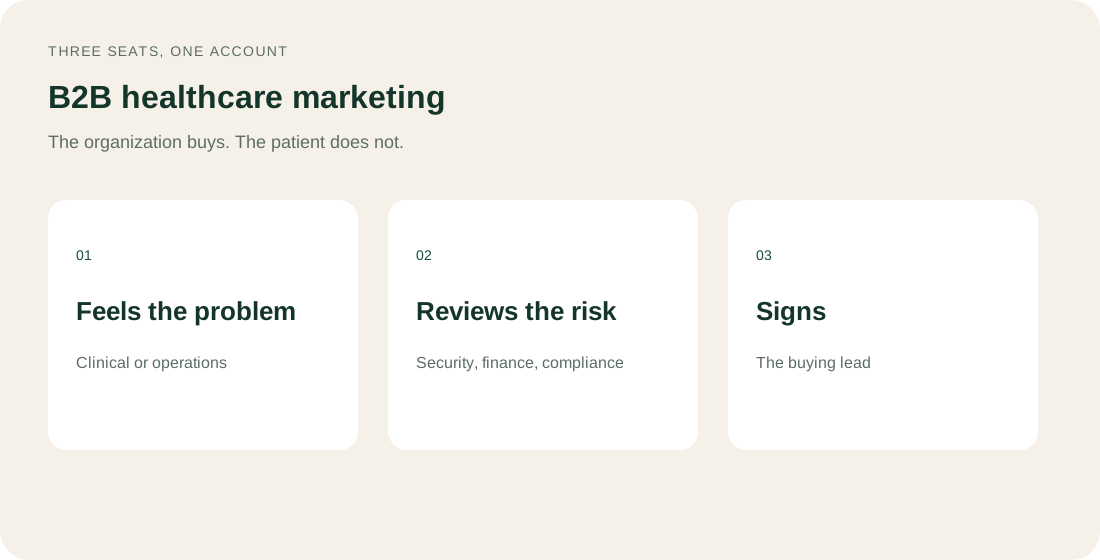
B2B healthcare marketing sells to a hospital, a health system, a clinic, a payer, or a company that supplies them. It is not advertising to patients. Three seats usually have to agree: the person who feels the problem, the person who reviews the risk, and the person who signs. ReplyLead gets the data, builds the list, targets that seat, and sends the cold email and the LinkedIn note. We book the meetings. You close them.
By Mark Glazer / Updated 4 October 2026
B2B marketing in the healthcare industry
The job is a meeting with a named seat, in a named segment. It is not a campaign aimed at "healthcare." A hospital, a clinic, a payer, and a company that sells software into hospitals will not read the same note, and they will not be convinced by the same proof.
A useful week of this work has four outputs. The segment is written down. The seat is written down. The note speaks to that seat's problem, not to the whole product. The replies are counted from that seat, not as a blended open rate. If those four are missing, the activity is not B2B healthcare marketing yet. It is a blast.
Proof has to survive a review. The clinical or operations person wants to know what changes in the work. The risk reviewer wants to know what can go wrong and who else has used it. The person who signs wants the cost, the term, and why this account should spend time on it. One paragraph rarely does all three. That is why the first meeting is with one seat, and the materials for the other seats come after.
Where B2B healthcare marketing goes wrong
The strategy is rarely the problem. Most healthcare programmes that produce nothing fail in one of three places, and all three are decided before a single reader sees a word of the copy.
| The failure | What it looks like | What it costs | What ReplyLead does |
|---|---|---|---|
| The ICP is a building | A national hospital file is treated as a list of buyers | A share of every send goes to a facility that cannot buy and to a type you do not sell to | Resolve the type and the signing level from the data before anything is sent |
| The copy is addressed to an industry | One note that would read the same to a hospital, a payer and a software vendor | Replies from people who were curious, not from the seat that can act | Write to one named seat, with the proof that seat asks for, in your voice |
| The sending setup cannot reach the inbox | Authentication, volume and reputation treated as an afterthought | The campaign is never read, so none of the strategy is ever tested | Dedicated sending domains, separated provider pools, weeks of warmup, low volume per mailbox |
The ICP is a building, not a buyer
Hospital data is a list of facilities. The federal file has 5,419 of them and no parent-organization column, so several buildings can sit under one signature and the file cannot tell you which. 1,382 of those rows, 25.5 percent, are critical access: small rural hospitals with a federal designation and a different budget, a different committee and a different reason to care. A programme built for 500-bed systems that keeps those rows is writing to the wrong building about a quarter of the time, and the reply rate it reports is measuring the wrong population.
This is the part nobody can skip with better writing. The seat has to be resolved from the data first: the type of facility, whether the decision sits in the building or at the system, and who signs at that level. ReplyLead does that resolution, because ReplyLead builds the list.
The copy is addressed to an industry
"Healthcare" is not an audience. A hospital chief operating officer, a payer network lead and a founder selling software into clinics do not share a problem, a budget cycle or a risk review. A note that could be sent to all three without a change tells each of them that nobody looked at their situation.
Machine-written variants make this worse rather than better. Rewriting the same paragraph forty ways varies the sentences and leaves the substance identical, and a reader who has seen the pattern before recognises it immediately. The fix is not more variation. It is one seat, one problem, one piece of proof that seat actually asks for: what changes in the work for the clinical or operations lead, what can go wrong and who else has done it for the risk reviewer, and the cost, the term and the reason this quarter for the person who signs.
The sending setup decides whether any of it is read
A good list and a good note still produce nothing if the message lands in a spam folder. That part is governed by published provider rules, not by opinion, and it is covered below.
B2B healthcare buyers and customer segments
Name the segment. These four get mixed up most often. They are not a complete map of healthcare. ReplyLead builds a separate list for each one.
| Segment | You sell to | ReplyLead leaves this out | You tell us |
|---|---|---|---|
| Hospitals | A facility, or the system that owns several facilities | Every row in a hospital file is treated as its own buyer | Acute care, critical access, or psychiatric |
| Health systems | One signature that covers many buildings | Buildings are counted as separate deals | Who signs for the system |
| Clinics and groups | The practice | A hospital file is used as if it contained clinics | The federal hospital file does not |
| Suppliers and healthtech | A company that sells into providers | Vendors are mixed into a provider list | Hospital, or a vendor to hospitals |
Inside any one of those segments, the seats still split. A clinical champion, an operations lead, and a buying lead can share an account and still reject each other's meeting. The healthcare lead generation guide is the page for that second split: one purchasing decision, three local decisions, or a mix you have not resolved.
One segment, counted: hospitals
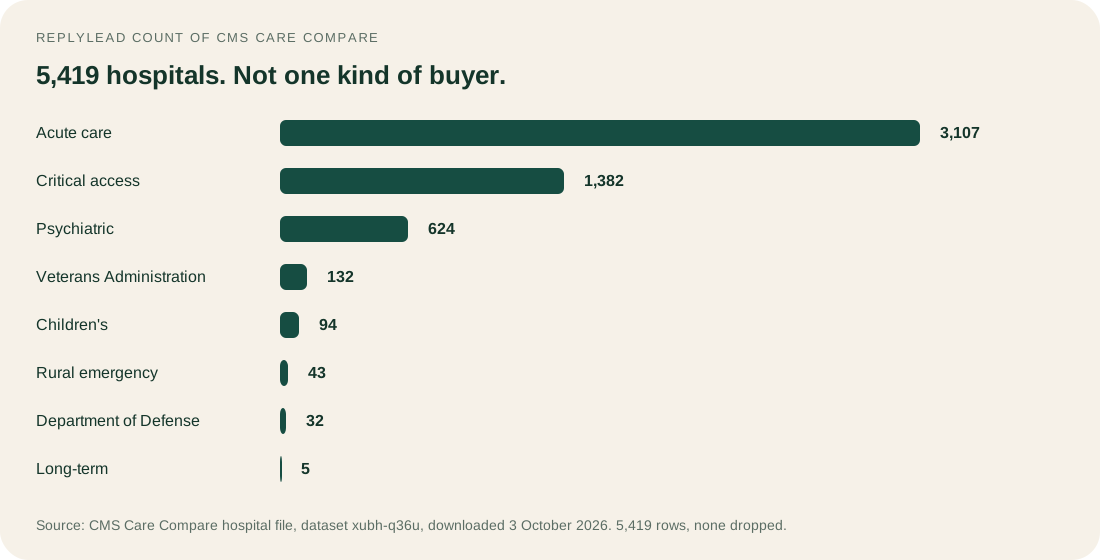
When the segment is hospitals, ReplyLead gets the data and builds the list. The source is CMS Care Compare dataset xubh-q36u, downloaded by ReplyLead on 3 October 2026: 5,419 hospital rows. We target the hospital type you sell to, and we send to that list. This count is hospitals only. It is not a count of clinics, and it is not a ranking of marketing companies.
Acute care is 3,107 rows, 57.3 percent. Critical access is 1,382 rows, 25.5 percent. Psychiatric is 624 rows, 11.5 percent. The other 306 are Veterans Administration (132), children's (94), rural emergency (43), Department of Defense (32), and long-term (5). Critical access hospitals are small rural hospitals with a federal designation. They are not a smaller copy of a city medical center. ReplyLead writes that hospital a different email than the one written for a 500-bed acute-care hospital.
Ownership changes with the type. Proprietary is 647 of 3,107 acute care hospitals, 20.8 percent. It is 63 of 1,382 critical access hospitals, 4.6 percent. It is 338 of 624 psychiatric hospitals, 54.2 percent. A for-profit filter is a different market in each type.
2,245 of the 5,419 rows have no overall star rating. Rated 4 and rated 5 together are 1,330 rows. ReplyLead can keep or drop the unrated rows when we build the list. Dropping them does not mean those 2,245 are poor hospitals. Texas, California, and Florida together are 1,065 hospitals, 19.7 percent of the file. That is where the buildings are. It is not where the signature sits. The file has no parent-organization column, so several buildings can be one system and this file cannot tell you.
| Type | Hospitals | Percent of 5,419 |
|---|---|---|
| Acute care | 3,107 | 57.3 |
| Critical access | 1,382 | 25.5 |
| Psychiatric | 624 | 11.5 |
| Veterans Administration | 132 | 2.4 |
| Childrens | 94 | 1.7 |
| Rural emergency | 43 | 0.8 |
| Department of Defense | 32 | 0.6 |
| Long-term | 5 | 0.1 |
How B2B healthcare marketing differs from B2C
B2C asks a person to do something about their own care. B2B asks an organization to buy. Mixing them produces the wrong list, the wrong proof, and the wrong next step.
| B2B | B2C | |
|---|---|---|
| Customer | An organization | A person |
| Decision | More than one seat | Often one person |
| Proof | Workflow, risk, cost | The person's own situation |
| Next step | A meeting with a named seat | A visit, a signup, a purchase |
| ReplyLead | Cold email and LinkedIn, then a booked meeting | Not this work |
Why healthcare emails land in spam
Strategy guides on this topic tend to stop at content and channels. The providers decide the rest, and they publish the rules. These are their numbers, not ours.
Google requires, for anyone sending more than 5,000 messages a day to Gmail accounts, SPF and DKIM authentication on the sending domain plus a DMARC policy, one-click unsubscribe on marketing and subscribed mail, and a spam rate in Postmaster Tools kept below 0.30 percent, with Google's own guidance to stay below 0.10 percent. Those requirements took effect on 1 February 2024. A healthcare programme that ships without authentication has already lost the delivery argument before the targeting is discussed.
Microsoft publishes limits in a different shape. Exchange Online documents a recipient rate limit of 10,000 recipients per day for a mailbox and a message rate limit of 30 messages per minute. Above the mailbox there is a Tenant External Recipient Rate Limit, a tenant-wide cap on external recipients per day, which Microsoft describes as depending on the number of licenses a tenant has; trial tenants are capped at 5,000 external recipients a day. The practical consequence is narrow and worth stating precisely: distributing the same volume across more mailboxes or more domains inside one tenant does not by itself lift a tenant-level control. It spreads sender reputation. It does not create capacity.
| Provider | Documented limit | Documented requirement | ReplyLead operating choice |
|---|---|---|---|
| Google Workspace | 2,000 messages per user per day; 3,000 external recipients per day | SPF and DKIM plus DMARC, one-click unsubscribe, spam rate below 0.30 percent above 5,000 daily Gmail messages | About 10 to 12 cold sends per mailbox per day |
| Microsoft 365 (Exchange Online) | 10,000 recipients per mailbox per day; 30 messages per minute; a tenant-wide external recipient limit tied to licenses | Authentication aligned with SPF or DKIM for high-volume senders | About 1 to 2 cold sends per mailbox per day |
The gap between those last two columns is the whole point. A technical ceiling is not a recommended volume. ReplyLead sends roughly 10 to 12 external messages per Google Workspace mailbox per day against a documented 3,000 external recipients, because the constraint that matters in cold outreach is sender reputation, not the provider's maximum. ReplyLead runs Google Workspace and Microsoft 365 (Exchange Online) mailboxes connected over OAuth, on dedicated sending domains, with the two pools kept separate and weeks of warmup before a cold send. The full architecture is on how it works, and the placement detail is on deliverability.
None of this is a healthcare-specific trick. It is the reason a healthcare campaign with the right segment and the right seat can still return nothing, and it is the first thing worth checking before rewriting the copy again.
A brief you can use on Monday
These six lines are the brief. ReplyLead gets the data, builds the list, targets the seat, and sends the email. If a line is blank, the campaign is not ready.
- Segment. Hospital, health system, clinic, payer, or a supplier to them. One of those, not "healthcare."
- Seat. Who feels the problem. Who reviews the risk. Who signs. You are writing to one of them first.
- Excluded. The types you do not sell to. ReplyLead keeps them off the list. For hospitals, that is often a hospital type.
- Proof. The one fact that seat needs before they will take a meeting.
- Meeting. What has to be true for your team to accept the meeting. A booked slot is not the same thing as a held meeting, and neither is a closed deal.
- Closer. The person on your team who takes the call. ReplyLead books it. That person closes.
Healthcare marketing consulting
Outside help is for the part you do not want to staff. Ask any firm the six lines above, and ask what you still pay in a month when nothing closes. If they cannot name the segment and the seat, they are selling activity.
Use the questions if you are not sure the brief matches.
You sell to organizations, and your team closes. ReplyLead gets the data, builds the list, targets that seat, sends the cold email and the LinkedIn note, and books the meetings. Tell us who you sell to.
Method
The segment table and the six-line brief are ReplyLead's operating split, the same split used in the healthcare lead generation guide, checked 3 October 2026. The hospital numbers are a full pass over CMS Care Compare dataset xubh-q36u, downloaded that day: 5,419 data rows, none dropped. Percents are each rounded half up on their own and are not forced to sum to 100. ReplyLead's scope and fee are taken from the how-it-works page and the pricing page. The provider rules are quoted from Google's Email sender guidelines and Gmail sending limits pages and from Microsoft Learn's Exchange Online limits page, each fetched on 4 October 2026. ReplyLead's own per-mailbox volumes are operating choices, stated separately from those documented ceilings.
Questions
What is B2B healthcare marketing?
Selling to an organization in healthcare: a hospital, a health system, a clinic, a payer, or a company that supplies them. It is not advertising to a patient. Three seats usually have to agree before anyone signs.
Who are the three seats?
The person who feels the problem, the person who reviews the risk, and the person who signs. They can sit in the same account and still need different proof. Name the seat. ReplyLead builds the list and writes to that seat.
Why do hospital types matter?
The federal hospital file has 5,419 rows. 3,107 are acute care, 1,382 are critical access, and 624 are psychiatric. Critical access hospitals are small rural hospitals with a federal designation. A sequence written for a large acute-care hospital is the wrong sequence for them. Proprietary ownership is 20.8 percent of acute care, 4.6 percent of critical access, and 54.2 percent of psychiatric.
What does ReplyLead do?
ReplyLead gets the data, builds the list, targets the segment and the seat you name, and sends cold email and LinkedIn. We book qualified meetings onto your calendar. Your team takes the calls and closes. The fee is a monthly infrastructure amount plus a share of the revenue you close.
What do you need from me?
Who you sell to, which seat you want in the room, and who on your team closes. If the segment is hospitals, say whether you mean acute care, critical access, or psychiatric. ReplyLead gets the data and builds the list. Your team takes the call.
When should I not book?
Do not book if you want patient advertising, names with no meetings, or a vendor who will close the deal for you. ReplyLead gets the data, sends the outreach, and books the meetings. Your team closes.
Why do healthcare cold emails go to spam?
Usually because the sending setup does not meet the provider's published rules. Google requires SPF and DKIM plus DMARC, one-click unsubscribe on marketing mail, and a Postmaster Tools spam rate below 0.30 percent for senders above 5,000 messages a day to Gmail, with its own guidance to stay below 0.10 percent. Microsoft documents mailbox recipient limits, a 30 messages per minute rate limit, and a tenant-wide external recipient limit tied to license count. Volume per mailbox, authentication and warmup decide placement before the copy does.
What is the most common mistake in B2B healthcare marketing?
Treating a facility list as a buyer list. The federal hospital file has 5,419 rows and no parent-organization column, and 1,382 of those rows are critical access hospitals, which are small rural facilities with a federal designation. A programme built for large systems that keeps those rows is writing to the wrong building about a quarter of the time.
When this page does not apply
It does not apply to patient advertising or to recruiting people into a study. The hospital count does not include clinics, and it does not name the parent system. If the question is who inside the account can approve a vendor, use the healthcare lead generation guide. If the question is the fee, use pricing.
Sources
- ReplyLead, how it works - cold email and LinkedIn, meetings on your calendar, you run the sales calls. Checked 3 October 2026.
- ReplyLead pricing - the monthly infrastructure fee and the revenue share. Checked 3 October 2026.
- Healthcare lead generation guide - one purchasing decision, three local decisions, or an unresolved mix. Checked 3 October 2026.
- Methodology - how ReplyLead measures its own outbound. Checked 3 October 2026.
- CMS Care Compare dataset xubh-q36u - 5,419 hospitals. Counted 3 October 2026.
- CMS CSV used for the count - the file that was counted. Checked 3 October 2026.
- Google, Email sender guidelines - authentication, one-click unsubscribe, and the 0.30 percent spam-rate ceiling for senders above 5,000 daily messages to Gmail. Checked 4 October 2026.
- Google Workspace, Gmail sending limits - 2,000 messages per user per day and 3,000 external recipients per day. Checked 4 October 2026.
- Microsoft Learn, Exchange Online limits - recipient rate limit, 30 messages per minute, and the tenant external recipient limit tied to license count. Checked 4 October 2026.
- ReplyLead deliverability - inbox placement and the thresholds that govern it. Checked 4 October 2026.