B2B PARTNERSHIPS / START WITH A SPECIFIC CONTRIBUTION
Professional partnership email template for B2B sales.
A professional partnership email template should make 3 things clear: the customer situation you have in common, what your team could contribute, and the next decision you want to discuss. Introduce a possible working relationship without implying that a referral arrangement, delivery commitment or endorsement already exists.
Updated 17 October 2026 / By Mark Glazer, ReplyLead
1 letterA complete fictional introduction.
3 modelsReferral, co-delivery and joint resource.
2 fee basesThe same percentage can mean different amounts.
01 / A POSSIBLE RELATIONSHIP, NOT AN ASSUMED ONE
Make the reason for writing easy to evaluate.
This fictional example connects a CRM implementation business with an analytics specialist. The shared customer situation is post-implementation reporting. It does not claim that either company has agreed to work together or that a particular customer needs the service.
ILLUSTRATIVE EMAIL / FICTIONAL PEOPLE AND BUSINESSES
Subject: Reporting support after CRM implementation
Hi Jordan,
I run Example Analytics, where we build reporting workflows for B2B service teams.
Your team at Example CRM focuses on implementation for that market. There may be a useful fit when a client needs reporting support after the CRM project.
We would like to compare where our delivery scopes meet, including who would own the client relationship and the reporting work.
Would a short conversation about that handoff be useful?
Thanks, Maya Example Analytics
The premise needs evidence. Verify the recipient's actual market and service scope. A matching job title or a scraped company category is not enough to support the first paragraph about their business.
The contribution needs substance. Describe work you can actually deliver. Replace broad promises about growth with a defined task, capability or resource. Use approved proof only when relevant and available.
The ask is a decision. The letter asks whether discussing a particular handoff would be useful. It does not ask for a customer list, promise leads or attach an unagreed commission schedule.
Choose the relationship before choosing the wording.
REFERRAL
Introduce a relevant customer situation.
Explain which type of customer need would make an introduction relevant and why your service could address it. The potential partner should be able to recognize an appropriate situation without promising an outcome.
"Would comparing the situations that make an introduction useful be worthwhile?"
Before any actual handoff, agree the information that may be shared, customer expectations, existing-account exclusions and how a referral would be acknowledged. An introduction is not automatically a qualified opportunity.
CO-DELIVERY
Define a boundary between two teams.
Identify the task your team could perform and the dependency it creates for the other team. This can involve a delivery subcontract or white-label work, but the first email should not assume either structure.
"Would it be useful to compare who would own implementation, reporting and client support?"
Discuss contracting, communication, quality standards, capacity and escalation before using the other organization's name in a proposal. The marketing-agency prospecting guide separates direct-client acquisition from delivery partnerships.
JOINT RESOURCE
Contribute to one useful buyer decision.
Propose a specific topic, audience and contribution: for example, a joint worksheet about moving from CRM setup to usable reporting. Confirm that both teams have relevant expertise and want to participate.
"Would a shared worksheet on the implementation-to-reporting handoff be useful to your audience?"
Agree authorship, review, distribution and how any resulting inquiries would be handled. A proposed resource does not authorize a logo placement, endorsement or automated exchange of contact records.
03 / TURN INTEREST INTO A DEFINED CONVERSATION
Resolve the handoff before calling it a partnership.
Who contracts?
Establish whether the customer would contract with one business or separately with both. Do not imply that your team can bind the other business to terms or deliverables.
Who delivers?
Name the work each team could take on, the inputs it needs and the point at which the next team can begin. Leave uncertain capability or capacity unresolved until the responsible team confirms it.
Who supports?
Agree the customer-facing contact and the escalation path. A smooth introduction is not enough if the customer cannot tell which team owns a later problem.
What qualifies?
Define relevant customer need, scope, exclusions, timing and permission to introduce. Keep a raw contact, an accepted introduction, a held conversation and a closed customer separate in reporting.
If the prospect responds positively, answer their specific questions before adding another meeting request. If they want a meeting, confirm actual availability and time zone. If they decline further outreach, record the opt-out in the sending system. The reply-category guide explains those distinct outcomes.
04 / SAME PERCENTAGE, DIFFERENT AMOUNT
A referral percentage needs a calculation basis.
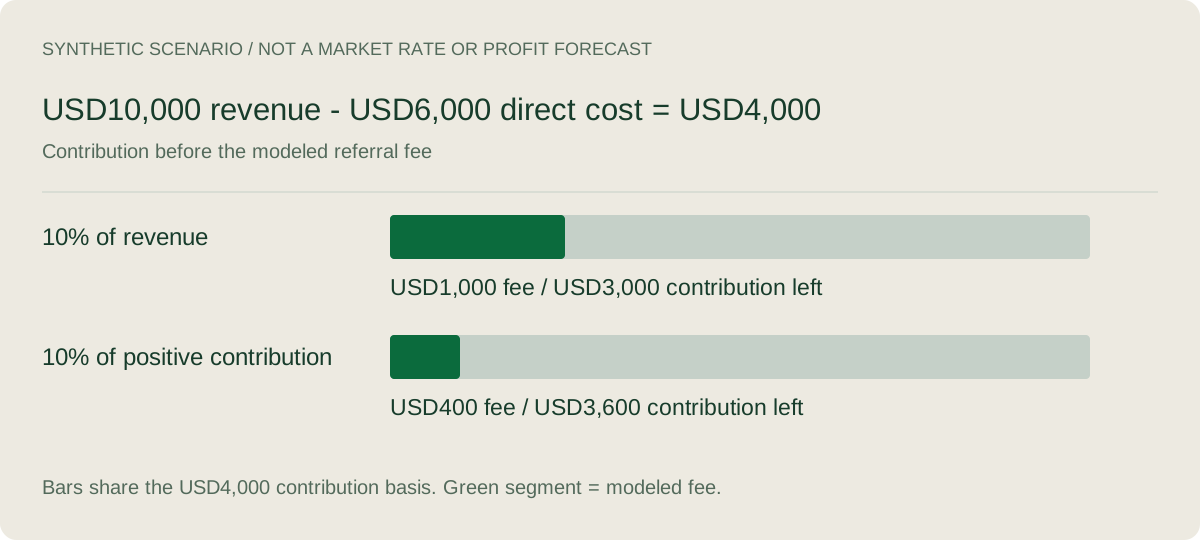
Compare a fee calculated on entered revenue with the same percentage calculated on positive contribution before the referral fee. This is a worksheet for understanding arithmetic, not a suggested commission, contract interpretation or ReplyLead price quote.
Enter the same deal, cost and percentage for both calculations. No rate is preselected.
Calculation basisModeled feeContribution left after fee
Entered revenue
Positive contribution
These are two modeled bases for the same entered percentage. This tool cannot identify the correct contractual basis or whether any fee is payable.
Runs locally. No amounts, currency or percentage are sent in tool events. It does not create a proposal or change any agreement.
The worked example
Using synthetic USD10,000 revenue, USD6,000 direct delivery cost and a 10% fee: the revenue-based fee is USD1,000, leaving USD3,000 before overhead and other costs. Positive contribution before the fee is USD4,000; 10% of that is USD400, leaving USD3,600. The fee difference is USD600.
Formula: contribution before fee = revenue minus direct delivery cost. Revenue-based fee = revenue times percentage. Contribution-based fee = the greater of contribution and zero, times percentage. Contribution left = revenue minus direct delivery cost minus the modeled fee.
Synthetic arithmetic only. Both scenarios use the same deal, direct cost and percentage. They are not market fee benchmarks or verified profit outcomes.
The contribution-based scenario assumes a zero fee when contribution before the fee is zero or negative. That is a model choice, not a universal agreement rule. Losses remain visible. The calculation excludes overhead, taxes, refunds, disputed attribution, recurring periods and other costs or adjustments not entered here. It performs no currency conversion.
05 / TARGET THE RIGHT BUSINESS RELATIONSHIP
Build the partner list around the customer situation.
A useful prospecting brief explains which businesses already serve the relevant market, what complementary work you can substantiate, and which relationships would create a conflict. Separate direct customers from possible referral or delivery partners before selecting contacts.
ReplyLead manages cold email and LinkedIn within an agreed outbound scope: targeting, list building, infrastructure, messaging, reply handling, qualification and meeting coordination. Your team approves capability claims, exclusions and the intended relationship, then owns partner negotiations, delivery commitments and closing. Review the managed outbound process.
This can suit a specialist seeking complementary service providers, an established team exploring a defined partner channel, or a business that needs to distinguish partner inquiries from customer opportunities. If the relationship is not yet defined, start with the customer situation and the contribution your team can support.
Agree what counts as a relevant response and an accepted handoff before launch. Track introductions, scheduled meetings, held conversations, accepted opportunities and attributed customers separately. An interested partner does not establish customer demand or committed delivery capacity.
ReplyLead's commercial model includes a monthly technology/infrastructure fee plus an agreed share of attributable closed revenue. The fixed fee remains when nothing closes. The referral worksheet above does not calculate that agreement or set its basis. See ReplyLead pricing and scope. No partner organization is named or implied by this guide.
The letter and adaptations are editorial examples built around a stated customer situation, a specific contribution and one next decision. They are not generated from private prospect data and have no claimed measured conversion rate.
The worksheet accepts nonnegative two-decimal amounts up to 1,000,000,000 and percentages from 0 to 100 with up to two decimal places. It calculates in integer cents and rounds each modeled fee to the nearest cent. All four supported currency labels use two-decimal amounts. Enter one consistent deal basis; a monthly amount and a full-contract amount cannot be compared as if they were the same period.
The model neither verifies the inputs nor forecasts whether a deal will close. A positive residual is contribution after the entered cost and fee, not accounting net profit. Changing any input hides the previous result until recalculation.
When this page is the wrong starting point.
A generic partnership message is unsuitable when you cannot identify the contribution, recipient's relevant business or intended customer situation. Do not imply familiarity, a referral or a current relationship that does not exist. Accurate message content and recipient preferences also matter independently of the wording; see Google's sender guidelines.
This page does not establish that a referral payment is permitted in your sector or jurisdiction, interpret a contract, or approve sharing customer data. Resolve the applicable requirements before implementing an arrangement. The worksheet is arithmetic for a defined scenario, not a professional valuation, tax model or profit forecast.
Partnership email questions.
What should a professional partnership email include?
State the relevant customer situation, your specific contribution and one next decision to discuss. Verify the recipient's business context. Do not imply that a partnership, referral arrangement, endorsement or delivery commitment already exists.
Can I use the example without editing it?
No. The names and businesses are fictional, and the relationship is hypothetical. Replace the premise with verified context and your actual capabilities. The example is an original recommendation, not a measured winning script.
How is a referral partnership different from co-delivery?
A referral introduces a relevant customer situation. Co-delivery divides work between teams. Either arrangement still needs agreed responsibilities, customer expectations and commercial terms; an introductory email does not create those terms.
What does the referral-fee worksheet compare?
It applies the same entered percentage to two modeled bases: entered revenue and positive contribution before the referral fee. Contribution before fee equals revenue minus the entered direct delivery cost. It then shows the amount left after each modeled fee.
What happens if direct delivery cost exceeds revenue?
The worksheet preserves the negative contribution. The contribution-based fee is zero under its explicit model assumption, while a revenue-based fee can deepen the loss. Actual agreements may use different rules. The result is not net profit or a contract interpretation.
Does the calculator work across currencies?
It supports USD, CAD, EUR and GBP as two-decimal currency labels. It performs no currency conversion or regional tax calculation. Use one currency and the same deal or reporting period throughout the scenario.
Can ReplyLead find potential business partners?
An agreed B2B outbound scope can target a defined partner relationship using cold email and LinkedIn. ReplyLead manages the outreach workflow and agreed handoff; your team approves capabilities and owns negotiations, delivery commitments and closing. No existing partner affiliation is implied.