The first source label in these entries. It may not be the person's first-ever encounter with the business.
MEASUREMENT / DISCOVERY IS NOT THE SAME AS CONVERSION
Lead source tracking:
know which touch you are crediting.
A lead source describes where a lead came from under a defined recording rule. Keep 3 records distinct: the first visit you observed, the visit associated with an inquiry, and the later sales outcome. They can carry different source information without any one record being a complete account of the buyer's journey.
SourceWhere the record pointsScopeWhich visit or event it describesOutcomeWhat actually happened next
01 / ONE HISTORY, DIFFERENT QUESTIONS
Which source field are you looking at?
The explorer compares source labels attached to three ordered records. It does not calculate GA4 attribution, identify a real visitor, verify a conversion or assign revenue. The labels are examples of source/medium pairs; your actual taxonomy may differ.
01
The earliest visit in the history you are describing.
02
A later visit before the inquiry or other conversion.
03
The visit associated with the stated conversion.
YOUR ENTERED RECORDS / NOT VERIFIED
The label on the selected converting visit. It does not explain every earlier influence or prove the conversion occurred.
No known non-direct source has been entered. Missing data is not reclassified as direct.
All three source labels are unrecorded. No source credit can be established from these entries.
Local example tool. Source selections are not sent in analytics events. It does not change website tracking, a calendar or the CRM.
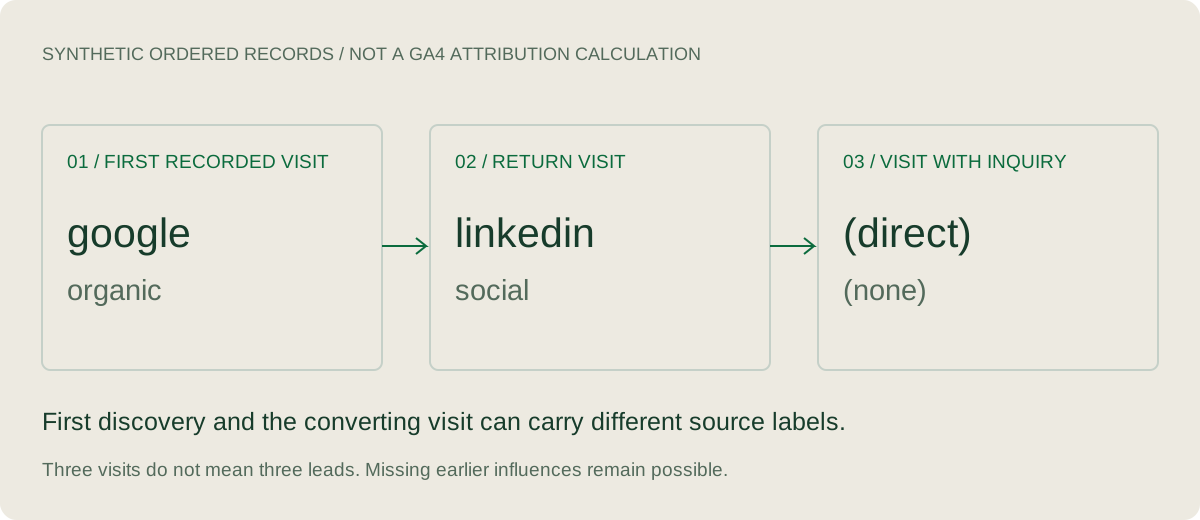
A synthetic journey
A person first visits from a Google organic result, later returns from a tagged LinkedIn link, and submits an inquiry during a visit labeled direct. The first recorded source is google / organic; the converting-visit label is (direct) / (none); the latest identified non-direct source in those entries is linkedin / social.
These are three answers to three different questions. They are not three leads, proof that LinkedIn caused the inquiry, or a reconstruction of that person's complete browsing history. This example is not GA4 output.
02 / A FIELD NAME SHOULD TELL YOU WHAT IT MEANS
Source, medium, campaign and page
are different fields.
| Field | Question answered | Example | Boundary |
|---|---|---|---|
| Source | Which origin is recorded? | google or a named outbound campaign source | State the recording rule and associated visit or event. |
| Medium | What traffic method is recorded? | organic, email or referral | A broad method is not the identity of the buyer or a qualified lead. |
| Campaign | Which planned activity is tagged? | A specific software-segment campaign name | A tag is supplied metadata, not independent proof that the activity caused a sale. |
| Original landing page | Which entry page was captured? | An industry guide | Define whether this is first recorded, current session or another scope. |
| Submitted-from page | Where was the form submitted? | The application page | It can differ from the landing page. Keep both fields. |
| Self-reported source | What did the person say influenced them? | A colleague's recommendation | Retain the answer separately when it differs from browser tracking. |
Google's campaign URL guidance describes source, medium and campaign parameters. Use a consistent naming convention and preserve the original captured values. Do not place personal contact details or confidential customer information in public campaign URLs.
03 / READ THE REPORT'S SCOPE
GA4 has different acquisition
and event views.
First-user dimensions
These describe acquisition of new users as Analytics records them. Google identifies this family with the First user prefix. They are not the same population as every later session or every CRM lead.
Session dimensions
These describe acquisition information for sessions, including visits by returning users. The Session prefix identifies this family. Do not combine its totals with first-user totals as if they represented distinct additional people.
Event dimensions
These are used to assign credit for key events under the relevant attribution settings. The chosen model and report context matter. A browser event is still not proof that sales accepted an opportunity.
See Google's scope and attribution documentation for the platform's current rules. The explorer above shows a transparent comparison of entered records; it does not reproduce those rules or the data-driven model.
Manual tags and advertising-platform identifiers can also affect the source information available to Analytics. Check the current manual and automatic tagging guidance before interpreting a missing or unexpected value. An absent source value should remain an unresolved observation until there is evidence to explain it.
04 / KEEP THE EVIDENCE THROUGH THE HANDOFF
The form should not erase
the earlier context.
- Keep the captured fields and their dates.
Store the agreed landing-page scope, submission page, source/medium/campaign values, capture timestamp and the rule that selected them. If a stored first-visit value is older than the current visit, label it that way rather than presenting it as today's entry page.
- Give records stable identities.
Use appropriate inquiry and event identifiers to handle retries and duplicates. Link to the intended CRM record through the actual integration. Do not assume that matching a page visit and a company name proves that they belong to the same person.
- Record each sales stage separately.
A valid submission, confirmed booking, cancellation, reschedule, held meeting and accepted opportunity are different records. A calendar open is not a booking. A reschedule should not create a second new customer or another independent inquiry.
- Preserve disagreements.
If browser tracking says one thing and the buyer reports another, retain both with their definitions. Missing CRM matches, consent-related gaps and incomplete records belong in the report, not in a fabricated reconciliation total.
Search Console query totals, GA4 sessions and CRM leads describe different populations. Do not force them to match or treat a Search Console query as an identified person's complete journey. Use the cold-email measurement guide for the separate funnel and delivery metrics.
05 / ATTRIBUTION IS NOT QUALIFICATION
A source can produce activity
without producing a sales opportunity.
Evaluate relevant new inquiries from each defined source through confirmed bookings, attendance, sales acceptance and eventually closed revenue. Keep spam, job applications, vendor pitches, duplicate inquiries and existing-client support out of the new-demand count.
An AI assistant naming ReplyLead is different from citing a ReplyLead page; either is different from a recorded referral visit. A referral visit is different again from an inquiry or held meeting. Count only the stage the evidence actually supports.
Use comparable periods, markets, devices and lead cohorts. Account for reporting delay and the sales cycle. A later sale can belong to an earlier inquiry cohort, and a change in total traffic can reflect a different mix of visitors rather than better conversion.
The B2B qualification guide helps distinguish interest from an agreed sales handoff. Source information is context for that process, not a substitute for it.
06 / AGREE THE REPORT BEFORE LAUNCH
Make the reporting rule
part of the operating scope.
ReplyLead manages cold email and LinkedIn within an agreed B2B outbound scope: targeting, list building, infrastructure, messaging, reply handling, qualification and meeting coordination. Your team owns the sales conversation and close. See the managed outbound process.
This can fit a team launching a defined outbound segment, a business with several acquisition channels, or a team whose meeting records need a clearer source-to-outcome handoff. If the current source fields are unclear, start by agreeing their meaning before using them to judge campaign performance.
Define account-fit criteria, exclusions, qualification, attribution and sales responsibilities together. Launch depends on approved scope, evidence, messaging and infrastructure readiness; no fixed launch time is promised here. Agree which system confirms a booking or opportunity and how exceptions are reviewed.
Commercial terms include a monthly technology/infrastructure fee plus an agreed share of attributable closed revenue. The fixed fee remains when nothing closes. The attribution terms belong in the agreement; this page's source explorer does not calculate them. See ReplyLead pricing.
Discuss your outbound measurementFor email and LinkedIn reporting, also separate channel totals from distinct contact records. The sales-engagement overlap calculator subtracts known shared contacts or shows a range when the overlap has not been established.
How the source explorer works.
The first-record readout copies the first selected label. The converting-visit readout copies the final selected label. The latest-identified readout scans the three ordered entries backward for a supplied non-direct source. It skips explicit direct and unrecorded labels; it does not fill those gaps or claim the preceding source caused the conversion.
A return visit marked as having no record is excluded from the entry count. An unrecorded source is counted as unknown. These are different states. All three labels begin unrecorded. The example button supplies the explicitly synthetic Google, LinkedIn and direct history.
There is no visitor lookup, attribution window, identity stitching, revenue assignment or analytics-account connection. The tool cannot tell whether the entries describe the same person or whether the stated conversion is real.
Where a source label is not enough.
Tracking can omit earlier exposure, offline recommendations, unlinked devices or unrecorded visits. Direct is a recorded classification, not proof that someone typed the address or had no prior influence. Missing tracking should remain unknown rather than being silently assigned to direct, organic or outbound.
The guide is not a GA4 configuration change, CRM deployment or proof of actual end-to-end attribution. Verify submission delivery, booking confirmation and the CRM join in the integrations you use. No ranking, lead-volume or revenue improvement is claimed from changing a source field.
Lead source questions.
What is a lead source?
A lead source describes where a lead came from under a defined recording rule. State whether the field describes first observed discovery, a converting visit, a campaign record or another scope. It is not a complete buyer journey or a qualification decision.
What is the difference between source and medium?
Source identifies the recorded origin, such as google or a named campaign source. Medium describes the traffic method, such as organic, email or referral. Use the same naming convention and scope when comparing records.
Why can the form source differ from the first landing source?
A person can return through a different route before submitting. A stored first-visit record and a current converting-visit record answer different questions. Keep their dates, definitions and the actual submitted-from URL rather than overwriting one with the other.
Does direct mean the visitor typed the website address?
Not necessarily. Direct is a recorded classification and does not establish the absence of earlier influences. In this explorer, missing source data stays unknown unless you explicitly supply a direct classification. The tool does not reproduce GA4 attribution rules.
Is an AI citation the same as an AI referral?
No. A mention, a cited URL, a recorded referral visit, an inquiry, a booking and a held meeting are different observations. Count each only when supported by the relevant evidence.
Does the source explorer connect to Analytics or a CRM?
No. It compares the labels you select for three ordered records. It does not identify visitors, join sessions, verify conversions, assign revenue or change a system. The worked journey is synthetic.
Which GA4 source dimension should I use?
Use the dimension scope that matches the question. First-user dimensions concern new-user acquisition, session dimensions concern sessions, and event-scoped dimensions concern key-event attribution. Check the current platform documentation and your settings rather than combining these populations.
How should a B2B team evaluate lead-source quality?
Follow comparable new-inquiry cohorts through confirmed bookings, held meetings, sales-accepted opportunities and eventually closed revenue. Exclude spam, duplicates, job applications, vendor pitches and existing-client support from new-demand counts, and keep missing CRM matches visible.
Sources and check dates.
- Google: scopes of traffic-source dimensions - user, session and event scope and attribution behavior. Checked 17 October 2026.
- Google: campaign URL builders and parameters - manual source, medium and campaign tags. Checked 17 October 2026.
- Google: manual tagging and auto-tagging - recorded traffic-source information and identifier interactions. Checked 17 October 2026.
- ReplyLead measurement guide - distinct funnel/delivery stages and reporting context. Checked 17 October 2026.
- ReplyLead operating process - managed outbound responsibilities. Checked 17 October 2026.
- ReplyLead pricing - technology cost and agreed revenue-share model. Checked 17 October 2026.
The explorer and synthetic journey are original explanatory material. They are not an observed ReplyLead customer journey, benchmark or attribution result.