Sales engagement
The interactions between a seller and buyer, and the way the team organizes them. A useful program carries the buyer's context from an initial message into later conversations rather than treating each channel as a separate start.
B2B OUTBOUND / ONE CONVERSATION ACROSS CHANNELS
Sales engagement is how a sales team manages its interactions with buyers. For a B2B program using 2 channels, email and LinkedIn, the same contact can appear in both. Coordinate the conversation, preserve the buyer's requests and measure people, activities and sales outcomes separately.
01 / BEFORE YOU ADD TWO CHANNEL TOTALS
Use unique contact counts within each channel for the same population and reporting period. Do not enter message sends, LinkedIn impressions or company counts. The calculator compares your supplied totals; it does not connect to an inbox, identify people or verify delivery.
Whole numbers from 0 to 10,000,000. A blank is unknown, not zero.
YOUR COUNTS / NOT VERIFIED
No counts enteredTwo channel totals do not establish their overlap.
A distinct contact record is not proof of a delivered message, a reply, a qualified lead or a meeting.
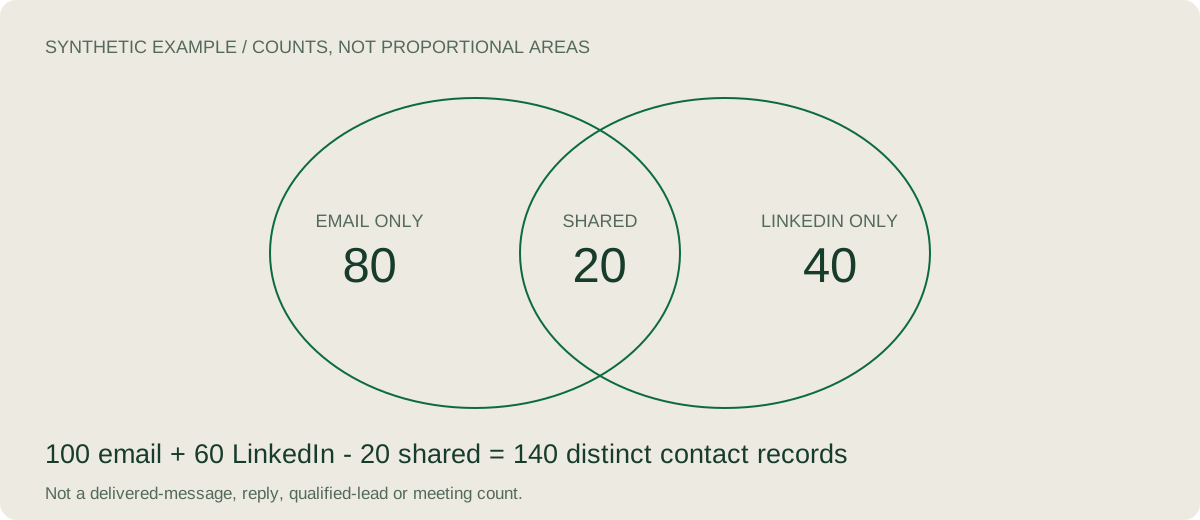
Suppose an email report has 100 unique contacts and a LinkedIn report has 60. If 20 are matched as the same contacts across both reports, the combined count is 100 + 60 - 20 = 140 distinct contact records. The groups are 80 email-only, 20 shared and 40 LinkedIn-only.
If the overlap has not been established, the justified range is 100 to 160. At one extreme, all 60 LinkedIn contacts also appear in email. At the other, none do. Neither total tells you how many messages were sent or which people responded. These are hypothetical inputs, not ReplyLead results.
02 / THE WORK, THE SOFTWARE, THE RECORD
The interactions between a seller and buyer, and the way the team organizes them. A useful program carries the buyer's context from an initial message into later conversations rather than treating each channel as a separate start.
Software can organize tasks, cadences and communications. The published Salesforce category description includes communication and activity tracking. Those capabilities do not, by themselves, establish audience fit or message quality.
Training, content and support prepare the team to sell. That differs from the interactions themselves, a distinction also made in Outreach's definition guide. Both need an owner; purchasing software does not assign that owner.
A CRM records relationships, activity and deal state. An engagement workflow determines the next task and preserves the conversation around it. Systems may combine these functions. Assess the actual integration and responsibility split instead of assuming a product category guarantees a complete process.
For the initial conversation, see what sales outreach covers. For an email-only sequence, use the cold email sequence guide. This page addresses coordination and measurement across channels.
03 / CONTEXT BEFORE THE NEXT TOUCH
A prospect who asked for a product detail by email should not receive an unrelated introductory pitch on LinkedIn. Equally, a connection acceptance is not proof of interest in a sales meeting. The operating record needs the actual message, a clear owner and an agreed next action.
| Situation | Keep in the record | Next action | Do not count it as |
|---|---|---|---|
| No response yet | Prior messages, channel, dates and current owner | Review the planned next touch against the full history and current exclusions | Interest, a conversation or a qualified lead |
| Information requested | The actual question and material requested | Send the relevant approved information through the conversation owner | A booked meeting |
| Time agreed | Date, time, time zone, attendees and meeting purpose | Confirm the scheduling details and record the confirmed booking separately | Attendance or an accepted opportunity |
| Not ready until later | The buyer's wording and any agreed revisit date | Set the appropriate future action instead of continuing the initial sequence | Permanent disqualification or present readiness |
| Stop requested | Request, date and applicable contact/account scope | Apply the relevant suppression across coordinated activity; do not switch channels to bypass the request | A reason to add another touch |
Use consistent reply categories and keep the original thread available to the person responding. If multiple representatives share an account, assign a conversation owner and make recent activity visible before another message is prepared. An address match, similar name or shared company alone is not enough to establish that two records represent the same person.
04 / THE UNIT CHANGES THE ANSWER
Count recorded actions, such as sent messages or completed tasks, under explicit definitions. Several actions can concern one contact. A platform event should not be silently relabeled as delivery, reading or interest.
Deduplicate within each population using a documented identifier. Contact counts and company counts answer different questions. The overlap calculator helps explain the contact arithmetic; it cannot verify identities or perform a CRM join.
Separate automatic replies, refusals, information requests, scheduling discussions and confirmed bookings. Then record cancellations, rescheduling and attendance. Use the same cohort and observation window for comparisons.
Let the sales owner confirm opportunity acceptance and record the reason. Attribute closed revenue under agreed rules, keeping unmatched records visible. More channel activity does not establish that the additional activity caused a sale.
Use the lead-source guide to distinguish original discovery from a converting visit. Use the funnel-metric definitions when comparing stages. A tool calculation, CTA click or calendar open should not enter the qualified-inquiry count.
Before testing a new channel, define the relevant audience, time window and primary outcome. Track stop requests, duplicates, meeting attendance and sales acceptance as guardrails. An uncontrolled before-and-after change can also reflect seasonality, a different audience or sales-cycle lag.
05 / SOFTWARE NEEDS AN OPERATING OWNER
ReplyLead runs cold email and LinkedIn, including targeting, messaging, reply handling and meeting booking within the agreed campaign scope. Your team provides the relevant service and customer context, approves material claims, takes the sales conversation and handles proposals and closing. The published division of work is the starting point for the scope discussion.
You have a defined B2B audience and a team ready to take qualified conversations, but need coordinated research, outreach and reply management. Agree the exclusions, qualification definition, reporting and handoff before launch. Setup depends on infrastructure readiness and approved inputs; this guide does not promise a launch date.
If the issue is product adoption, consumer customer service, candidate applications or closing existing proposals, define that need separately. Adding prospecting volume will not resolve an unowned sales process after the meeting. This is not a recruitment page or a software subscription checkout.
The commercial model is a monthly technology fee plus an agreed share of attributable closed revenue. The technology fee remains payable when no deal closes. Confirm what infrastructure, reporting and integrations are included in the actual scope, along with any separate costs. See current pricing and commercial terms.
Let E be unique email contact records, L unique LinkedIn contact records and S the known shared records. With a common population, period and identity rule, distinct records = E + L - S. Email-only = E - S; LinkedIn-only = L - S. S must be between zero and the smaller channel count.
If S is unknown, the minimum possible distinct count is max(E, L) and the maximum is E + L. When one channel contains zero records, the range collapses to the other channel's count. The result can then be exact without identifying any shared records because the intersection must be empty.
Inputs must be whole numbers from zero to ten million. Blank, negative, decimal, exponential and formatted-with-comma entries are not accepted. The limit bounds input handling; it is not a claim about ReplyLead's database. The calculation uses counts you enter locally and sends no count values in its tool-use events. It does not upload a list or update a CRM.
Do not combine contacts from different reporting periods or count a person in one channel and a company in the other. Resolve duplicated identities within each channel first. When the matching rule is uncertain, keep the overlap unknown; a guessed number creates false precision.
A contact record is not necessarily a unique person, reachable address, qualified buyer or permission to contact someone. The calculator does not verify any of those properties. The workflow recommendations are general operating guidance, not a certification that a platform, campaign or jurisdiction is compliant. Your team's existing qualification decisions should not be silently replaced by a reporting tool.
Sales engagement is how a sales team manages its interactions with buyers. It includes the communication and the operating context around it: history, ownership, next action and measurement. It is broader than a single outbound sequence.
Engagement concerns buyer-seller interactions. Enablement prepares the team with training, content and support. A team can need both; buying an engagement platform does not replace audience research, relevant messaging or an accountable owner.
The functions can overlap, but they describe different jobs. Engagement software supports communication and activity workflows; a CRM records relationships and sales state. Verify how the actual systems exchange identifiers, requests, tasks and outcomes.
Only if you have established that there are no shared contacts, using the same population, period and identity rule. Otherwise subtract the known overlap. If it is unknown, report the possible range instead of assuming the totals describe different people.
The exact distinct count depends on the shared contacts. Without that count, the minimum is the larger channel total and the maximum is their sum. If either channel is zero, both bounds are equal because the overlap must be zero.
No. It counts supplied contact records under your matching rule. It does not establish delivered messages, responses, buyer interest, qualification, attendance or revenue. Measure those outcomes separately with evidence from the relevant systems.
ReplyLead runs cold email and LinkedIn within the agreed targeting, messaging, reply-handling and booking scope. Your team takes the sales conversation, proposal and close. Confirm the operational split before launch.
No contact list is requested. The arithmetic runs locally on the counts you enter. Tool-use events omit the counts and results. The calculator does not identify people, contact prospects, verify delivery or update your CRM.
Checked 17 October 2026. Category descriptions come from primary providers; no vendor performance claim is adopted. The calculator is original set-count arithmetic. The example is synthetic, not a market benchmark or customer result.