Logistics marketing for reaching the right business customers.
A logistics marketing strategy starts with the customers you want to reach and the service you can deliver. Define the target market, give buyers a specific reason to talk and assign a clear owner to each channel. This guide explains the choices for carriers, 3PLs and logistics technology companies, including where ReplyLead's managed outbound fits.
Updated 17 October 2026 / By Mark Glazer, ReplyLead
MarketThe customers worth reachingMessageA relevant reason to talkHandoffA clear next sales step
01 / ONE INDUSTRY, DIFFERENT COMMERCIAL JOBS
Choose the market before choosing the channel.
TRANSPORT
Carriers and freight services
Start with routes, equipment, commodity restrictions and the service you can commit. Build a target account set around the shipping work, then establish the relevant transport or procurement owner. A carrier directory is not a shipper directory, and a location alone does not prove lane demand.
FULFILLMENT
Warehousing and 3PL
Define the operating model: storage, pick-and-pack, returns or another specific service. Relevant questions include SKU and order characteristics, facilities, integration requirements and seasonal commitments. A pallet position is a stock of space; orders per day are a processing flow. Keep them in separate capacity plans.
SOFTWARE
Shipping and logistics technology
Define the workflow, integration environment and people affected by the change. Public technology signals can guide research, but the buyer must confirm requirements and purchasing responsibility. The optional operational calculator below is for a service-capacity pool; it does not estimate software market size or subscription growth.
Use the existing logistics targeting and lane-fit guide to check an individual account's service context. The marketing plan answers a prior question: which type of work should the business pursue, and what must be true for the resulting demand to be useful?
02 / A CHANNEL NEEDS A JOB AND AN OWNER
Build a logistics marketing strategy around buyer questions.
A prospective customer may need to understand coverage, service capability, onboarding and the commercial comparison before taking a call. Your website and proof should make those answers findable. Outbound can then start a specific conversation with relevant accounts. Neither traffic nor a large contact list resolves an unclear service proposition.
Planning options and responsibilities; these are not a promise of one bundled service.
Workstream
Buyer question
Useful asset or action
Owner and measurement
ReplyLead outbound
Is this relevant to our shipping or logistics workflow?
Agreed targeting, cold email and LinkedIn, relevant context and coordinated replies
ReplyLead within agreed scope; qualified inquiries and booking outcomes tracked separately
Website and search
Can this business serve our requirement?
Accurate capability pages, coverage, integration details and usable inquiry path
Client or separately scoped specialist; relevant visits and valid inquiries, not rankings alone
Evidence and reputation
What supports the claim?
Approved case studies, current credentials and references appropriate to the buyer
Client owns permissions and accuracy; no invented savings or performance
Paid distribution
Is there a relevant way to discover this service?
A bounded experiment with audience, budget, destination and stop rules
Client or separately scoped specialist; no media spend implied by this guide
Commercial follow-through
What would working together involve?
A properly scoped discovery, quote or demonstration and an accountable next action
Client sales team; held meetings, accepted opportunities and signed business
No unnamed partner relationship is claimed. Agree the provider, deliverables and separate price before assigning work outside managed outbound. Do not budget against a universal logistics conversion rate: use your own comparable cohorts, and retain the uncertainty where the evidence is missing.
For an early plan, choose one target segment, one commercial reason to talk and one primary next step. Define what will be excluded, what proof can be used and what outcome will justify continuing. A small coherent campaign is easier to assess than several channels with inconsistent audiences and definitions.
03 / AN INQUIRY SHOULD ARRIVE WITH CONTEXT
Measure the path into an operationally useful conversation.
Keep the original source, submitted-from page, company, stated requirement, relevant geography and the buyer's next-step request. Collect shipping or operational details only when they help the sales owner assess the requirement. Do not ask for confidential customer or contract data merely to unlock a guide.
Relevant inquiry
Separate new business interest from job applications, vendors, duplicate submissions, tracking requests and existing-customer support. Keep unknown fit as unknown rather than treating an incomplete record as a proven rejection.
Commercial conversation
Confirm the purpose and attendance separately from booking. Your sales owner resolves the operational and buying details. A request for rates is not yet a commercially accepted opportunity.
Accepted opportunity and delivery
Record the sales decision and the reason. After a win, confirm the actual implementation and capacity commitment. Update the plan with real operating information instead of leaving the original scenario unchanged.
Use source definitions and cross-channel contact counting to keep reporting consistent. Compare the same market, period and stage. A shorter sales observation window can hide later wins; aggregate lead growth can hide a decline in accounts your operations team can serve.
04 / MANAGED OUTBOUND AND YOUR SALES TEAM
Turn the plan into an agreed campaign.
ReplyLead manages cold email and LinkedIn, including targeting, infrastructure, messaging, reply handling and meeting booking within the agreed scope. Your team supplies accurate capability and customer context, approves claims, defines relevant exclusions and takes the sales conversation, quotation and close. See how the work is divided.
The model has a monthly technology fee plus an agreed share of attributable closed revenue. The technology fee remains when nothing closes. Confirm infrastructure, integration and any separately commissioned marketing work in the proposal. Current pricing and terms govern the actual engagement. Setup depends on readiness and approved inputs, not a launch promise in this calculator.
This is suitable for a defined B2B logistics audience with a credible service and sales coverage. It is not a consumer parcel-support service, freight marketplace, tender-management system, staffing agency or outsourced operations team. If the constraint is delivery capacity or sales follow-through, address that before increasing the volume of conversations.
Optional: check capacity before pursuing more accounts.
If operational capacity limits the customers you can take on, use this optional calculator to check your own figures. It subtracts existing commitments and a reserve from a single capacity pool. You can skip it when planning your marketing: it does not select buyers, estimate leads or predict campaign returns.
Changing the basis clears the counts. These units are not interchangeable.
01 / TOTAL
02 / ALREADY COMMITTED
03 / HELD BACK
Use whole units. Zero is allowed except for capacity per new account, which must be at least 1. Blank fields are unknown. Maximum 10,000,000 per input.
YOUR SCENARIO / NOT VERIFIED
No capacity assumed
Capacity and commitments have not been entered.
Available after commitments and reserve
Capacity ceiling at your account allocation
Proposed new-account allocation
Remaining after the scenario
This does not verify lanes, equipment, timing, staffing, buyer fit, profitability or demand. It does not change an existing qualification decision.
The 100-load example
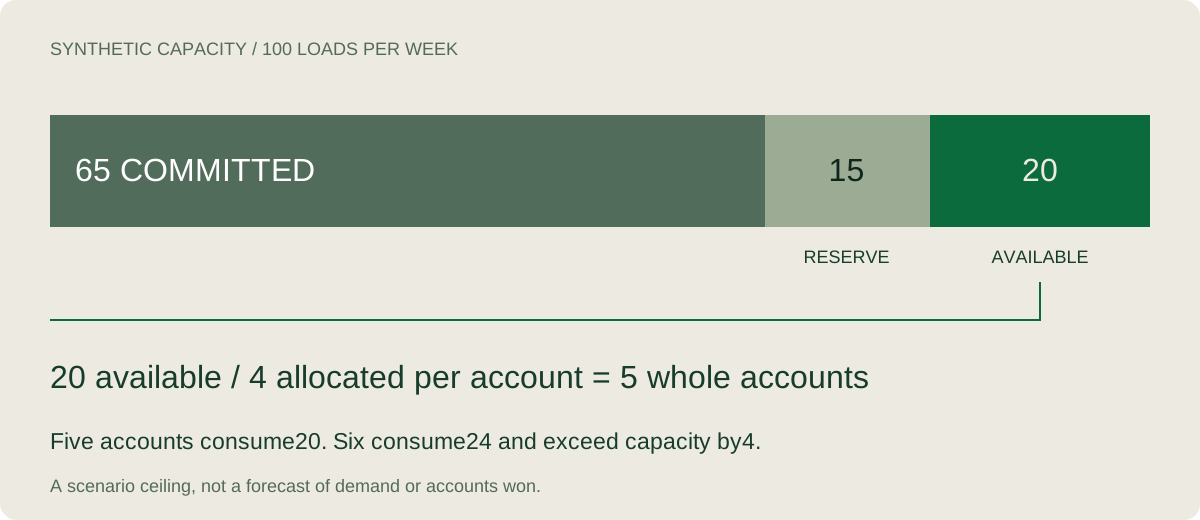
A hypothetical weekly plan has 100 loads of capacity, 65 committed and a reserve of 15. That leaves 100 - 65 - 15 = 20 loads per week. At an allocation of 4 loads per new account, the arithmetic ceiling is 5 whole accounts. Five accounts consume 20 loads and leave zero additional unallocated capacity beyond the reserve. Six would consume 24 and exceed the available amount by 4.
The example assumes the work is interchangeable within the chosen pool. Real routes, equipment, appointment windows and labor constraints may make it impossible to use every remaining unit. It is a scenario, not an instruction to acquire five customers.
Illustrative capacity, not observed operations. The three labeled segments total 100 loads per week. The reserve stays outside the new-account allocation.
The capacity ledger's calculation
Available capacity = total operating capacity - existing commitments - operational reserve. The whole-account ceiling = floor(max(0, available capacity) / allocation per new account). Proposed allocation = proposed accounts x allocation per account. Remaining = available capacity - proposed allocation.
A negative available value remains visible: it means the commitments and reserve already exceed the entered total. The zero floor applies only to the whole-account ceiling; it does not hide the existing shortfall. A negative remaining value shows how much the proposed plan exceeds the available amount. No fractional account is rounded up.
All inputs are whole units under one basis. Counts range from zero to ten million, with a positive per-account allocation. The upper limit keeps handling bounded; it is not a real operating benchmark. Unit changes clear the inputs instead of applying an unsupported conversion. The calculation runs locally, requests no customer list and sends no entered counts in its tool-use events.
What the plan cannot establish
The ledger assumes a common, interchangeable capacity pool. Do not mix incompatible routes, equipment, facilities, service levels, peak and off-peak periods, or daily flows with stock capacity. Use separate scenarios for materially different operating constraints. Your operations team must verify the true availability.
The calculator does not establish rates, margin, regulations, insurance, customs eligibility or a customer's buying intent. It works with the unit you enter in any location, but that does not validate regional service capability or legal requirements. The capacity example does not predict marketing demand, appointments or revenue.
Logistics marketing questions
What is logistics marketing?
Logistics marketing connects the services a business can deliver with the buyers who need them. A useful plan defines the market, capability, evidence, channel responsibilities and sales handoff before increasing acquisition activity.
How do I build a marketing strategy for a logistics company?
Choose a specific commercial model and serviceable market, establish the operating constraints, identify the buying roles and prepare accurate proof. Assign each channel an owner and a measurable job. Keep relevant inquiries, bookings, attendance, opportunities and customers separate.
Does the capacity ledger predict new customers?
No. It calculates an operating ceiling from your entered capacity and per-account allocation. It does not estimate demand, conversion, win probability, revenue or how soon accounts will be acquired.
Can I use loads, orders and pallet positions in the same plan?
No. Use one consistent basis in each scenario. Loads per week and orders per day are different flows; pallet positions are a stock of space. The tool clears counts when you change basis and does not convert between them.
Why can the available capacity or remaining capacity be negative?
Existing commitments and reserve can exceed the entered total, or the proposed new accounts can consume more than the available amount. The tool keeps those shortfalls visible. Only the maximum whole-account count is floored at zero.
Does this replace the logistics lane-fit planner?
No. The capacity ledger plans the size of a proposed account group within one assumed pool. The separate logistics lead-generation guide checks individual geography, equipment and commodity context. Operations still needs to verify feasibility.
Does ReplyLead handle the whole marketing and logistics operation?
No. ReplyLead runs the agreed cold email and LinkedIn program through reply handling and meeting booking. Your team owns capability decisions, the sales conversation, quotation and close. Website, search, paid distribution or other specialist work requires its own agreed owner and scope.
Sources and limits of the evidence
Checked 17 October 2026. First-party service descriptions support the stated scope. The capacity example and formula are original, explicit planning arithmetic. They are not industry benchmarks or customer results.
ReplyLead's logistics field guide - buyer-model distinctions and individual lane-fit questions, preserved as a separate destination.