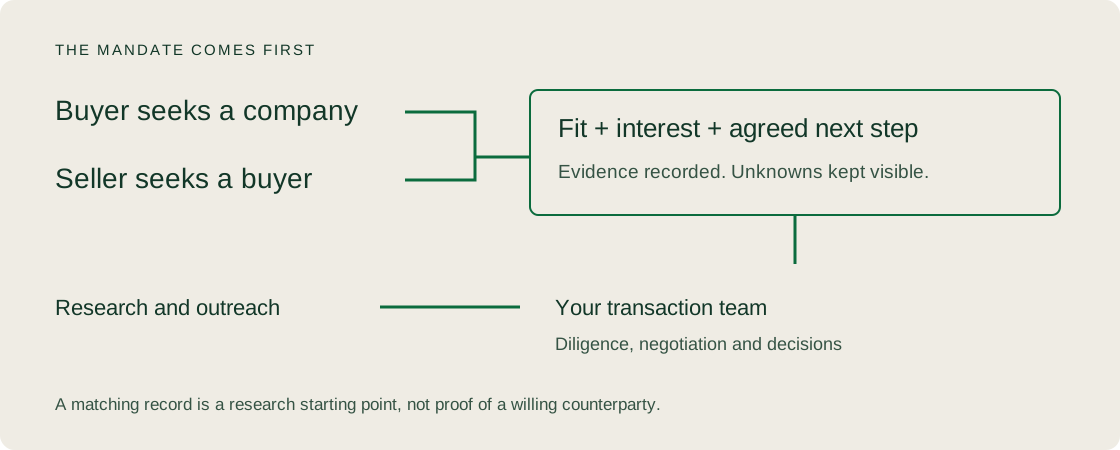
Lead generation for business acquisitions starts with 2 different searches: companies a buyer could acquire, or potential buyers for a business. ReplyLead handles targeted research, cold email and LinkedIn outreach, replies and meeting coordination against your agreed criteria.
An initial conversation, not a commitment to buy or sell. Your team and advisers handle the transaction.
Define the commercial job before building a list. Each path needs different evidence, questions and permissions.
BUYER TO COMPANY
Find businesses that fit your acquisition thesis.
You are a strategic acquirer, investment team or searcher looking for target companies. Start with business model, geography, size range and exclusions. Research who can discuss ownership and strategic options. Ask about interest and timing; do not infer a willingness to sell from a company profile.
Useful handoff: why the company fits, the evidence and its date, who replied, what they actually said, open questions and the agreed next step.
SELLER TO BUYER
Find potential buyers for an authorized mandate.
You are an owner or appointed adviser seeking relevant strategic or financial buyers. Define the buyer thesis, size and geography, operating capabilities, decision roles and confidentiality boundary. A related acquisition is a research signal, not proof that the buyer has current appetite or funding.
Useful handoff: strategic rationale, stated interest, participant role, disclosure permission and the next question for your transaction team.
Looking for customers for an advisory firm instead? Say so when you contact us. Winning an advisory client and sourcing a counterparty for an existing mandate are different campaigns. For services sold to banks or investment firms, see financial-services prospecting.
Both sourcing paths need evidence of fit and a direct conversation. A matching record alone does not establish a transaction opportunity.
A SEARCH WITH A REASON
Same outreach channel. Different sourcing questions.
A buyer needs to know which owners are worth approaching. A seller needs to know why a particular buyer might care. We turn that difference into the account criteria, first message and questions passed to your transaction team.
For buyers: test the acquisition thesis.
A company can match a sector code and still be the wrong acquisition. Define the operating model before building the target list.
Research the fit
Look for evidence of the service mix, customer type and operating footprint. Keep estimated financials separate from figures confirmed by the company.
Write the exclusion rule
Existing relationships, unsuitable business models and non-negotiable criteria belong in the brief before outreach, so the search does not keep producing the same unsuitable names.
Ask an owner-level question
Establish whether the appropriate person is open to an acquisition conversation. A positive reply is a starting point for your team, not proof that the business is for sale.
Illustrative search: a commercial-maintenance buyer could exclude equipment resellers and residential-only operators even when all three share an industry label.
For sellers: write the buyer rationale.
A list of large companies is not a buyer strategy. Separate the reasons an operator, strategic acquirer or investment group might pursue this business.
Research the rationale
Adjacent services, an existing regional footprint or a relevant acquisition history can justify further research. None confirms current buying appetite or available funding.
Set the disclosure boundary
Agree the wording and information that can be used before approaching anyone. Your first inquiry can describe the activity and region without naming the business.
Ask a fit question
Find out who evaluates acquisitions, whether the broad profile fits their present criteria and what information they need next. Your team decides when to move into a detailed transaction discussion.
Illustrative search: a specialist service provider might be relevant to an adjacent operator expanding its capabilities, rather than every company in the same sector.
These are planning examples, not client results. We agree the search, exclusions and response handoff before a campaign starts. A submission here requests that discussion; it does not launch outreach.
02
A useful lead has a reason to belong.
Agree the handoff standard before outreach. Keep what is known separate from what still needs a conversation.
Acquisition sourcing: evidence and qualification limits
Check
Evidence to retain
What it does not prove
Company fit
Business model, geography, ownership and dated sources; estimates labeled.
A database category does not verify revenue, profitability or availability.
Relevant participant
Role and involvement confirmed in the exchange.
A senior job title alone does not establish authority to sell or acquire.
Expressed interest
The person's actual response to the stated mandate.
An automatic reply, referral or polite acknowledgement is not transaction interest.
Next step
Agreed purpose, participants, timing and disclosure boundary.
A booked meeting is not attendance, an accepted opportunity or a completed deal.
Ownership and exclusions
Existing relationships, duplicate accounts, restricted parties and suppression lists.
A newly found contact is not necessarily a new relationship for your team.
Use a shared review of accepted and rejected handoffs to refine account criteria. Preserve the reason for a rejection, including existing relationships and an incorrect business model. Do not relabel unverified financial estimates as facts to make a list look more qualified.
VALUATION + FINANCING / REGIONAL SCENARIOS
Put numbers around the conversation.
Build the seller's earnings bridge, then test an acquisition's debt payments and cash flow. These tools adapt GLZR's seller valuation calculator and buyer acquisition calculator for this sourcing brief. Regional inputs cover 102 countries, with custom inputs for other markets.
Use local figures and actual borrowing terms. A country-risk adjustment is an optional sensitivity, not observed local transaction pricing. Results are educational scenarios, not an appraisal, tax calculation or financing approval.
Country, currency and regional assumptions
All money inputs and results use this currency.
Only for checking the chosen USD reference band. No amounts are converted automatically.
United States: USD. Country-risk input 0.23% (January 2026). FX is 1 USD per USD. The initial 9.5% loan rate is GLZR's dated modeling assumption, not a lender quote.
Currency changes do not convert amounts. Review the inputs before comparing countries.
Seller valuation calculator
Build earnings and an indicative value.
Illustrative defaults describe one owner-operator. Multiple working owners require a documented normalization of compensation and replacement costs. Do not add the same expense back twice.
Earnings adjustments, debt and transaction costs
Include the salary and benefits needed to replace the owner's work.
Worked example, USD: SDE 450,000; adjusted EBITDA proxy 340,000. At 3.1x SDE, indicative enterprise value is 1,395,000. With zero surplus cash, debt and transaction costs, the illustrative equity bridge is also 1,395,000 before tax.
These are example inputs, not a business valuation. Select a reference band explicitly. The calculator flags a mismatch rather than silently switching valuation methods.
Buyer acquisition calculator
Test the price against cash flow and borrowing terms.
All loans in this model use the same currency as the business inputs. A cross-currency loan needs a separate FX-risk analysis. The model does not apply US SBA terms, tax rules or local lending eligibility to other countries.
Use cash flow before interest, income tax, maintenance capex and working-capital changes. Do not deduct an item twice.
Cash-flow adjustments and seller financing
Zero means tax has not been deducted; this is then a pre-tax scenario.
Positive uses cash; negative releases cash.
Worked example, USD: Purchase price 1,395,000; buyer cash 20%; senior debt 1,116,000; nominal annual interest 9.5%; 120 monthly payments. Closing costs of 25,000 are paid separately in cash.
Monthly principal and interest: USD 14,441. Annual debt service: USD 173,289. Annual cash available before debt: USD 310,000; coverage: 1.79x; cash after debt: USD 136,711. This example deducts zero income tax.
Scenario sensitivity after calculating the buyer case
Financial inputs stay in this tab unless you choose to include them with your mandate.
Reported benchmarks, modeled adjustments, your assumptions.
IBBA and M&A Source, Q2 2026 reported multiples by USD purchase-price band
USD reference band
Earnings basis
Reported multiple
Under $500K
SDE
2x
$500K-$1M
SDE
2.8x
$1M-$2M
SDE
3.1x
$2M-$5M
EBITDA
4x
$5M-$50M
EBITDA
5.8x
Source: IBBA and M&A Source, Q2 2026 Market Pulse highlights, released August 2026; chart checked 17 October 2026. These are advisor-reported survey figures, not industry-specific benchmarks. The highlights do not identify them as a mean or median. Reference bands remain in USD even when your inputs use another currency.
Calculation method and regional limits.
Seller: SDE = pre-tax profit + supported add-backs for one owner. The adjusted EBITDA proxy subtracts fully loaded replacement management cost. Indicative enterprise value = selected positive earnings x selected multiple. Equity bridge = enterprise value + included surplus cash - debt repaid - seller costs. Actual purchase agreements determine what is included.
Buyer: monthly payment = principal x monthly rate / (1 - (1 + monthly rate) raised to minus the loan months). At zero interest, payment = principal / months. First-year debt service sums up to12payments per amortizing loan, or fewer when its term ends sooner. Cash available = operating cash flow - maintenance capex - entered tax - increase in working capital. Coverage = available cash / annual debt service.
Country sensitivity: adjusted multiple = 1 / (1 / base multiple + max(0, country risk premium - US premium)). This optional GLZR methodology holds growth constant. It does not establish a local market multiple or incorporate inflation, exchange-rate exposure or company-specific risk. No artificial valuation confidence range is generated.
Sources and dates:102 country-risk inputs checked against Damodaran's published country-risk table (January 2026, with the Turkey row marked February 2026). Country labels, currencies, loan assumptions and FX references are adapted from GLZR's October 2026 public inputs. The FX snapshot is 23 September 2026, not a live quote. GLZR's derived country-adjustment methodology is credited under CC BY 4.0; this implementation changes the band selection, validation and treatment of negative cash flow.
Lending: a policy rate plus a fixed spread is a scenario assumption, not the rate a bank will charge. Replace it with lender terms. Cases without amortizing debt have no debt-coverage ceiling in this model; that does not mean unlimited purchasing power. Standby principal remains owed. Real funding can have fees, balloon payments, covenants, taxes and eligibility requirements absent here. SBA 7(a) is a US program, not a worldwide financing default.
04
The outreach work, and the work your team owns.
ReplyLead's outbound scope
Translate your approved brief into account research and contact selection.
Prepare messaging and sending infrastructure, with readiness and deliverability checks.
Run agreed cold email and LinkedIn activity and respect exclusions.
Handle replies, record qualification answers and coordinate the next conversation.
Report activity and handoffs against the definitions agreed for the campaign.
Confirm mandate authority, target criteria and contact restrictions.
Approve what can be disclosed, by whom and at which stage.
Provide relationship exclusions and resolve duplicate-account ownership.
Assess transaction fit, funding, financial evidence and appropriate advisers.
Take meetings, perform diligence, negotiate and decide whether to proceed.
Set the outreach boundary in writing. Sourcing conversations and completing a transaction require different capabilities.
ILLUSTRATIVE EXAMPLE / NOT A CLIENT RESULT
An industrial-services acquisition brief.
A buyer wants businesses that maintain equipment for commercial customers in a defined region. The research brief excludes equipment resellers, residential-only contractors and companies already in the buyer's pipeline.
What research can establish
The company website describes recurring maintenance and lists relevant service locations. Retain those source URLs and the date checked. Ownership and financial size remain unconfirmed unless reliable evidence is available.
What the conversation must establish
Ask the appropriate participant whether a discussion is relevant, what can be shared and who should join. If the owner declines, record that response. If they want to talk, pass the context to the buyer without describing the company as a willing seller before that is established.
The same discipline applies to seller-side research: a past acquisition may justify investigating a strategic buyer, but current interest and capacity still need confirmation. Adapt the criteria to the mandate instead of recycling the same list across sectors.
Agree the scope and economics before launch.
ReplyLead's published outbound model has two parts: a monthly technology and infrastructure fee and an agreed share of attributable closed revenue. The fixed fee remains payable when nothing closes. See the current pricing and cost structure.
For acquisition sourcing, confirm the work, capacity, term, attribution rules and commercial basis in writing. Do not assume that an acquisition purchase price is the revenue-share basis or that a standard sales campaign agreement covers a transaction mandate.
Launch depends on approved targeting, exclusions, messaging, disclosure permissions and infrastructure readiness. New domains need warming. Your agreed start date should reflect those conditions.
A useful fit conversation starts with
A defined buyer or seller mandate, an authorized decision owner, criteria your team can explain, a process for reviewing conversations and capacity to follow up.
Resolve these gaps first
No authority to discuss the mandate, no agreed disclosure boundary, a request to treat estimated financials as verified, or an expectation that a database list guarantees willing counterparties.
Prefer a conversation? Choose a time with Mark. Bring the sourcing objective and your role in the mandate.
Define the search before outreach starts.
A database record does not establish that an owner wants to sell or that a buyer has available capital. Confirm mandate authority, exclusions, disclosure permissions and the handoff criteria before starting. Your transaction team handles financial verification, valuation, funding, diligence and closing.
Questions before an acquisition campaign.
Can you find companies to acquire and buyers for a seller?
These are two different sourcing briefs. Buyer-side outreach starts with the acquisition criteria and asks whether an owner is open to a conversation. Seller-side outreach starts with an authorized disclosure brief and explores buyer fit. Agree one brief, permission boundary and handoff definition for each campaign.
Does a company in a database mean it is for sale?
No. A company record can support research into fit. It does not establish that the owner wants to sell, that financial estimates are accurate, or that the business is available. Record these as unanswered questions until confirmed by an appropriate person.
What counts as a qualified acquisition conversation?
Use an agreed definition: relevant company, appropriate participant, explicit interest in discussing the stated mandate, and a documented next step. An email address, a reply, a calendar booking and a completed transaction are different stages. Financial and legal diligence remain with the transaction team.
Will ReplyLead negotiate or value the business?
This page describes prospect research, outbound, reply handling and meeting coordination. Valuation, transaction advice, buyer funding verification, diligence, negotiation and closing must be assigned to the client and its appointed advisers. Confirm responsibilities in the engagement before outreach starts.
What does acquisition lead generation cost?
ReplyLead publishes a monthly technology and infrastructure fee plus an agreed share of attributable closed revenue for its outbound service. The fixed fee remains when nothing closes. Acquisition sourcing needs a written scope and attribution agreement; do not assume an acquisition purchase price is the revenue-share basis.
How quickly can a campaign start?
Start depends on mandate approval, usable account criteria, exclusions, permitted disclosures, inbox readiness and sending infrastructure. New sending domains require warming. Agree the actual start conditions during scoping instead of treating a date or a meeting volume as guaranteed.
How this planning framework was built.
The buyer and seller paths capture different sourcing criteria: the companies a buyer wants to acquire, or the reasons a potential buyer could fit a seller. The inquiry records the chosen path, context and exclusions for a scoping conversation. The calculators use the explicit assumptions, formulas and sources shown beside the results.
The industrial-services example and financial defaults are hypothetical. IBBA figures are cited US survey benchmarks; country-adjusted multiples are optional modeled sensitivities. Use these tools for scoping, alongside appropriate transaction advice.