Your discovery call should end with a clear decision.
A discovery call is a sales conversation used to understand a business situation and decide whether a useful next step exists. Keep 4 things separate: what is confirmed, what is unresolved, who owns the next action and when it should happen. ReplyLead manages cold email and LinkedIn; your team takes the sales conversation and close.
A first discussion, a technical review and a commercial follow-up need different agendas. Keep the facts that were already established. The planner changes the focus of the conversation without turning every follow-up into a new qualification exercise.
A STARTING POINT / NOT A SCRIPT TO READ OUT
Start with the reason for this conversation.
Confirm the purpose
What would make this conversation useful for both sides?
Understand the current situation
What is happening now, and which part needs attention?
Resolve the most important unknown
What must be understood before a next step is useful?
Agree what happens next
Who will do what, by when, or is there no useful next step today?
No purpose or duration is assumed. The agenda is a planning aid; it does not book, qualify or approve a meeting.
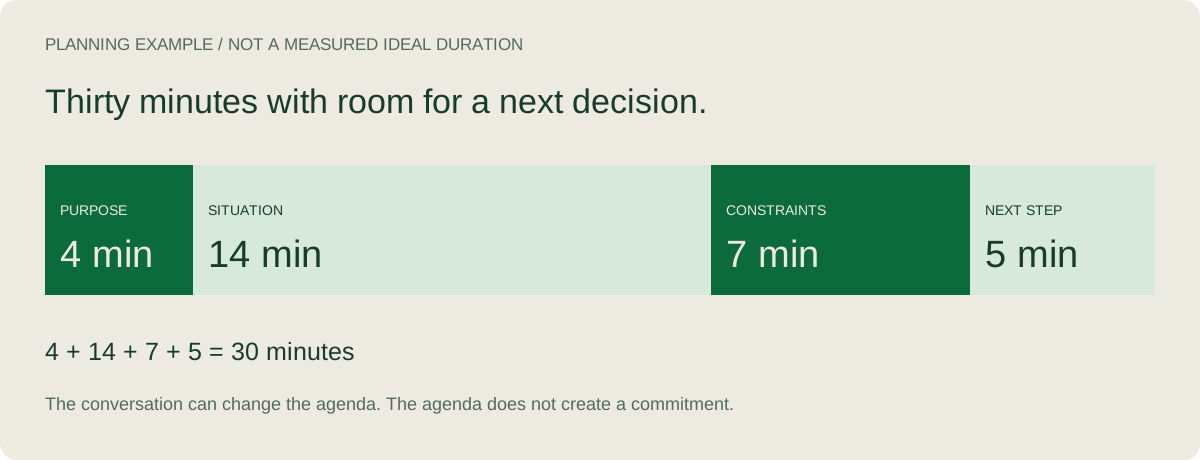
A hypothetical 30-minute allocation. It illustrates the planner, not an industry benchmark or the duration of a ReplyLead booking.
Leave room for the other person's answer to change the conversation. If the main issue becomes clear early, use the time to understand it rather than asking every prepared question. If a topic needs a specialist, identify the missing participant and the exact question for a follow-up.
Discovery call questions that clarify a decision
The questions below are original examples. Use the relevant ones in a conversation; they are not a compulsory checklist or evidence that a prospect has a problem.
What prompted the conversation?
Start with the reason the person agreed to speak. A recommendation, an active project and a general request for information create different contexts. A useful question is: What made this worth discussing now? If they are exploring, record exploration rather than inventing urgency.
What happens today?
Understand the actual workflow before suggesting a replacement. Ask: How does your team handle this today, and where does it become difficult? Distinguish a recurring problem from an isolated inconvenience. If the current process works well, that is relevant evidence too.
What would a useful change look like?
Ask for the buyer's definition of a worthwhile result. What would need to improve for a change to be worth the effort? A measurable objective is useful when it exists, but a number supplied in conversation still needs a definition, period and owner before it becomes a forecast.
What could make the solution unsuitable?
Discuss constraints while there is time to act on them. These may concern geography, delivery capability, existing systems, evidence, resources or the commercial model. Ask: Which requirement would rule this out if we could not meet it? Do not conceal a mismatch merely to keep the meeting moving.
Who needs to help resolve the open question?
A title alone does not describe the decision process. Ask: Who needs to review this part before the team can decide? A user, technical evaluator, budget owner and signatory can be different people. Bring the right person into the relevant discussion rather than repeating the same introductory call for everyone.
A follow-up should continue the conversation.
Carry forward what is known
Read the thread and previous notes before the call. Retain the agreed problem, approved scope, completed qualification and outstanding commitments. Confirm only what may have changed. A change in meeting stage does not erase earlier work.
For example, if a qualified team requests a technical review, prepare the specific workflow and dependency questions. Do not reopen basic company-fit questions just because the technical evaluator is joining for the first time.
Investigate a material change precisely
If the prospect reports a new market, different system, changed requirement or decision date, establish which part of the prior plan it affects. Preserve unrelated agreements. If the effect is uncertain, record the uncertainty and assign the evidence needed to resolve it.
The HR-tech demo planner shows how a product workflow and implementation dependency can shape a technical discussion. The same distinction applies to other B2B evaluations.
The useful output is a decision record.
A pleasant conversation and a calendar entry are not the same as a shared next step. Record the outcome in a way the prospect and sales owner can recognize. The structure below is a suggested working format, not a completed customer record.
01 / CONFIRMED
What both sides established
The current situation, relevant requirement and scope actually discussed. Separate the prospect's statement from an internal interpretation.
02 / UNRESOLVED
The question still open
The missing fact, evidence or review needed. An unanswered question remains open; silence does not become approval.
03 / OWNER
The next action and responsible person
A specific task and a named owner in your private CRM record. A promised document is a task, not a completed delivery.
04 / TIMING
The agreed timing, if any
The date, time zone or event that triggers the next action. If no date was agreed, preserve that fact rather than manufacturing one.
Possible outcomes include an agreed next meeting, an evidence request, a later review point, or a conclusion that the service does not fit. A proposed invitation becomes an accepted next step only when the relevant agreement exists. Apply the meeting acceptance standard separately; this agenda does not automatically mark a held call as qualified.
Assess the conversation without rewarding bad meetings.
Separate activity from the evidence needed to progress
Observation
Useful interpretation
The invitation was sent
A booking action occurred; attendance and acceptance still need their own evidence.
The call happened
The meeting was held; qualification follows the agreed criteria.
A useful next step was agreed
Record the task, owner and timing rather than only a positive sentiment label.
No fit was established
Preserve the reason. A correctly closed mismatch can improve future targeting.
Compare held conversations with the same source, audience definition and observation window where possible. Keep cancellations, reschedules, duplicate opportunities and existing-client conversations visible. A higher booking count is not an improvement if more calls are missed or fewer meet the agreed standard.
BEFORE THE DISCOVERY CALL
ReplyLead builds the route to the conversation.
ReplyLead manages the agreed cold email and LinkedIn programme: targeting, list work, sending infrastructure, messaging, replies, qualification and booking. Your team supplies the service context, approved claims and exclusions, then handles the sales conversation and close.
Starting a new outbound programmeDefine the customer you serve, the problem your team can address and the boundaries of the first campaign.
Adding coverage for an established marketRetain existing qualification and relationships. Agree which new conversations would be useful to your sales team.
Improving the handoffMake the original reply, reason for meeting, agreed timing and unresolved question available to the person taking the call.
A ReplyLead scope discussion should cover audience, delivery capacity, exclusions, claims, existing relationships and what counts as a useful meeting. The prospecting workload guide can help clarify the preparation work your team needs covered.
Pricing includes a monthly technology/infrastructure fee plus an agreed share of attributable closed revenue. The infrastructure amount remains when nothing closes. Review current pricing and agree the attribution terms. Infrastructure readiness and reputation-building affect launch; an agenda choice is not a launch commitment.
The planner uses the conversation purpose, selected duration and reported change status. Each timed plan has four blocks that sum to the chosen duration. A technical or commercial follow-up retains the established context and focuses on the open evaluation or scope decision. A reported material change adds a specific review question.
If purpose or duration is unknown, the corresponding detail stays unspecified. The tool does not read a CRM, verify a statement, create a meeting or send your selections to a prospect. Its duration choices generate planning examples, not measured optimal durations.
Where this guide stops
This is a B2B conversation-planning guide. It does not replace product expertise, an agreed qualification standard or specialist review of contracts, finance, privacy or regulated requirements. It is not a script for pressuring a prospect into a meeting or treating every objection as something to overcome.
If the prospect needs support for an existing service, route the request to support. If no relevant problem or delivery fit exists, record that outcome. Neither the planner nor a completed call establishes an opportunity or revenue.
Discovery call questions, answered
What is a discovery call?
A discovery call is a sales conversation to understand a business situation and decide whether a relevant next step exists. It should clarify the current problem, useful outcome, constraints and decision process without assuming that a booking already proves qualification.
What should I prepare before a discovery call?
Review the original message thread, available account context, the reason for the meeting and any previous commitments. Prepare the important unknowns rather than a long list of questions whose answers are already available.
How long should a discovery call be?
This page does not assert an ideal duration. The planner provides 15-, 30- and 45-minute planning examples. Choose a duration appropriate to the purpose and participants. The allocations are assumptions, not measured performance benchmarks or ReplyLead booking promises.
Is a discovery call the same as a demo?
No. A discovery conversation clarifies the situation and decision. A demonstration shows how a proposed approach handles a relevant task. A technical follow-up can combine both, but the demonstration should address the question already established.
Should an already qualified prospect be qualified again?
Retain completed qualification and the evidence behind it. A material change may require a targeted review of the affected part of the plan. It does not automatically invalidate unrelated facts or require restarting every question.
What if there is no useful next step?
Record the outcome and its reason. The next action might be a later review point, a specific evidence request or no further discussion. Do not invent a commitment or label a mismatch as a qualified opportunity.
Does the agenda planner book or send anything?
No. It changes a local conversation agenda based on your selections. It does not access a CRM, contact a prospect, create a calendar event or verify qualification. The inquiry buttons lead to the existing ReplyLead form.
Sources and evidence boundaries
Checked 17 October 2026. Questions and time allocations are original planning examples, not customer results or conversion benchmarks.