Saves in this browser

No held meetings scored yet.

Qualified Meeting Operations Planner - Stage 1 of 2

REPLYLEAD / ACCEPTANCE STANDARD

What is an accepted sales meeting?

This planner uses 6 named meeting states. A booked meeting is a future calendar reservation. A held meeting is a booked meeting that occurred. A qualified meeting is a held meeting that passed every applicable required qualification criterion: company, role, problem, commercial, timing, and decision. An accepted meeting is a held meeting that passed every applicable required criterion in the saved standard. A rejected meeting is a held meeting that failed at least one required criterion. A replaceable meeting is a booking whose slot may be reused under the saved no-show, cancellation, reschedule, or substitution rule. Unknown is not a pass. N/A drops that criterion. This page and the capacity page are one project. Defaults are user assumptions, not published rates. ReplyLead methodology

6named meeting states
9required starting criteria
1report with nine sections
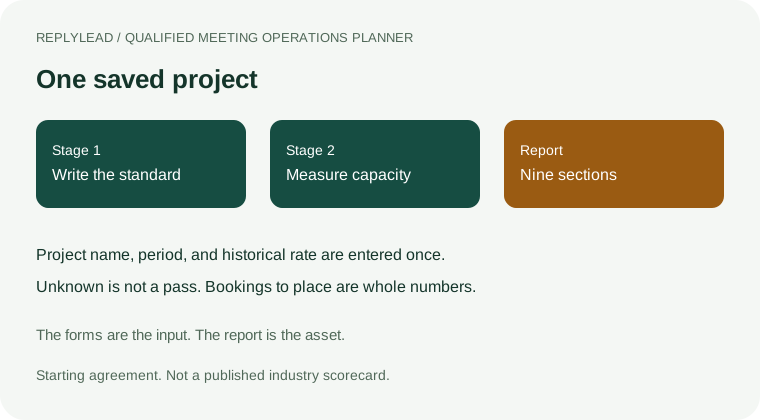
ReplyLead diagram of the planner: Stage 1 writes the standard, Stage 2 measures capacity, and one report collects the agreement, scorecard, and capacity result.
ReplyLead product map. One project. Two stages. One report.

The six names this planner uses

ReplyLead names used on both stages of this planner
NameDefinition
Booked meetingA future calendar reservation. A booking slot. It has not occurred.
Held meetingA booked meeting that occurred. The conversation happened.
Qualified meetingA held meeting that passed every applicable required qualification criterion (company, role, problem, commercial, timing, decision).
Accepted meetingA held meeting that passed every applicable required criterion in the saved standard. Never a future block.
Rejected meetingA held meeting that failed at least one applicable required criterion.
Replaceable meetingA booking whose slot may be reused under the saved no-show, cancellation, reschedule, or substitution rule.

Write the standard, then take the report

Name the project. Keep or edit the starting criteria. Export the report. Score a meeting only if you want an observed rate. Hours live on Stage 2.

Starting criteria

Starting points, not a published scorecard. Mark required or optional. Add or remove rows.

Edit lifecycle sentences and process rules

Optional: score a held meeting

Skip this to export the agreement and capacity as they stand. Observed rate uses held meetings only.

The report is the asset

Nine sections are already filled from the starting assumption. Copy, print, or export. Change a field and the same document updates.

REPLYLEAD / QUALIFIED MEETING OPERATIONS PLANNER

Untitled project - One working week - 5 working days. Starting assumption. Not a market fact.

1. Meeting acceptance agreement

Booked: A future calendar reservation. A booking slot. It has not occurred.

Held: A booked meeting that occurred. The conversation happened.

Qualified: A held meeting that passed every applicable required qualification criterion (company, role, problem, commercial, timing, decision).

Accepted: A held meeting that passed every applicable required criterion in the saved standard. Never a future block.

Rejected: A held meeting that failed at least one applicable required criterion.

Replaceable: A booking whose slot may be reused under the saved no-show, cancellation, reschedule, or substitution rule.

Attendees: Every required attendee attends the held meeting.

Duplicate: A second booking of the same opportunity in the same period is not a new accepted meeting.

Existing opportunity: An already-open opportunity is not booked as if it were net-new unless this rule says otherwise.

No-show: A no-show is a show-rate loss. The slot is replaceable only if this rule says it can be refilled.

Cancellation: A cancellation that cannot be refilled is a show-rate loss.

Reschedule: An in-period reschedule stays one booking.

Substitution: A substitute attendee counts only if the attendee rule allows it.

Evidence: Each required pass needs a recorded fact.

Dispute: When this agreement and a CRM stage disagree, this agreement decides acceptance.

Saved criteria
CriterionGroupWeight in the decisionRule
Required attendeesattendeesRequiredEvery required attendee attended.
CompanycompanyRequiredThe company is in the segment you serve.
RoleroleRequiredThe person can move or block the deal.
ProblemproblemRequiredA problem you solve, stated in their words.
CommercialcommercialRequiredThe likely deal size sits in the band you will work.
TimingtimingRequiredA buying window exists.
DecisiondecisionRequiredWho else must agree is named or known.
EvidenceevidenceRequiredThe facts behind each required mark are recorded.
Not a duplicateprocessRequiredThis is not a duplicate of an already accepted meeting.
Existing opportunityprocessOptionalThis is not an already-open opportunity you would not re-book.

2. Qualification scorecard

No meetings scored. Observed acceptance rate: not calculated. Historical acceptance rate: not entered.

3. Capacity calculation

Gross 60 hours. Remaining after prospecting and admin 30. Usable share produces 21 usable hours. Booked hours 6 already include committed preparation. Incremental follow-up 0. Open hours 15.

4. Funnel assumptions

Show rate 80% (user assumption). Acceptance rate source: blank. Booked hours include committed preparation and are not subtracted twice.

5. Available booking capacity

Meetings that fit the open hours: 12.00. Safe new bookings (floor): 12. Hours per new booking: 1.25.

6. Expected held and accepted meetings

Maximum-capacity held: 9.6. Maximum-capacity accepted: Not calculated. Planned-volume forecast: planned bookings not entered. These are different measures.

7. Identified constraint

Capacity only. Team status: Demand was not entered.

8. Recommended next diagnostic step

Demand was not entered. This result is capacity only. Enter planned bookings or required accepted meetings before calling this a volume problem.

9. Assumptions and limitations

Every default is a user assumption. This report does not invent search volume, industry rates, or ReplyLead performance. It does not model overbooking. It does not call volume the bottleneck unless demand was entered. Calendar arithmetic is not a win-rate or revenue forecast. Checked 26 September 2026.

Method

Open the calculation rules

Applicable required criteria are required criteria not marked N/A. Accepted means held and every applicable required criterion is pass. ReplyLead methodology Observed rate = accepted held meetings / held scored meetings. Calculation Historical rate is typed by the user or left blank. Assumption if typed Stage 2 floors open hours divided by hours per new booking to a whole booking count. Booked hours include committed preparation and are subtracted once. Demand is compared only when planned bookings or required accepted meetings are entered.

How a mark is treated
MarkRequired criterionOptional criterion
PassNeeded for acceptanceRecorded only
FailRejects the meetingDoes not reject
UnknownNot a pass; meeting not acceptedNot a pass; does not reject
N/ADropped from the setDropped from the set

Checked 26 September 2026. External calendar documents support reserved time. They do not set this standard.

Questions

When is a meeting accepted?

After it is held, and only when every applicable required criterion passes. Unknown is not a pass. N/A drops that criterion. A failed required criterion rejects. A failed optional criterion does not reject. ReplyLead methodology, not a CRM stage name.

How do you define a qualified meeting?

A held meeting that passed every applicable required qualification criterion: company, role, problem, commercial, timing, and decision. Qualification is a subset of acceptance. The assumption is that those groups are the ones you marked required. The limit is that a future booking cannot be qualified. Open Stage 1 to write the rule.

What happens if a required criterion is unknown?

The meeting is not accepted. The disposition is incomplete until the fact is known. Do not treat a missing fact as a pass.

How does Stage 1 share a project with Stage 2?

The same browser keeps one project. Export the JSON project to reopen the same standard in another browser. The historical rate, period, and project name entered here appear on the capacity page.

Where this stage stops

It does not research the account. It does not invent an acceptance rate. Search demand for this URL has not been measured. This page does not publish an impressions figure. Capacity is Stage 2.

Sources

Checked 26 September 2026. These pages document calendar events. They do not validate this agreement.

Continue the same project

Follow the diagnostic in section 8 of the report. ReplyLead runs cold email and LinkedIn only when that section names spare accepted-meeting capacity.

Open Stage 2 capacity See how ReplyLead works Read pricing