Buyer persona: the role, the problem, the evidence.
A buyer persona is a research-based description of the people involved in buying a service or product. For B2B targeting, keep 3 records distinct: the company profile, the buyer persona and the actual contact. ReplyLead uses cold email and LinkedIn to reach relevant business audiences; a useful persona describes the work and decision responsibilities that make a conversation relevant.
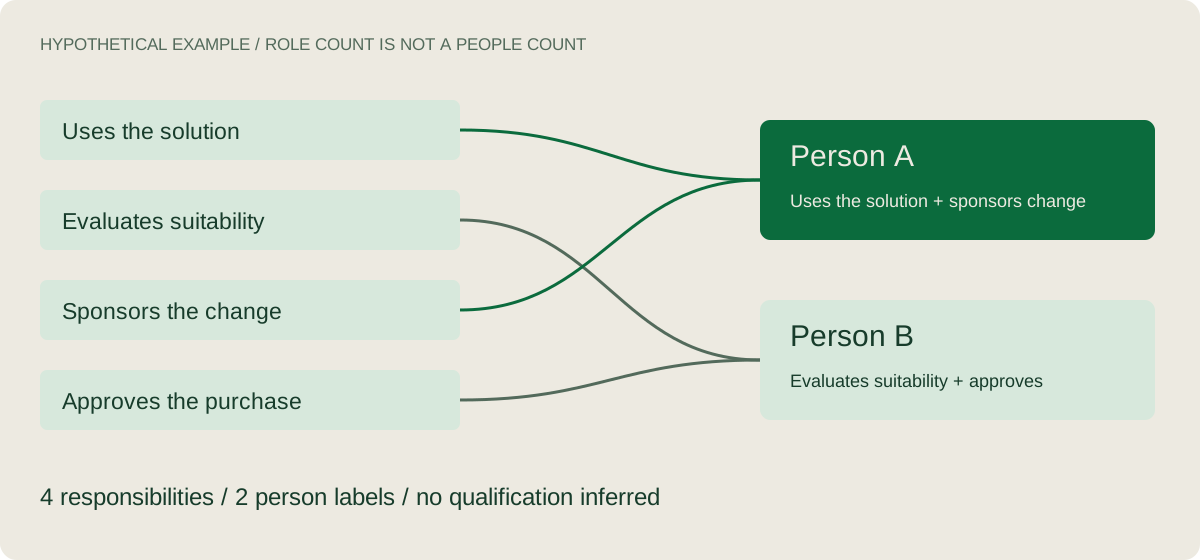
Four responsibilities do not always mean four people.
One person can use a product, sponsor the change and approve a purchase. Another organization can split those responsibilities across a larger group. Define the responsibility first; then establish who holds it in the account you are researching.
ANONYMOUS WORKING MAP
Person A to D are labels for people you already know about. The map does not discover or verify their identities. No names or contact details are needed.
NO ASSIGNMENTS YET
The responsibilities are known. Their owners are not.
4responsibilities with an unestablished owner
Keep these questions open. The available labels are not evidence of four people, four decision-makers or four qualified leads.
For a responsibility that does not apply to the purchase, record that separately from an unknown owner. An unfinished map does not undo an existing qualification decision.
A hypothetical assignment, not a typical buying committee or a customer result. The real roles and owners depend on the purchase.
A B2B buyer persona needs evidence about work.
A persona is useful when it changes the audience, the message or the sales conversation for a defensible reason. It does not need an invented name, portrait, age or hobby. The worksheet below focuses on information your team can investigate and use.
RESPONSIBILITY
What does this person own?
Describe the task, process or result within their remit. Record relevant title variations as research clues. A title alone does not confirm decision authority or the exact scope of the role.
Evidence: current role description, public company information or the person's own explanation.
BUSINESS SITUATION
When does the work become relevant?
Describe the operating condition that could make your capability useful. Separate the observed condition from the problem you hypothesize. A new location may change responsibilities; it does not prove the current supplier is failing.
Evidence: a dated public event or an explicitly described business requirement.
DECISION CRITERIA
What would they need to evaluate?
Identify the questions that matter for suitability: workflow, implementation, service area, evidence, commercial model or support. Unknown requirements should remain questions for the conversation.
Evidence: procurement requirements, technical documentation or an actual evaluation discussion.
BOUNDARIES
What should the message avoid assuming?
Record known exclusions, unsupported claims and topics that require another participant. A persona should help the team avoid a misleading message as well as write a relevant one.
Evidence: the agreed campaign scope, delivery limitations and actual responses.
Build the profile from research, then test the parts that matter.
Start with the organizations you serve.
An ideal customer profile describes the organization. A buyer persona describes relevant responsibilities within it. Keep company size, business model, geography and delivery constraints in the account criteria. Use firmographic data for company attributes and the existing ICP framework for its own task.
Use several sources without counting copies as confirmation.
Compare customer conversations, permitted CRM notes, public role descriptions and company materials where available. Several records copied from the same source are not independent evidence. Preserve dates and context so an old job description does not silently become a current role claim.
Write the smallest useful profile.
Describe the recurring responsibility, relevant situation, decision questions and message boundary. Separate a repeatable pattern from a single person's preference. If the pattern is based on a small or biased sample, retain that limitation instead of turning it into a universal industry rule.
Validate at the actual account.
A persona guides research; it does not prove that a specific contact holds the role. Confirm current responsibilities and the relevant purchasing unit. The business contact finder addresses contact discovery, while the persona remains the working description behind that search.
Update the affected part when evidence changes.
Record what the response established and what it contradicted. Keep completed account qualification and valid facts. A changed title or new stakeholder can require an update to the contact map without restarting unrelated qualification.
The client and the client's buyer are different audiences.
For ReplyLead, the client is the company hiring managed outbound. That client's buyer is the organization or person the campaign needs to reach. These planning examples show why the distinction changes the persona.
An agency serving med-spa businesses
The agency hires ReplyLead. Its campaign may need to reach an independent owner or a group marketing lead, depending on the service and purchasing structure. A patient profile is a different audience and is not the B2B persona for that campaign.
The manufacturer hires ReplyLead. Its buyers may involve engineering, operations and purchasing responsibilities at a relevant industrial account. A plant-level technical requirement and a group-level vendor agreement are different questions.
The software provider hires ReplyLead. Recruiting, payroll and workforce operations can involve different workflows and evaluators. A general HR title does not establish which product task the person owns.
These are hypothetical purchasing situations, not a claim that each industry follows one committee structure. Use the industry guides as context and establish the actual account's responsibilities.
Make the persona useful to messaging and the sales handoff.
Keep the type of evidence visible
Working statement
How to use it
What not to infer
This role commonly handles the workflow
Guide account and contact research
That every matching job title owns this purchase
The company published a relevant change
Ask a grounded scope question
That the named person has a confirmed problem or budget
The contact stated a requirement
Retain it in the thread and handoff
That other unstated criteria are also satisfied
One person holds several responsibilities
Keep those responsibilities on the same contact
That each role is another lead or opportunity
Use the personalization evidence guide to keep copy factual. After a response, the discovery-call planner helps carry the conversation forward. Persona relevance, expressed interest, an accepted meeting and a qualified opportunity remain different stages.
FROM A WORKING PROFILE TO EXECUTION
Use the persona to agree a focused outbound scope.
ReplyLead manages cold email and LinkedIn, including agreed targeting, list work, infrastructure, messaging, reply handling, qualification and booking. Your team provides the service context, approved claims and exclusions, then owns the sales conversation and close.
Ready to turn the buyer profile into a campaign brief? Review targeted lead generation for account-selection evidence, exclusions and the work your team can delegate to ReplyLead.
A new marketYou need to establish which organizations and responsibilities could make the conversation relevant.
An established audienceYou want the campaign to reuse approved criteria and improve the missing contact context.
A complex purchaseYou need to distinguish users, evaluators, sponsors and approvers without assuming a title tells the whole story.
Bring existing customer evidence, target-market criteria and delivery boundaries. Agree the research depth, messages, exclusions, handoff and reporting before launch. Infrastructure readiness and reputation-building are separate from persona preparation.
The published model includes a monthly technology/infrastructure fee plus an agreed share of attributable closed revenue. The fixed infrastructure cost remains when nothing closes. Review current pricing and agree the attribution rules. No research sample or persona map is a promise of meetings.
The map groups assigned responsibilities by anonymous person label. Assigning Person A twice still counts one person label. An unknown owner remains unresolved. A responsibility marked not applicable is listed separately and is not counted as a missing person. The example assigns four responsibilities to two labels.
The inputs are your working assumptions; the tool has not verified identity, authority or applicability. It stores no names and does not search for people, update a CRM, contact anyone or calculate a lead score. It does not invalidate an already qualified list.
Where a persona cannot answer for the buyer
A persona cannot establish an individual's budget, intent, permission, authority or current need. Avoid filling a profile with invented demographic or personal details merely to make it look complete. Do not infer sensitive characteristics or treat a public company fact as a private fact about a named person.
The map covers four common responsibility questions as a working framework. A real purchase may need additional people or responsibilities. A complete-looking map is not proof that all relevant stakeholders are known.
Buyer persona questions
What is a buyer persona in B2B?
A B2B buyer persona is a research-based description of the responsibilities, situations and decision questions that make a business conversation relevant. It guides targeting and messaging but does not verify the needs or authority of an individual contact.
What is the difference between a buyer persona and an ideal customer profile?
An ideal customer profile describes the organization you can serve. A buyer persona describes relevant people and responsibilities within that organization. The actual contact record identifies a specific person, whose current role still needs evidence.
Does a buyer persona need a fictional name or portrait?
No. For B2B outbound, the useful information concerns responsibilities, business context, decision criteria and evidence. An invented biography or photograph does not establish that a real person has the assumed needs.
Can one buyer hold several decision responsibilities?
Yes. The working map can assign several responsibilities to one anonymous person label. In its hypothetical example, four responsibilities belong to two labels. That example is not a typical committee size or a verified customer record.
What should happen when the role owner is unknown?
Keep the assignment unresolved and identify the evidence needed. Do not invent a name or mark a responsibility not applicable merely because its owner has not been found. Preserve completed account qualification and unrelated facts.
Can AI generate a reliable buyer persona by itself?
AI can help organize supplied evidence, but generated details are not new evidence. Check the source behind a responsibility, business condition or stated requirement. Do not publish invented demographics, intentions or customer findings as research.
Does the map find contacts or calculate a lead score?
No. It groups your assignments by anonymous label and separates unknown from not-applicable responsibilities. It does not verify identities, discover contacts, update a CRM, send messages or determine qualification.
Sources and evidence boundaries
Checked 17 October 2026. The responsibility framework and example are original working guidance, not measured committee-size or conversion benchmarks.