Targeted lead generationMake the next account worth pursuing.
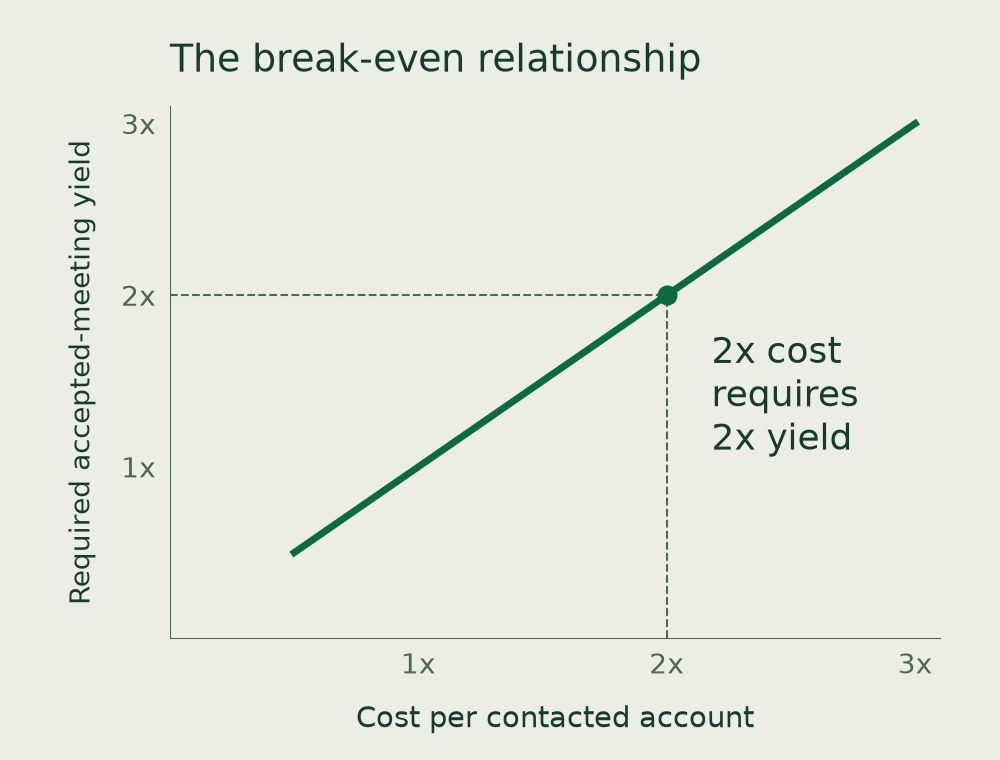
ReplyLead runs targeted lead generation through cold email and LinkedIn, from account research to reply handling and meeting booking. Your team takes the sales calls and closes. Compare the targeting brief, delivery scope and economics below: if cost per account doubles, qualified meeting rate must also rise 2 times to preserve unit cost.
Updated 17 October 2026 / By Mark Glazer, ReplyLead
A mathematical relationship, not a campaign forecast. The complete method and worked example are below.
THE TARGETING DECISION
A smaller list has to earn its extra cost.
Tighter targeting can take more research per company. The useful question is whether that extra work produces enough sales-accepted conversations to justify the cost. A higher meeting rate on its own cannot answer that.
Compare the cost of reaching one distinct account with the share of accounts that produce a held meeting your sales team accepts. Keep the same definition of an accepted meeting in both segments. This comparison evaluates targeting economics; it does not predict whether a prospect will buy.
TARGETING COST COMPARISON
What must the tighter segment deliver?
Three inputs. One break-even threshold. No contact details needed.
Campaign cost divided by distinct accounts contacted.
currency units / account
Use the same currency and include comparable work.
currency units / account
Per 100 contacted accounts. Count each account once.
accounts / 100 contacted
Values stay in this tab. Tool-use analytics contain no entered costs or yields. This is a comparison, not a booking or a campaign forecast.
YOUR BREAK-EVEN YIELD
-
Enter your comparison or explore the worked example.
No conversion rate or campaign result is assumed.
Tighter cost per account / baseline cost per account x baseline meeting yield
More qualified conversations. Still a higher unit cost.
Suppose a baseline campaign costs 15 currency units per contacted account and 4 of every 100 accounts produce a qualified held meeting. The cost per account producing an accepted meeting is 100 x 15 / 4 = 375.
A tighter segment costs 30 per account. If its qualified meeting rate increases to 6 per 100, the unit cost becomes 100 x 30 / 6 = 500. That is a 50% higher yield but a one-third higher cost per accepted account. It must reach 8 per 100 to break even.
These are deliberately hypothetical inputs, not client results, market benchmarks or expected ReplyLead performance. The example demonstrates a trade-off a buyer can calculate with actual campaign data.
At the same 100 contacted accounts; all monetary values use one currency
Scenario
Cost / account
Accepted accounts
Cost / accepted account
Baseline
15
4
375
Tighter: yield improves
30
6
500
Tighter: break-even
30
8
375
Tighter: lower unit cost
30
10
300
MANAGED EXECUTION / CLEAR RESPONSIBILITIES
What you delegate to ReplyLead.
ReplyLead runs the outbound work.
Within the agreed scope: account and contact research, list preparation, sending infrastructure, messaging, cold email and LinkedIn execution, reply handling, qualification and meeting booking. The delivery process explains the division of work.
Your team owns the commercial decision.
You supply customer context, product claims and exclusions; agree the targeting and conversation criteria; take sales calls; assess opportunities; prepare proposals and close. Someone needs to own the next step after the meeting.
Additional channels need their own scope.
Paid advertising, search, content, design or other specialist work is not implied by a managed outbound engagement. No additional partner is named here. Confirm the provider, responsibilities and separate price before assigning that work.
Monthly technology fee + agreed revenue share.
The technology fee covers the agreed campaign infrastructure and remains payable when nothing closes. The revenue share applies to attributable closed revenue under the agreement. Confirm the infrastructure scope, share, attribution window, exclusions and any additional charges before starting. See ReplyLead's pricing model.
Launch depends on the accepted brief, evidence, message approvals and sending readiness. A new market may require more preparation than an established audience. No launch date, meeting volume or revenue result is promised by this page.
Include the work needed to research, contact and handle responses for each segment. Allocate shared infrastructure and staff time consistently. If one figure includes research and reply handling while the other is a contact-data price, the comparison is invalid. Show one-time setup separately when comparing a new test with an established campaign.
ReplyLead's commercial model includes a recurring technology fee and an agreed revenue share. A pre-sale cost comparison does not capture a future revenue-share payment. Evaluate total customer economics separately once the applicable attribution and margin are known.
Accounts with an accepted meeting.
The numerator is distinct contacted accounts that produced at least one held meeting that meets your written sales criteria. The denominator is distinct accounts contacted in that segment. Multiple contacts, follow-ups or meetings at the same company do not create more accounts.
A calendar booking is an earlier event. Keep cancellations, no-shows and sales rejection visible. When attendance or acceptance is missing, mark it unknown; do not quietly promote it to a successful meeting or count it as a proven failure.
A comparable observation window.
Compare campaigns with the same time available to receive replies, attend meetings and record sales acceptance. Keep late outcomes attached to the original cohort. Comparing a mature campaign with one launched last week can make the newer segment look worse simply because its outcomes have not arrived.
The tool assumes one stable baseline. A small or changing sample is a scenario, not reliable evidence that the tighter segment will work at scale. It does not calculate statistical confidence or adjust for seasonality.
The same commercial definition.
Write down what the sales team accepts before the test: serviceable company, relevant responsibility, stated reason to talk and a useful next step. A qualification change halfway through the comparison changes the metric.
Lower cost per accepted account is not necessarily higher profit. Compare opportunity acceptance, customer value, delivery cost and sales-cycle length as cohorts mature. A more expensive segment may still be worthwhile when actual downstream value supports it.
FROM A MARKET DESCRIPTION TO A RESEARCH BRIEF
Make every extra filter explain its job.
A targeting brief should distinguish requirements that determine whether you can serve an account from preferences that help order the work. Making every preference mandatory can remove viable companies without improving the sales conversation.
Required: can this business use what you sell?
Specify the business model, serviceable geography and implementation requirements that are genuinely necessary. For each requirement, name acceptable evidence and the treatment of missing evidence. "Not found" should remain an unresolved research item when absence has not been established.
Example of a research instruction: "The company must operate the workflow our product supports; retain the source describing that workflow." This is more useful than a broad industry tag because the researcher can explain why each account belongs. It is an instruction, not a claim about a real prospect.
Prioritize: why start with this account?
A relevant company announcement, customer resemblance or technology observation can guide the research order. Record the observation, source and date. Keep its meaning narrow: a funding announcement is not a confirmed budget for your product, and a platform signal does not establish dissatisfaction with the current supplier.
Test whether the extra prioritization step improves accepted conversations enough to justify its cost. Avoid an unexplained score whose weights make an account look precise without a validated relationship to outcomes.
Exclude: who should not enter this campaign?
Document active opportunities, existing customers, competitors, partners and other agreed exclusions. Resolve account identity before matching suppression lists so a second domain or subsidiary is not mistaken for a new company. Retain the reason for the exclusion separately from missing contact information.
If the list has already been approved, preserve that targeting decision. Resolve execution gaps without restarting qualification merely because a field is incomplete.
Learn: what belongs in the conversation?
Current priority, buying process, budget and willingness to evaluate often need a buyer conversation. Use public research to ask a relevant question; do not turn a plausible problem into a statement about the company's internal situation.
Ask the sales owner to record why a conversation progressed or stopped. A wrong role, unsupported environment, future timing and a missed meeting imply different next actions. A single "bad lead" label loses the information needed to improve the next segment.
A TARGETING TEST YOUR SALES TEAM CAN INTERPRET
Change the targeting rule. Keep the comparison honest.
Name one targeting change.
For example, compare the current account criteria with those criteria plus one relevant workflow requirement. Explain why that requirement could change the sales conversation. Do not change the audience, channel, pricing and meeting definition together and then credit targeting with the result.
Keep account membership explicit.
Decide how overlapping accounts are assigned before outreach. Prevent the same company entering both campaigns through different employees. Where random assignment is feasible, use it; otherwise retain the differences between the segments and treat the result as observational.
Agree the outcome and review date.
Count relevant bookings first, then attendance and sales acceptance. Record enough cost detail to compare like with like. Choose an observation window appropriate to your actual response and sales cycle; this page supplies no universal sample size or guaranteed test duration.
Decide using outcomes and uncertainty.
Review the unit cost alongside accepted opportunities and the reasons sales rejected conversations. A tighter segment with a higher yield can still cost more. A promising small test may justify another bounded test rather than immediate expansion across the entire market.
The account-evidence checklist
A contact record gives you a way to identify or reach a person. A campaign target needs an account-level reason to belong, a relevant person and a message grounded in what is known. Commercial interest comes later, through the response and sales conversation.
Use the following acceptance matrix when agreeing a campaign brief. It separates facts that can support selection from questions that still belong in discovery. It is a planning framework, not a claim that every field is available for every company.
Account selection: evidence to inspect before drawing a commercial conclusion
Targeting decision
Evidence to inspect
Appropriate use
Still needs confirmation
Business model
The company's own service, product and customer descriptions
Check whether the business does the work your solution addresses
Whether the specific problem exists and is a priority
Market and geography
Published locations, coverage and relevant operating footprint
Apply the serviceable-market boundaries in the brief
Buying location, implementation needs and contractual coverage
Buyer responsibility
Current role, function and company context
Start with the person connected to the problem
Budget authority, other stakeholders and approval process
Technology or audience signal
A dated source and a clear explanation of what it shows
Form a relevant research question or segment
Current use, dissatisfaction, replacement plans or buying intent
Customer similarity
Shared business characteristics with supplied customer examples
Expand the candidate-account pool
Fit beyond the similarity, contact relevance and willingness to engage
Keep exclusions explicit: existing customers, active opportunities, competitors and other agreed categories should be handled deliberately. Consolidate records belonging to the same company so a larger contact file is not mistaken for more target accounts. Keep missing evidence visible; a failed lookup does not prove that a company is unsuitable.
If your team has already approved the list, reuse that decision and its documented criteria. Resolve missing execution details without quietly restarting qualification. For the mechanics of preparing contact data, see lead list building; for a company's selection fields, see firmographic data.
Define a qualified conversation before counting one.
Agree what sales needs to know: the company, relevant role, reason for the conversation, stated requirement and next step. An information request may deserve a useful reply before a meeting. A referral may need another contact. Preserve that context instead of counting every response as interest.
Inquiry: a relevant business question or expression of interest, separated from automatic replies, vendors and support requests.
Booked meeting: an agreed calendar event. Record cancellations, reschedules and duplicate bookings.
Held meeting: attendance confirmed separately from the invitation.
Accepted opportunity: your sales team accepts the opportunity against the agreed criteria.
Closed revenue: the deal and attribution evidence specified in the agreement.
Review outcomes by the audience and campaign period actually used. An increase in contact volume or replies is not enough to establish a better campaign. The useful question is whether the selected accounts produce sales conversations your team accepts and can progress.
Bring examples of customers you serve well and explain what makes the relationship work. Separate characteristics essential to delivery from coincidental similarities. Use the economics comparison to examine whether an additional research filter earns its cost.
Enter a different market.
Bring the buyer problem, serviceable geography and relevant product evidence. Decide which assumption the first conversations should test. A new market should not inherit another segment's expected yield simply because the company sizes look similar.
Execute an approved target list.
Keep the approved account criteria and exclusions. Resolve missing contact information, message evidence and ownership of replies. A missing data field is not permission to restart a qualification decision your team has already made.
When this approach fits.
Targeted outbound is a discussion worth having when you sell to identifiable businesses, can explain a specific customer problem and have a sales owner ready to continue the conversation. The commercial case depends on your market, deal economics and delivery capacity; those must be discussed rather than assumed from a keyword or database count.
This page is for companies buying managed B2B outreach. It does not describe consumer lead resale, guaranteed appointments, a self-service data subscription or a sales-closing service. If you need help finding a personal email, a job or existing-customer support, this inquiry path is not intended for that purpose.
The campaign example establishes historical execution and labelled responses. It does not establish the reachable size of your market, a conversion benchmark or an expected return. Contact availability, company fit and buyer interest are different questions.
Bring the market you want to reach.
Tell us what you sell, who buys it and what your team would consider a useful sales conversation.
Let C be campaign cost per distinct contacted account and Y be accounts with a qualified held meeting per 100 contacted accounts. Cost per accepted account is 100 x C / Y. Setting the two segments' costs per accepted account equal gives required tighter yield = baseline yield x tighter cost / baseline cost.
A result above 100 is impossible under this definition because each contacted account can count only once in the numerator. A zero baseline yield does not provide a finite cost-per-accepted-account benchmark. The tool therefore requires positive costs and a positive baseline yield no greater than 100. Values are not currency-converted.
The comparison uses consistent average costs. It does not model fixed-cost changes at scale, timing of cash payments, revenue share, marginal costs, statistical uncertainty or customer lifetime value. It is original planning arithmetic with a worked example, not empirical performance research. All input and output values stay in the browser tab.
Targeted lead generation questions
What is targeted lead generation?
Targeted lead generation focuses research and outreach on a defined set of businesses and relevant people. The targeting criteria, evidence and exclusions should be explicit. Being a target does not establish interest or make the person a qualified sales opportunity.
What does ReplyLead do for a targeted campaign?
ReplyLead runs the agreed account research, contact preparation, infrastructure, messaging, cold email and LinkedIn, reply handling, qualification and meeting booking. Your team supplies commercial context, takes sales calls and owns proposals and closing.
Can you work from a list we have already approved?
Discuss the existing list, its approved criteria, exclusions and execution status with us. Preserve the completed targeting decision; identify missing contact data, messaging context and handoff details rather than automatically restarting qualification.
How do you target companies like our existing customers?
Customer examples can provide a starting point for lookalike research. Specify the business characteristics that explain the fit and check candidate companies against those criteria. Similarity alone does not establish current need, budget or a willingness to buy.
Does a technology signal prove buying intent?
No. A website technology observation or platform-audience connection can support research or a relevant question. It does not by itself prove current use, dissatisfaction, budget or a plan to switch. Keep the observation separate from the commercial conclusion.
How is the service priced?
The model combines a monthly technology fee with an agreed share of attributable closed revenue. The technology fee remains when nothing closes. Confirm the infrastructure scope, revenue share, attribution rules, exclusions and additional charges in the agreement.
How many meetings can a targeted campaign generate?
There is no universal number supported by this page. Discuss the serviceable audience, evidence, deal economics, sending readiness and sales follow-through. Keep inquiries, booked meetings, attendance and accepted opportunities separate when evaluating results.
Does tighter targeting always reduce acquisition cost?
No. More research can increase the cost per contacted account. A tighter segment must improve its qualified meeting rate enough to compensate. The comparison tool calculates that threshold; it does not predict the actual yield or the value of a future customer.
What counts as an accepted account in the comparison?
A distinct contacted account that produced at least one held meeting that meets your written sales criteria. Count each account once, even when several people or meetings are involved. A booking without confirmed attendance and sales acceptance is an earlier stage.
Can we discuss a campaign without using the calculator?
Yes. The comparison is optional and does not submit an inquiry. Use a campaign-discussion link to open the existing application. Describe what you sell, the businesses you want to reach and your sales goals.
Can the calculator compare US and Canadian costs?
Use the same currency and cost scope for both inputs. The formula compares cost ratios and does not convert currencies or apply regional prices. It cannot supply a US, Canadian or other regional conversion benchmark.
Sources and calculation method
Service sources checked 17 October 2026. The cost comparison and worked sensitivity example are original arithmetic, not a campaign benchmark. The numerical inputs are hypothetical unless you replace them with your own figures.