REPLYLEAD / INDUSTRY FIELD GUIDE
Telecommunications lead generationHeadquarters is
not the service address.
Check serviceability and contract context before asking for a connectivity conversation.

THE BUYING PROBLEM
Telecommunications is a market.
What is the decision?
Telecom lead generation should begin at the service location. Headquarters data alone does not tell you whether a branch is serviceable or who buys connectivity. Separate connectivity, managed communications, and channel partnerships. Define the territory, implementation constraints, and service capabilities before building the contact list.
The costly targeting mistake
Broadband availability is not proof of actual provider usage, network performance, dissatisfaction, or a renewal date. Keep service addresses separate from billing and headquarters addresses. Verify delivery feasibility with the responsible provider before representing a location as serviceable.
01 / WORK THE PROBLEM
Telecom multi-site readiness mapper.
Separate provider-confirmed feasibility from reported availability. Turn a branch list into a site-by-site research and deployment brief.
Illustrative inputs loaded. Edit them to build your own brief.
Calculations run in your browser. This tool makes no live account lookup. Our tool events record action names, not your field values.
YOUR WORKING BRIEF
1 sites ready for scope review
| Site / address | Evidence state | Next action |
|---|---|---|
| HQ / 100 Example Street | confirmed | Review service scope with Central IT. |
| Branch East / 20 Sample Road | reported | Request provider feasibility for this service. |
| Branch West / Address missing | unknown | Resolve service address and buying owner. |
Next actions
- The status values are entered by you; this tool performs no live availability lookup.
- Confirm multi-site connectivity requirements, installation conditions and evidence dates.
02 / FOLLOW THE REASONING
Watch the evidence
change the next step.
ILLUSTRATIVE CASE / NOT A CLIENT RESULT
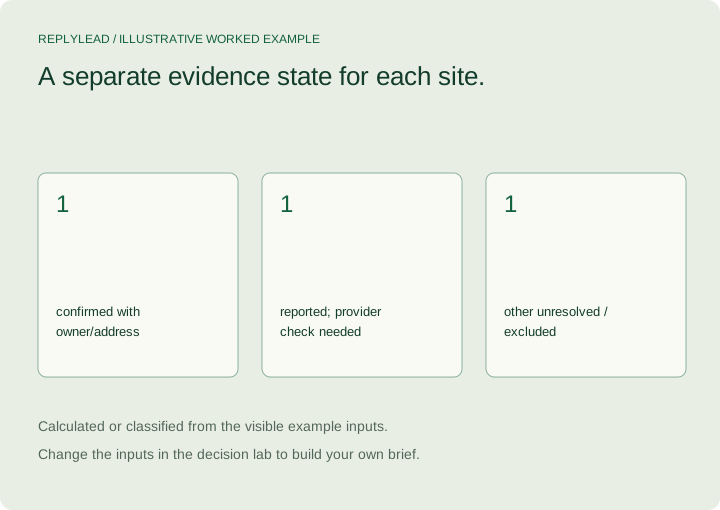
Three locations are not three ready sites
The illustrative branch list includes a headquarters address, an eastern branch with reported availability and a western branch whose service address is missing.
Keep evidence states separate
Only HQ has provider-confirmed feasibility. Reported availability at Branch East still needs a provider check. Branch West needs a valid service address and buying owner first.
Build a staged next step
Begin scope review for the confirmed site and export research tasks for the others. Do not infer current provider, service performance or renewal dates from an availability map.
03 / SELECT THE COMMERCIAL ROUTE
Different buyers.
Different first conversations.
Three adaptable telecommunications plays. Each connects a buying role, a verifiable reason to research, a useful asset and a handoff rule.
01Business connectivity
+
- Who buys
- IT or operations owners responsible for the specific business location.
- A reason to research
- A verified office opening or relocation makes connectivity planning relevant.
- Leave out
- Unserviceable addresses and assumptions that existing connectivity is inadequate.
- Bring something useful
- A site-readiness checklist covering location, timing, installation access, and technical requirements.
- Start the conversation
- Who is coordinating connectivity for the new location, and has the service scope been finalized?
- Accept the handoff when
- The buyer confirms the location and requirements and agrees to a feasibility review.
02Multi-site communications
+
- Who buys
- Central IT and operations teams coordinating several business locations.
- A reason to research
- A company announces branch expansion, consolidation, or a communications project.
- Leave out
- Independent franchises incorrectly treated as centrally purchased accounts and unsupported renewal assumptions.
- Bring something useful
- A site-by-site responsibility map with buying ownership and migration dependencies.
- Start the conversation
- Are communications decisions made centrally or by each location?
- Accept the handoff when
- The buyer explains account ownership and names the scope that can be reviewed.
03Channel partnerships
+
- Who buys
- Channel or business-development leaders at complementary service providers.
- A reason to research
- A provider publishes a partner program or a territory expansion relevant to your capabilities.
- Leave out
- Overlapping exclusivity commitments and territories outside delivery capabilities.
- Bring something useful
- A partner-fit matrix covering territory, service boundaries, customer ownership, and escalation.
- Start the conversation
- Who reviews partner coverage and the responsibilities for customer handoff?
- Accept the handoff when
- The partner confirms coverage fit and a commercial-review owner.
ReplyLead recommendations. Adapt the message to the actual evidence; these are not tested winning scripts. Download the three-play worksheet.
04 / KNOW WHAT THE SOURCE PROVES
Useful evidence.
Clear boundaries.
The source should change the account decision. Record its date and the field it actually supports; keep the missing information visible.
| Source or artifact | Use it for | Still needs confirmation |
|---|---|---|
| FCC availability map | Provider-reported broadband availability at locations | Not the installed service, contract terms, performance or confirmed delivery feasibility. |
| Provider feasibility review | Whether the requested service can be delivered at the address | Record the service, date and any installation conditions. |
| Customer site inventory | Service address, access conditions and buying owner | Billing and headquarters addresses may not be service locations. |
Reference: FCC National Broadband Map guide. Account-specific sources in this table are evidence to collect, not claims that a prospect has been verified.
FIRST-PARTY MEASUREMENT
2.12%Median unique replies per contacted lead.
81 campaigns with at least 500 contacted leads.
Know what the number measures.
ReplyLead's frozen August 12, 2026 extraction includes automatic replies and mixes client and internal programmes. It is a cross-campaign reference, not an industry target, positive-reply rate or meeting forecast.
For an industry cohort, separate human replies, positive replies, booked meetings, held meetings and sales-accepted opportunities. Keep the contacted-person denominator and maturity window consistent. A result from a different audience is not a substitute for your segment's evidence.
Inspect the benchmark definitions and datasetSource: ReplyLead campaign benchmark, checked 24 September 2026.
BEFORE YOU LAUNCH
The questions that
change the brief.
What does the telecom multi-site readiness mapper produce?
Separate provider-confirmed feasibility from reported availability. Turn a branch list into a site-by-site research and deployment brief. It exports your entered inputs, the resulting decisions and the next actions as a CSV working brief.
What qualifies a telecommunications lead for a sales handoff?
Record service location, required service, technical and commercial owners, feasibility status, deployment constraints, and the next review step. Keep contract details unknown until confirmed by the buyer.
Are the examples measured ReplyLead client results?
The annotated examples are illustrative planning cases. The 2.12% benchmark is separately identified first-party mixed-programme evidence with automatic replies included. No industry conversion rate is inferred from it.
How to use this field guide.
Choose a buying situation, work through the decision lab, and attach a source and date to the facts that drive the result. Confirm unresolved requirements with the appropriate owner before launch. The tool rules are visible in the worked example and produce a planning brief from your inputs; they do not verify accounts or predict campaign outcomes.
ReplyLead runs cold email and LinkedIn. Review the operating process, commercial terms and documented client examples when evaluating a managed program.
Where judgment still matters.
Broadband availability is not proof of actual provider usage, network performance, dissatisfaction, or a renewal date. Keep service addresses separate from billing and headquarters addresses. Verify delivery feasibility with the responsible provider before representing a location as serviceable.
The playbooks address B2B account acquisition. They do not establish contact permission or a legal determination. Apply your organization's contact, suppression and jurisdiction review before outreach.
Sources behind the method.
Checked 24 September 2026. Public references support the stated definitions. Account-specific facts still need a dated record from the buyer or an appropriate primary source. The planning choices and examples are ReplyLead recommendations.
- FCC National Broadband Map guide: Explains provider-reported availability; not contract, performance, or customer-adoption evidence.
- ReplyLead benchmark and methodology: the scoped cross-campaign statistic above.
- ReplyLead operating process: cold email and LinkedIn program context.
- Google sender guidelines: Authentication and sender requirements for personal Gmail recipients. Checked 24 September 2026.
- Yahoo sender best practices: Yahoo-specific requirements to review before a campaign; separate from account fit. Checked 24 September 2026.
- RFC 5321: SMTP: Transport acceptance is separate from inbox placement or a human response. Checked 24 September 2026.
- NIST Cybersecurity Framework: Reference vocabulary for vendor risk-management responsibilities; not a prospect diagnosis. Checked 24 September 2026.
- Census NAICS: Classification describes establishments; verify the actual business activity and buying unit. Checked 24 September 2026.
BUILD WITH REPLYLEAD
Bring the market.
Leave with a sharper brief.
Bring your target buyer, delivery boundaries and the working brief. Define the account evidence, message and sales handoff for your industry.
Discuss your telecommunications program