Lead generation for M&A firms. Start the right owner conversation.
Lead generation for M&A firms should help an advisory team find potential clients, understand their situation and agree a useful next conversation. ReplyLead runs the research, cold email and LinkedIn outreach, reply handling and booking. We recommend 3 separate checks before a handoff: company fit, the person's authority and their openness to an advisory discussion.
Are you winning a client, or working an existing mandate?
The person you contact should understand why your firm is approaching them.
Three different reasons for approaching an owner.
Advisory client origination.
Winning a sell-side advisory client
You want a business owner to consider appointing your firm. Research should reflect the sectors, business models, locations and transaction sizes your team can serve. The first discussion establishes the owner's objectives and whether an advisory relationship is relevant. It does not presume the company is for sale.
A USEFUL NEXT QUESTION
What decision is the owner considering, and why now?
Record: The owner's stated objective, timing and permission for the next conversation.
Buyer search for a represented seller.
Finding buyers for a signed engagement
You are identifying counterparties for a client you already represent. The research, permission to disclose information and next step are different. Use our business acquisition sourcing page to scope that search.
A USEFUL NEXT QUESTION
Which buyer criteria and disclosure boundaries has the seller agreed?
Record: The agreed search scope and what the advisor may share at each stage.
Acquisition target search.
Finding companies for an acquisition client
A buy-side search starts with the client's criteria and a clear explanation of whom you represent. It should not be blended into a campaign asking the same owner to hire you as a sell-side advisor. For investment-team searches, see private equity lead generation.
A USEFUL NEXT QUESTION
Which criteria must a company meet, and which can the buyer discuss?
Record: Required criteria, flexible preferences and exclusions, kept separate.
02 / EVIDENCE BEFORE ASSUMPTIONS
A sales trigger is a reason to research. It is not proof of exit intent.
An announcement or business change can make an approach more relevant. Separate the observable fact from the question you still need to ask. In particular, do not infer retirement plans from a person's age or assume a long-serving founder wants to leave.
A
A new executive joins
What you know: a published appointment, if current and attributable to the right company.
What remains unknown: whether ownership is changing, whether the founder is stepping back, and whether outside advice is wanted.
Useful next research: check the executive's role and the company's own explanation of the change.
B
The company is hiring or expanding
What you know: an open role or announced expansion. A job listing can also be a replacement, or remain online after recruitment ends.
What remains unknown: profitability, financing needs and any intention to sell.
Useful next research: connect the change to the firm's actual business model and your advisory experience. Avoid a generic retirement pitch.
C
An owner discusses succession publicly
What you know: what the owner said, in the context and on the date it was said.
What remains unknown: whether they want an external sale, a family transition, a management transition or no action now.
Useful next research: establish the stated objective before choosing a campaign angle. A relevant discussion still needs the owner's agreement.
1 / 3
ReplyLead's published process starts with target criteria and buying signals. The checks above are our recommended application to advisory outreach, not a model that predicts which owners will sell. See the managed outbound process.
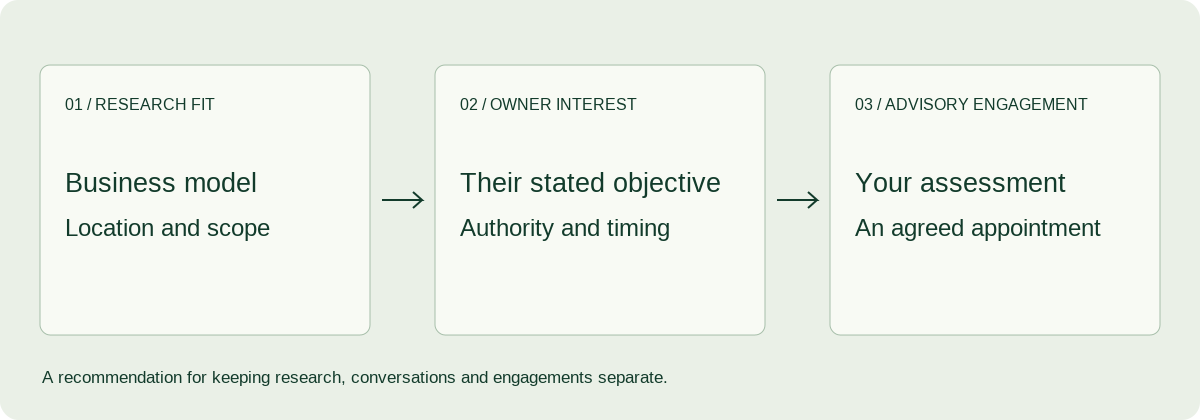
Research can establish a reason to approach. An owner conversation establishes interest. Your advisory process establishes an engagement.
FROM INTEREST TO COMMITMENT
How do you tell a serious seller from someone who only wants a valuation?
Look for the next step the owner is willing to take.
Mark Glazer's approach to owner readiness, shared 19 October 2026.
A request for a valuation tells you what someone wants to know. Willingness to move through an advisory process tells you more about their intent. Mark looks for an owner willing to meet, put an NDA and an engagement letter in place, and provide financial information that helps assess the business against a buyer's acquisition criteria.
That is what putting some skin in the game means here: committing time, agreeing the relationship and doing the work needed for a meaningful assessment. Your firm and the owner agree the engagement terms.
01 / TIME
Make time for a meeting
+
Discuss the owner's objective, timing and next steps. Willingness to meet is useful evidence; a meeting alone does not establish a sale mandate.
02 / CONFIDENTIALITY
Put an NDA in place
+
Establish how the parties will handle confidential information. Record willingness to sign separately from an NDA that is actually in place.
03 / ENGAGEMENT
Agree the advisory relationship
+
Willingness to agree an engagement letter distinguishes exploring an advisory relationship from simply requesting a number. Your firm agrees the scope and terms with the owner.
04 / INFORMATION
Provide financial information
+
Use the agreed confidential process to collect information the advisor needs to assess the business. Keep owner-provided figures separate from estimates found during research.
Connect the financial information to the buyer's buy box
A buy box is the buyer's acquisition criteria. Those criteria determine which information needs checking: for example, revenue or earnings range, business model, geography and the owner's intended transaction. An owner's financial information helps the advisor assess fit; it does not establish that a particular buyer will proceed.
Outreach can start the conversation. The advisory team establishes representation, handles confidential information and manages the sale process. Do not ask an owner to upload financial documents through a public lead-generation form.
These are practical readiness signals from Mark's approach, not a prediction of a completed sale. A step that has not been discussed remains unknown. An initial conversation can still be useful before all four commitments are established.
03 / THE CONVERSATION DESK
Would you hand this owner conversation to an advisor?
Use facts you have actually established. The result recommends a next action; it does not score the company, predict a sale or replace your firm's qualification standard.
RECOMMENDED NEXT ACTION
Start with what is known.
Check company fit, authority, openness and existing representation. Then record concrete commitments to the next steps. Unanswered questions stay unanswered; they are not failed qualification.
Keep the source and date with each research fact.
Record the owner's own explanation of what they want.
Do not label a company a potential seller solely because it fits your list.
This review stays in your browser. It is not attached to your inquiry and does not contain a real prospect record.
04 / HOW THE WORK IS DIVIDED
Owner outreach with a clear handoff.
ReplyLead runs the outbound work
We agree targeting, exclusions and messaging; research companies and relevant contacts; set up sending infrastructure; run cold email and LinkedIn; handle replies; and arrange conversations that meet the agreed criteria. Existing relationships and do-not-contact records belong in the campaign exclusions before launch.
Launch depends on the approved scope, usable contact data, sending readiness and agreed messaging. Our process includes mailbox warmup; a new campaign does not inherit an immediate launch promise.
Your firm owns the advisory relationship
Your advisors assess the situation, determine whether an engagement is appropriate, agree fees and representation, and handle valuation, diligence, negotiation and the transaction. Supplying a prospect list does not transfer those responsibilities.
A first meeting should arrive with the company, contact role, fit evidence, stated objective, timing, existing-advisor context and unanswered questions. Keep estimates separate from owner-confirmed information.
Measure the route to an engagement
Review conversations held, conversations your advisors accepted, engagement letters signed and attributable revenue under your agreement. Keep repeated conversations with the same company linked to one record. An interested reply is useful, but it is not a signed mandate.
Report why conversations did not progress: outside your focus, wrong authority, valuation-only curiosity, timing, existing representation or no permission to continue. This makes targeting improvements more specific than simply asking for more meetings.
A campaign brief your advisory team can use.
Start with the sectors and operating models you understand, the geographic scope, the size measure you use, and the situations your team wants to discuss. Specify whether size means revenue, EBITDA or another measure, its currency and whether it is estimated. Add categories to exclude and the questions you want answered before a handoff. Do not send confidential target names in this public form.
Our standard commercial model includes a monthly technology/infrastructure fee and an agreed revenue share. The fixed fee remains when nothing closes. For an advisory campaign, define in writing which advisory revenue is attributable, when it is counted and how existing relationships are handled. Do not assume the transaction purchase price is the fee basis. Review ReplyLead's published pricing model.
TALK TO REPLYLEAD
Build an owner-outreach campaign around your advisory focus.
Tell us which companies and owner situations your firm can serve. We will discuss targeting, exclusions and what should qualify for an advisor conversation.
Your inquiry is for a scope discussion. It does not authorize outreach to an owner, target company or investor.
We have not confirmed delivery yet. Please do not send the inquiry again while we wait.
How do you find owners who might hire an M&A advisor?
Start with companies your firm can serve, identify owners or authorized representatives, and approach them with a relevant reason to discuss their objectives. Research establishes fit; the owner's response establishes whether advisory support is relevant. Company age alone does not establish intent to sell.
How do you distinguish a valuation inquiry from a potential advisory client?
Ask what decision the valuation would help the owner make, then look for concrete commitments. Mark Glazer looks for willingness to meet, put an NDA and an engagement letter in place, and provide financial information so the business can be assessed against buyer acquisition criteria. Record willingness separately from completed steps; your advisor determines whether an engagement makes sense.
Can outreach work alongside referrals and existing relationships?
Yes, if exclusions and relationship ownership are agreed before launch. Compare proposed companies and contacts with your CRM, current clients and active conversations. Route existing relationships back to the person who owns them rather than starting a separate approach.
What happens when an owner already has an advisor?
Record the representation context and let your advisory team determine the appropriate route. An exclusive engagement is not permission to bypass another advisor. Do not describe that owner as an unrepresented prospect.
Do you guarantee signed mandates or completed transactions?
No. ReplyLead manages agreed outbound activities and qualifying conversations. Your firm assesses suitability, wins the engagement and manages the transaction. A reply, a meeting, a signed engagement and a completed deal are separate outcomes.
What should we prepare before discussing a campaign?
Bring your sector and geographic focus, the business models you understand, the size measure you use, exclusions, and the questions that make an owner conversation useful. You can start without sharing confidential company names.
When this approach is not the right fit.
This page is for firms seeking advisory clients through managed outbound. It is not a valuation service, a marketplace of businesses already for sale or a promise of signed engagements. Firms without an agreed target market, a clear advisory proposition or capacity to handle owner conversations should define those first. If you already represent a seller and need counterparties, use the acquisition sourcing workflow.
Service details and scope.
ReplyLead's delivery process explains research, infrastructure, reply handling and booking. Published commercial terms explain the fixed infrastructure fee and revenue-share model. Both checked 19 October 2026. The seller-readiness framework reflects Mark Glazer's owner-provided perspective, shared 19 October 2026. The conversation desk is practical guidance created for this page; it is not a customer case study or a validated prediction of transaction readiness.