REPLYLEAD RESEARCH / EMAIL INFRASTRUCTURE
Email provider market share,
with the denominator visible.
A receiving-domain study drawn from ReplyLead contact data. Explore the evidence, choose a dated snapshot, and cite the population you actually mean.
By Mark Glazer, ReplyLead | Updated 25 September 2026 | Editorial standards
RESEARCH NOTES / EXPLORER
One finding. A checkable source.
Build a precise citation
Pick a snapshot and measure. The result keeps the count, denominator and observation date together.
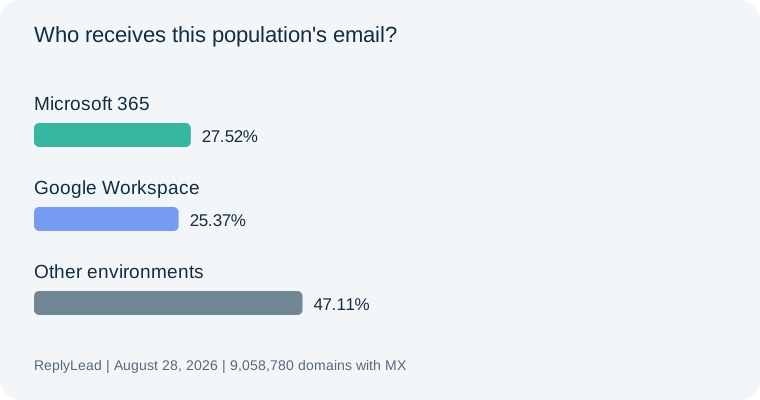
2,492,673 / 9,058,780 domains = 27.52%.
Citation includes a link to this research.
Download dated CSV | Download JSON and limitationsThe two snapshots have different populations and classification logic. Switching between them is not a market-share trend comparison. Both predate this page update; neither is a fresh September DNS scan.
Which provider receives your audience's email?
A population share cannot identify an individual company. Use the existing lookup to inspect its current public MX records. DNS reveals routing, not inbox placement or an individual mailbox's validity.
RESEARCH NOTES / TABLE
The complete July provider distribution
This table uses one retained snapshot and one denominator throughout: 8,384,502 domains with MX from 9,847,723 resolved domains, observed 19 July 2026. Its 30 category counts sum to the denominator. August Microsoft and Google counts are not inserted into this table.
| Receiving classification | Domains | Share of 8,384,502 |
|---|---|---|
| Microsoft 365 | 2,387,891 | 28.48% |
| Google Workspace | 2,166,677 | 25.84% |
| Smaller and regional hosts | 1,348,835 | 16.09% |
| Self-hosted (own domain) | 1,241,027 | 14.80% |
| Proofpoint | 307,368 | 3.67% |
| Hostinger | 138,851 | 1.66% |
| IONOS / 1&1 | 135,724 | 1.62% |
| Zoho | 97,967 | 1.17% |
| GoDaddy | 89,040 | 1.06% |
| Mimecast | 74,566 | 0.89% |
| Barracuda | 72,239 | 0.86% |
| Rackspace | 55,032 | 0.66% |
| OVH | 49,157 | 0.59% |
| Yahoo / AOL | 45,185 | 0.54% |
| Titan | 38,198 | 0.46% |
| cPanel-style host | 27,371 | 0.33% |
| Yandex | 16,490 | 0.20% |
| Proton | 14,770 | 0.18% |
| Cisco / IronPort | 12,431 | 0.15% |
| Trend Micro | 11,506 | 0.14% |
| Fastmail | 11,287 | 0.13% |
| Sophos | 10,674 | 0.13% |
| Apple iCloud | 10,000 | 0.12% |
| Amazon SES / WorkMail | 7,268 | 0.09% |
| Mail.ru | 6,656 | 0.08% |
| Symantec / Broadcom | 3,081 | 0.04% |
| Hushmail | 2,093 | 0.02% |
| Bluehost / Newfold | 1,679 | 0.02% |
| Forcepoint | 1,428 | 0.02% |
| Fortinet | 11 | 0.00% |
The historical classifier checks named gateways before mailbox providers. The own-domain category is a hostname heuristic, not proof of who operates the server. The long tail contains hosting services and routing intermediaries that were not named by this classifier.
RESEARCH NOTES / BYSIZE
A separate company-size exploration
In the retained size join, gateway-classified domains account for 5.33% of the 1-10 employee band and 18.06% of the 251-1,000 band. That is an observed association in this snapshot. It does not establish a bounce rate, a security-product recommendation or an effect on reply rates.
| Recorded employee band | Domains | Gateway | Microsoft | |
|---|---|---|---|---|
| 1-10 | 4,061,509 | 5.33% | 28.91% | 28.14% |
| 11-50 | 1,150,584 | 7.89% | 37.42% | 26.77% |
| 51-250 | 605,526 | 13.27% | 42.45% | 22.01% |
| 251-1000 | 173,891 | 18.06% | 40.70% | 17.89% |
| 1000+ | 100,297 | 15.75% | 34.81% | 18.77% |
| unclassified | 2,292,695 | 2.53% | 18.12% | 23.22% |
6,091,807 of 8,384,502 domains have a size band (72.66%); 2,292,695 are unclassified. Category subtotals in this separate join differ from the provider snapshot: gateway counts total 492,919 here versus 493,304 there. We retain this as exploratory evidence and exclude it from the primary citation tool until the historical join can be reconciled. Missing size is visible rather than silently removed.
Why industry statistics are absent
The archived investigation found missing or inconsistent industry labels. We do not publish an industry reply rate, reachable-company count or market size from a contact-database headline. A reliable industry cut needs a defined classification, deduplicated population and an explicit unknown category.
RESEARCH NOTES / GATEWAYS
A gateway is not the mailbox behind it
A domain can route through a service before reaching its mailbox host. MX classification identifies the visible receiving layer. A Mimecast or Proofpoint result does not reveal whether the mailbox behind it is Microsoft 365, Google Workspace or something else. The two layers should not be counted as independent customers.
The August archive contains 584,271 domains (6.45%) in its broad intermediary subtotal. That list includes Cloudflare Email routing. We therefore label it identified gateways and routing intermediaries, not a security-gateway market share. The July nine-gateway classifier is different; its total is 493,304 of 8,384,502 (5.88%).
Hostname frequency answers a different question
The August retained aggregates contain 2,483,157 distinct Microsoft MX hostnames and 7,312 Google hostnames. Ranking individual hostnames can fragment a provider across many entries. Provider classification and hostname popularity are different measurements; neither should be substituted for mailbox seats or customer counts.
What this changes in a campaign review
Separate the recipient's receiving environment from the sender's authentication and message content. Examine actual delivery and reply outcomes for each campaign before deciding what changed. This DNS study measures infrastructure prevalence only. For the separate outcome study, read reply rates by recipient email provider; for campaign denominators, read ReplyLead cold email benchmarks.
RESEARCH NOTES / METHOD
How the numbers were checked
- Start from the retained July provider aggregate, August provider-research aggregate and separately generated size join. The population originates in email domains present in contact records.
- Keep July's 9,847,723 resolved domains and 8,384,502 with MX separate from August's 10,241,042 resolved domains and 9,058,780 with MX.
- Recompute each percentage as its category count divided by its stated denominator. Verify that July provider categories partition its with-MX population and August resolution statuses sum to its resolved population.
- Publish observation dates, units and population counts in every CSV row. Preserve missing classifications and explain changes in grouping.
- Validate retained aggregates; do not imply that the currently expanded operational database reconstructs those historical cohorts. This release is a presentation and reconciliation of snapshots, not a new collection.
One stored representative MX hostname per domain was used for classification. This does not represent all backup MX hosts or validate mailbox availability. A DNS address record without MX can provide a fallback candidate under RFC 5321; it does not establish an SMTP listener. A null MX is a distinct no-mail declaration under RFC 7505.
The August resolution archive lists 625,877 domains with no MX but an address record, 396,857 NXDOMAIN results, 74,427 with no records and 85,101 unresolved. Those statuses are not all equivalent to undeliverable mailboxes.
RESEARCH NOTES / LIMITS
What these data cannot establish
- Not a representative business census. The population comes from contact data and inherits vendor selection and prospecting biases. It includes personal email domains, subdomains and multiple domains belonging to one organization.
- Not mailbox market share. A domain with two people and a domain with ten thousand people each contribute one observation. Email-client open statistics, paid seats and domains answer different questions.
- Not a September reading. MX records change. Observation dates remain July and August 2026 even though this page was revised in September.
- Not a performance prediction. Provider prevalence does not establish inbox placement, bounces, replies, meetings or revenue. Use campaign outcomes with their own denominators.
- Not a growth series. Population and classifier changes mean July and August figures are not a controlled measure of provider gains or losses.
- Not industry-level evidence. We have not established a complete, reconciled industry population from these snapshots.
- Not a raw-data replication. This release validates retained aggregates. The source database has since expanded; exact historical cohort reconstruction remains a separate task.
RESEARCH NOTES / CITE
Reuse the evidence without losing its context
Use the citation explorer to keep the count, denominator, date and scope together. The aggregate exports and chart are licensed CC BY 4.0. Attribute ReplyLead, link this canonical research page and identify the observation date. Do not turn a contact-domain share into a statement about all businesses.
Dated provider counts (CSV) | Research data and limitations (JSON) | August provider chart (SVG)
Correction record: 25 September 2026
The earlier provider table and downloads mixed August Microsoft and Google counts with July categories. This revision restores a coherent July distribution, separates the August summary, corrects the intermediary label, removes unsupported delivery predictions and documents the size-join discrepancy. Earlier external archive versions may retain the superseded presentation; use this dated release for the corrected figures.
RESEARCH NOTES / SOURCES
Primary sources and check dates
- RFC 5321, section 5.1: MX routing and address-record fallback; not proof of an SMTP listener. Checked 25 September 2026.
- RFC 7505: A null MX explicitly declares no email service. Checked 25 September 2026.
- Google Workspace MX documentation: Published receiving-record configuration for Google Workspace. Checked 25 September 2026.
- Microsoft 365 external DNS records: Published Microsoft 365 receiving-record configuration. Checked 25 September 2026.
- Cloudflare Email Service documentation: Email routing is a receiving intermediary; it is not evidence of a dedicated security gateway. Checked 25 September 2026.
RESEARCH NOTES / NEXT-STEP
Use the finding in your own outbound plan
ReplyLead runs cold email and LinkedIn programmes. Receiving-provider research is one input to list segmentation; it does not replace buyer relevance, qualification or campaign measurement.
Start with a domain, then the campaign.
Inspect a company's current receiving environment, read the campaign measurement method, or discuss a programme with clear qualification and reporting.