COLD EMAIL TOOL / SENDING DOMAINS / RUNS IN YOUR BROWSER
Domain age checker for cold email
This domain age checker reads each domain's registration date from its registry over RDAP, the protocol ICANN describes as the replacement for WHOIS, and turns it into the first day the domain can send a cold email campaign. ReplyLead's rule: a sending domain must be at least 30 days past its registration date, and its mailboxes must have warmed for at least 14 days, so a domain can send on the later of those two dates. Paste up to 25 domains to see each one's age, registrar, expiry date and launch date.
2 of 6 domains can send today. 3 more can send by 1 December 2026. 1 cannot send: not registered.
- harborquote.exampleRegistered 13 Jul 2020 / Example Registrar, Inc.6 years, 3 monthsregistry ageReadytoday
Can send today: 30 days old since 12 August 2020, and its mailboxes have warmed for 14 days or more.
- yardplanner.exampleRegistered 13 Oct 2026 / Example Registrar, Inc.21 daysregistry ageNot yet17 Nov 2026
Can send from 17 November 2026, in 14 days, when a 14-day warmup that starts today ends. It turns 30 days old on 12 November 2026.
- millcrestdata.exampleRegistered 24 Oct 2026 / Example Registrar, Inc.10 daysregistry ageNot yet23 Nov 2026
Can send from 23 November 2026, in 20 days, when it turns 30 days old.
- quietledger.exampleRegistered 1 Nov 2026 / Example Registrar, Inc.2 daysregistry ageNot yet1 Dec 2026
Can send from 1 December 2026, in 28 days, when it turns 30 days old.
- plantfloorops.exampleRegistered 10 Aug 2015 / Sample Names LLC11 years, 2 monthsregistry ageReadytoday
Can send today: 30 days old since 9 September 2015, and its mailboxes have warmed for 14 days or more.
- The registration ends on 30 November 2026, in 27 days. Confirm it renews; when a domain lapses, its mailboxes stop with it.
- Moved to a new registrar on 15 October 2026. If it changed owners then, its age is not your sending history.
- harborqoute.example-no registry dateFailscannot send
The registry has no record of it: the domain is not registered. Check the spelling.
turns 30 days oldwarmup endscan send
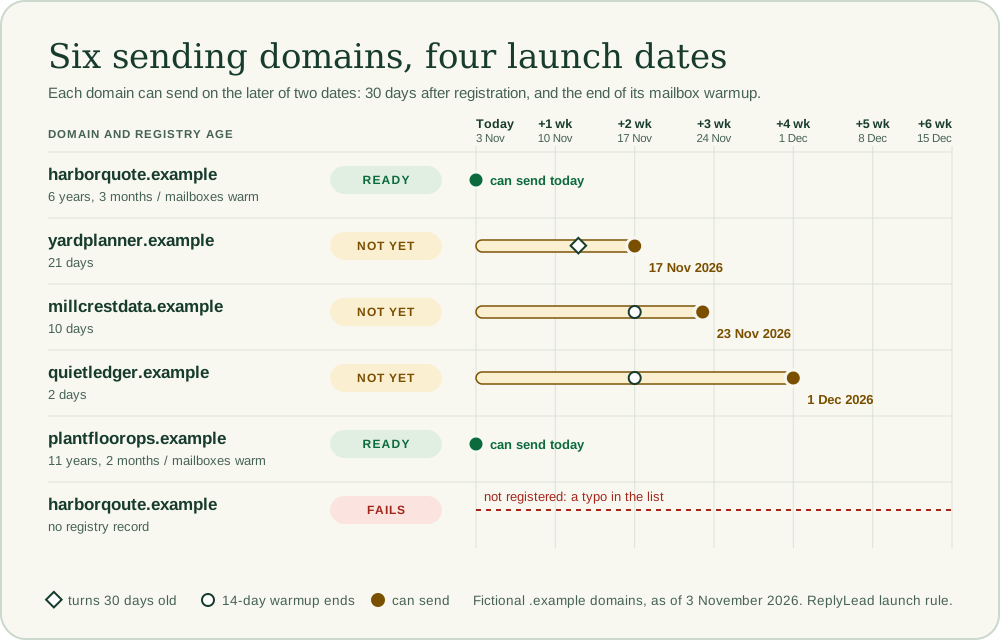
A sending domain can send on the later of two dates.
The first date comes from the registry: 30 days after the domain was registered. The second comes from your mailboxes: the day their warmup has run for the length you chose, 14 days at least. Whichever falls later is the first day ReplyLead would let the domain send a campaign email to a prospect.
The checker draws both on a six-week runway that starts today. In the example, two older domains already have warm mailboxes and can send now. A domain bought three weeks ago turns 30 days old in nine days, then waits five more for its warmup to end. Two domains bought this month wait for their 30th day, which falls after the warmup ends. A misspelled name fails because no registry has a record of it, the same result a typo in your own list would get.
What each result means, and where the rule comes from.
Every domain ends in one of four results. Ready and Not yet come from the two dates. Fails means the domain cannot carry email at all. Unproven means the registry gave nothing this page can read, and ReplyLead does not launch on a domain whose age it cannot prove.
| Check | What triggers it | Rule from |
|---|---|---|
| Registration date | The registry's registration event. A later re-registration event restarts the age, and the result says so. | RFC 9083 |
| 30-day age | Not yetuntil the domain is 30 days past its registration date. | ReplyLead launch rule |
| Mailbox warmup | Not yetuntil the warmup has run for the chosen length, 14 days at least. Not started counts from today. A switch on each domain marks its mailboxes as already warm. | ReplyLead launch rule; email warmup |
| Can send | Readywhen both dates have passed. | ReplyLead launch rule |
| Not registered | FailsThe registry answers that it has no record of the name. Usually a typo. | Registry answer |
| Expired or being deleted | FailsThe expiry date has passed, or the status shows a redemption period or pending delete. | ICANN status codes |
| On hold | FailsA client hold or server hold. ICANN: the registry does not activate the domain in the DNS, so it will not resolve. | ICANN status codes |
| No name servers | FailsThe status is inactive: no name servers are delegated, so the domain will not resolve. | ICANN status codes |
| Ends within 60 days | A note to confirm the renewal. When a domain lapses, its mailboxes stop with it. | This page |
| New registrar | A note when the domain moved to a new registrar in the last 90 days. A transfer keeps the registration date, so a bought domain keeps its age but not your sending history. | RFC 9083 transfer event |
| No readable record | UnprovenThe registry has no RDAP service a browser can read (.co, .us, .me and many country codes), or it did not answer within 10 seconds. | IANA bootstrap file |
Why ReplyLead waits 30 days and 14.
The two numbers are ReplyLead's operating rule for every campaign it launches, not a threshold Google or Microsoft publishes. ReplyLead's infrastructure guide says it plainly: we do not claim that a provider automatically trusts a domain because of its registration date.
The rule is caution about first impressions. A domain registered last week and a mailbox with no sending history give receivers nothing to judge, and the first emails a prospect sees from a new domain should not also be its first emails ever. Google's sender guidelines tell bulk senders to increase sending volume slowly to avoid delivery problems; the age gate and the warmup are where ReplyLead's slow start begins.
The warmup floor is 14 days. ReplyLead's warmup guide plans a ramp of 2 to 2.5 weeks, and the checker lets you set 18 or 21 days if your own plan is longer. Buying the sending domains early is the cheapest fix: a domain bought a month before the campaign is ready by the time its mailboxes are.
What ReplyLead's own domain data shows about age.
4.41% against 3.19%, with only four older domains behind the higher figure.
ReplyLead read the registry registration date of 186 of its sending domains and compared counted replies by age. Domains registered 10 or more years earlier showed 4.41% unique replies per contacted lead; younger domains showed 3.19%. Only four of the older domains had sends, and audiences, programmes and mailbox providers were not matched, so the aged-domain benchmark reports an association, not an effect of age.
Age is also not ownership. When someone buys an aged domain, the registry keeps the original registration date, and nothing in that date shows who sent what before. That is why the checker notes a move to a new registrar in the last 90 days, and why ReplyLead warms a bought domain's mailboxes like any other.
RDAP: the registry's own record, read from your browser.
RDAP is the Registration Data Access Protocol. ICANN describes it as the replacement for the WHOIS protocol, and RFC 9083 defines how a registry reports a domain in JSON, including a registration event (the object instance was initially registered) and a transfer event (moved from one registrar to another). RFC 9224 defines how a client finds the registry server for a name through IANA's bootstrap file.
The checker follows that path. It reads the bootstrap file, asks each domain's registry for its record, at most 4 at a time, and waits up to 10 seconds for each answer. The questions go from your browser to the registries; ReplyLead's servers never see the list.
Some registries publish no RDAP service a browser can read. On 3 November 2026, IANA's bootstrap file listed RDAP servers for 1,203 top-level domains, with none for .co, .us or .me. For those names the checker says Unproven rather than guess; the creation date is in your registrar account or the registry's WHOIS.
To plan new domains rather than check existing ones, the cold email domain generator suggests names and checks through RDAP whether each one is still unregistered.
How this checker was built, and what it does not know.
The rule is the one ReplyLead applies before any campaign starts: the registry registration date plus 30 days, and the warmup start plus its length, whichever is later. Dates are counted in whole UTC days. A domain registered at 11 PM counts that day as day one, so the 30th day can arrive a few hours earlier or later than in your time zone.
The same script draws the example on this page, the figure and every result you check, and its tests run against real answers saved from the .com, .org, .io, .xyz and .app registries.
The checker cannot see your mailboxes. The warmup date is what you enter, and Not started assumes the warmup begins today. It also cannot see reputation: it does not read DNS records, test inbox placement or predict replies. The deliverability checker reads SPF, DKIM and DMARC, and the mail provider lookup shows who hosts a domain's mail.
Analytics records only counts, such as how many domains were checked and how many can send. The CSV download is built in your browser.
Want ReplyLead to set up the domains and run the campaign?
ReplyLead runs cold email and LinkedIn outreach for B2B companies: list research, copy, sending infrastructure and reply handling, with your team taking the sales conversations. ReplyLead sets up each client's sending domains and mailboxes and applies the same two dates before any campaign starts. Campaigns run on dedicated sending infrastructure that carries a monthly technology fee, plus an agreed share of the revenue you close from the work. In a period where nothing closes, no revenue share is owed and the fee remains.
Pricing and how the work is split have the details.
Book a conversation with ReplyLead.
Loading available meeting times...
Domain age questions.
How old should a domain be before you send cold email from it?
ReplyLead waits until a sending domain is at least 30 days past its registration date and its mailboxes have warmed for at least 14 days, then launches on the later of the two dates. That is ReplyLead's own operating rule, not a threshold Google or Microsoft publishes, and a domain's age alone does not make a mailbox provider trust it.
How do I check how old a domain is?
Read the registration date from the domain's registry. RDAP, which ICANN describes as the replacement for the WHOIS protocol, publishes it as a registration event. This checker asks each registry directly from your browser, for up to 25 domains at a time, and shows the age, registrar, expiry date and the first day each domain can send.
Do aged domains get better cold email reply rates?
In ReplyLead's audit of 186 sending domains, domains registered 10 or more years earlier showed 4.41% unique replies per contacted lead, against 3.19% for younger domains. Only four older domains had sends, and the audiences, programmes and mailbox providers were not matched, so the audit shows an association, not an effect of age.
If I buy an aged domain, can I skip the warmup?
No. The registration date shows how long the name has existed, not how long you have sent email from it or what was sent before. ReplyLead still warms every new mailbox for at least 14 days. A recent move to a new registrar is often the sign of a purchase, so the checker notes registrar transfers from the last 90 days.
Why does the checker say a domain's age is unproven?
Its registry publishes no RDAP record a browser can read, which is the case for .co, .us, .me and many country-code domains, or the registry did not answer in time. ReplyLead treats a domain whose age it cannot prove as not ready; read the creation date in your registrar account instead.
Is domain age the same as sender reputation?
No. Reputation comes from how receivers judge the mail a domain sends: authentication, bounces, complaints and replies. Age is one fact a registry publishes. The deliverability checker on this site reads a domain's SPF, DKIM and DMARC records, which matter from the first email.
Does this checker store the domains I enter?
No. Each lookup goes from your browser to the registry's RDAP server, so the list never reaches ReplyLead's servers. Analytics records only counts, such as how many domains were checked and how many can send.
When this checker does not apply.
It answers one question for cold email: can this domain start sending a campaign yet, under ReplyLead's rule. It does not judge a domain's reputation, history or search value, and a domain that is Ready can still land in spam if its authentication or its list is wrong.
It reads registries that publish RDAP to browsers. For .co, .us, .me and many country-code domains it reports Unproven, and the registration date has to come from the registrar account. It checks 25 domains at a time; run larger sets in batches.
Sources and check dates.
- ICANN: Registration Data Access Protocol (RDAP). Supports: RDAP was created as the replacement for the WHOIS protocol. Checked 3 November 2026.
- RFC 9083, JSON Responses for the Registration Data Access Protocol (June 2021). Supports: the registration, reregistration and transfer event definitions the checker reads. Checked 3 November 2026.
- RFC 9224, Finding the Authoritative Registration Data Access Protocol (RDAP) Service (March 2022). Supports: how a client finds the registry server for a domain through IANA's bootstrap file. Checked 3 November 2026.
- IANA RDAP bootstrap file for domain names. Supports: 1,203 top-level domains with an RDAP server, none for .co, .us or .me. Read 3 November 2026.
- ICANN: EPP Status Codes, what they mean. Supports: a domain on client hold, or inactive without name servers, will not resolve; pending delete follows 30 days in redemption. Checked 3 November 2026.
- Google: Email sender guidelines. Supports: increase sending volume slowly to avoid delivery problems. Checked 3 November 2026.
- ReplyLead pages: the aged-domain benchmark (186 domains; 4.41% and 3.19%), the email warmup guide (2 to 2.5 week ramp), cold email infrastructure (no claim that age alone earns trust) and the domain generator. Read 3 November 2026.