Demand generation vs lead generation: the real difference
Updated 24 September 2026 // by Mark Glazer, ReplyLead // direction of motion, not marketing vocabulary
- 13dimensions compared side by side
- 7questions in the prioritisation tool
- 115outbound campaigns in our measured book
- 2.12%median campaign reply rate per contacted lead (81 campaigns with 500+ leads)
Demand generation creates awareness and preference, so buyers understand the problem and remember you. Lead generation creates or captures identifiable demand: it turns interest into a named person or account your team can work directly. That is why lead generation can be counted: across the 81 of our 115 outbound campaigns that contacted 500 or more leads, the median campaign reply rate was 2.12% per contacted lead, while demand generation is judged with attribution models.
Demand generation
Builds awareness, preference and demand
Content, ads, brand, community and events for an audience you mostly cannot name - and nurture, retargeting and account-based programmes aimed at buyers you already know. Producing the name is not its job. Measured with models.
Lead generation
Creates or captures identifiable opportunities
Choosing named, ICP-fit accounts and opening the conversation directly, or capturing the hand that goes up. Every result is a record, which is also the only thing it can be judged on. Measured with counts.
Between them sits the identification line: the point where anonymous demand becomes a known person or account. Lead generation is defined by that crossing. Demand generation runs on both sides of it. They are not rivals for one budget line - they are different machines with different timelines, cost structures and measurement, and the question worth answering is which one is your binding constraint this quarter.
Why the two get confused
Three reasons, all structural. Both end in the same word - pipeline - so vendors of each freely borrow the other's vocabulary. Both produce things called "leads", even though a demand-gen lead (someone who downloaded a guide) and a lead-gen lead (a named prospect who answered an outreach message) are at completely different funnel depths. And agencies routinely sell one under the other's label - a lead generation services buyer discovers this the moment a "lead generation" proposal turns out to be a content-and-ads retainer. The six-provider-type map on that page exists partly to catch exactly this switch.
The two machines, side by side
| Demand generation | Lead generation | |
|---|---|---|
| Mechanism | Pull: content, ads, SEO, brand, community | Push: outreach to named, ICP-fit prospects |
| Who you reach | Whoever is looking, or can be made to look | Exactly who you choose, looking or not |
| Timeline | Quarters to compound; durable once built | Weeks - bounded by infrastructure warmup, not by brand |
| Cost structure | Retainer plus media spend; scales with budget | Infrastructure plus execution; scales with mailbox capacity |
| Measurement | Attribution-modelled; blended signals | Direct: sends, replies, meetings - publishable denominators |
| Wins when | Large market, category being educated, time to build | Defined ICP, pipeline needed this quarter, ACV carries outreach |
| Primary objective | Make the problem, and your name, familiar - before buyers are in market and while they decide | Produce a named contact who will hold a conversation now |
| Buyer awareness | Works at any level: builds it where there is none, reinforces it where there is | Works with whatever awareness exists, including none |
| Stage of journey | Mostly before the identification line, but not only: nurture, retargeting and account-based work run after it too | The crossing itself, and it can move a buyer there directly from any earlier stage |
| Channel types | Search and social content, paid media, PR, podcasts, communities, events | Cold email, calling, LinkedIn outreach, forms, chat, gated assets, sales-led events |
| Gated or ungated | Mostly ungated on purpose: a gate suppresses the reach that is the point | Gated or direct by definition: the identity is the deliverable |
| Sales involvement | None while the audience is anonymous; in account-based work it runs alongside sales on named accounts | Immediate: the output is a conversation sales owns from the first reply |
| Characteristic failure | Audience and applause with no identifiable pipeline, defended by modelled attribution | Volume of contacts nobody wanted: activity that is measurable and still worthless |
Where the line actually falls
Most comparisons split the two by funnel stage: demand generation is top of funnel, lead generation is middle and bottom. That is tidy and it is wrong often enough to cost money, because it implies a buyer has to pass through demand generation to reach lead generation. They do not.
The boundary worth organising around is the identification line: the point where anonymous demand becomes a known person or account that sales or marketing can work directly. Lead generation is defined by that crossing - its job is to create or capture an identifiable opportunity, and it is judged on whether one exists. Demand generation operates on both sides of the line, and which side depends on the channel and the strategy: brand, content, community and broad paid reach work an audience you cannot name, while nurture, retargeting, account-based programmes, field events and customer marketing work people whose identity you already have. What changes at the line is not whether demand generation is allowed to run. It is what each machine is accountable for: after the crossing, demand generation is still building preference, and lead generation is still answerable for the named opportunity.
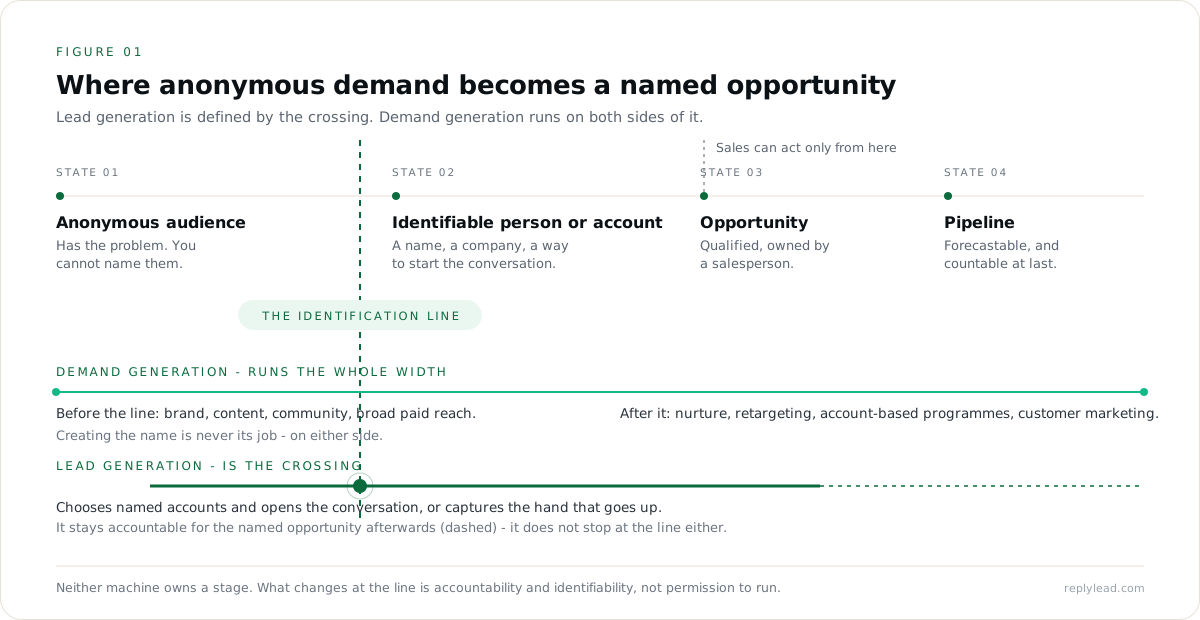
Two consequences follow, and they are the reason this page exists. First, a company with no brand and no audience can still produce qualified conversations this quarter, because outreach does not require prior awareness - it requires a defined ICP and deal economics that carry the cost of a conversation. Second, a company with a large, engaged audience can still starve, because nothing in its system asks anyone to identify themselves. Those are opposite problems and they are treated by opposite machines.
Same channel, different job
The channel is not the category. Almost every channel can run either machine, and the same budget line can produce awareness or conversations depending only on how it is implemented. This is where most "demand gen vs lead gen" arguments are actually happening without anyone saying so: two teams using the same tool for different jobs and reporting on different numbers.
| Channel | Run as demand generation | Run as lead generation | The tell |
|---|---|---|---|
| SEO and content | Ungated explainers that win the category's questions and get cited; success is reach and familiarity | Comparison, pricing and alternatives pages that route to a form or a booking link | Is there anything to fill in? Ungated is demand, a form is capture |
| Posting, commenting, executive presence, community building against an audience you do not own | Connection and message sequences to a named account list, or lead-gen form ads | Did you choose the individual recipient, or did they choose to look? | |
| Paid media | Broad reach and video against a category audience, judged on cost per reach and recall | Search ads on in-market intent keywords and retargeting, judged on cost per identified lead | Are you buying attention or buying a form fill? |
| Webinars and events | Open sessions, no registration wall, clipped and distributed afterwards for reach | Registration required, list worked afterwards by a person | The registration wall is the entire difference |
| A newsletter to an audience that opted in, building familiarity over months | Cold outreach to named prospects who never opted in, expecting a reply | Who built the list, and did the recipient choose to be on it? | |
| Podcasts and video | Being useful to a broad audience, sponsorship, guesting; unmeasurable individually | Interviewing your own target accounts, which is outreach wearing a microphone | Is the guest list your ICP list? |
The economics, honestly
Demand generation is an asset play: spend accumulates into content, rankings and brand memory that keep producing after the invoices stop - but the compounding is slow, the attribution is modelled rather than observed, and the budget scales with media prices you do not control. Lead generation is a flow play: output is roughly linear in capacity - list quality times sending volume times reply rate - which makes it deterministic, fast to start and easy to audit, but it produces only while it runs. The honest corollary cuts both ways: demand-gen vendors overpromise speed, and lead-gen vendors overpromise durability. Budget accordingly: flow to hit this year's number, asset to make next year's cheaper.
Which comes first?
Three questions settle the weighting. How defined is your ICP? A nameable market of thousands of accounts favours going to them directly; a broad horizontal market favours pulling. How soon does pipeline have to exist? Weeks means outbound - a warmed sending infrastructure produces measurable replies inside a month, which no content programme can promise. What does your deal carry? Outreach economics need deal sizes that support per-conversation cost (the arithmetic is on lead generation services); demand-gen economics need volume enough for statistical ad optimisation. Early-stage B2B with a clear ICP almost always sequences outbound first, then reinvests revenue into demand - because outbound validates the message demand-gen will later scale.
The same three questions as a decision table. Each row is one test; the column that wins more rows is the machine to fund first.
| Test | Fund lead generation first when | Fund demand generation first when |
|---|---|---|
| ICP definition | The market is a nameable list of thousands of accounts you can reach directly | The market is broad and horizontal, and buyers have to be pulled in |
| Time to pipeline | Pipeline is needed in weeks: warmed sending infrastructure produces measurable replies inside a month | Quarters are available for content, rankings and brand to compound |
| Deal economics | The deal size carries a per-conversation cost | Volume is large enough for statistical ad optimisation |
Default sequence for early-stage B2B with a clear ICP: outbound first, then reinvest closed revenue into demand generation, because outbound validates the message that demand generation later scales.
Which should you prioritise? Answer seven questions
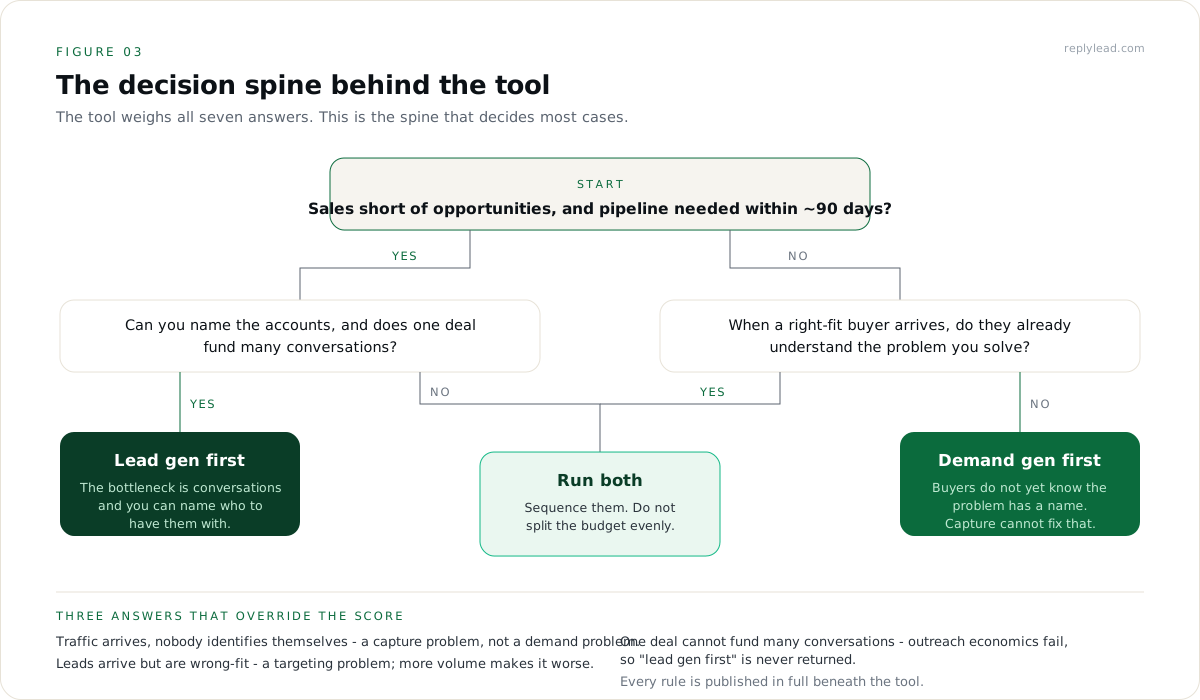
The tool below asks about conditions you can observe today, not about ambition. It applies fixed rules, published in full underneath it, and returns one of three answers: demand generation first, lead generation first, or run both. Your answers are not sent anywhere or stored (page analytics record only that the tool was used, never your answers), and there is no form to fill in to see the result. If you would rather not use it, the same rules are in the table below and the decision spine is in Figure 3.
Demand gen vs lead gen: which should you prioritise?
Seven questions about conditions you can observe today. Deterministic rules, published in full below. No signup; your answers are not sent or saved.
Answer the seven questions to see which machine to fund first. The rules are published in full below the tool.
The exact rules this tool applies
Each answer adds points to one side. The verdict is the difference between the two totals: a lead by two or more points decides it, anything closer returns run both. One guard overrides the score: if a single deal cannot fund many conversations, lead generation first is never returned, because outreach economics do not work at that deal size.
| Question | Answer | Effect |
|---|---|---|
| 1. Pipeline needed in ~90 days | Yes / No | Lead +2 / Demand +1 |
| 2. Accounts are nameable | Yes / Roughly / No | Lead +2 / Lead +1 / Demand +2 |
| 3. Inbound enquiries today | Steady / A few / None | Lead +1 / no effect / Demand +1 |
| 4. Buyer understands the category | Yes / No | Lead +1 / Demand +2 |
| 5. Sales has enough opportunities | Yes / No | Demand +2 / Lead +2 |
| 6. Deal size carries a conversation | Yes / No | Lead +1 / Demand +1, and blocks "lead gen first" |
| 7. Where it breaks | Unknown / Anonymous / Wrong-fit | Demand +2 / Lead +1 / Lead +1 |
Diagnose the symptom before choosing the machine
Most teams do not have a demand generation problem or a lead generation problem in the abstract. They have a specific symptom, and the symptom names the machine. This table is the diagnostic we run before recommending anything, including before recommending ourselves.
| If you see | The likely problem | Check this first | What treats it |
|---|---|---|---|
| Traffic and engagement, but almost no identifiable pipeline | Capture, not demand. The audience exists and nothing asks it to identify itself | Count the paths on your site that end in a named person. Many sites have exactly one, buried | Lead generation: routes, calls to action and outreach that convert existing attention into records |
| Sales contacting people who have never heard of you, and every call starts from zero | Demand deficit. Outreach is working, but it is carrying the entire education burden | Branded search volume and direct traffic trend. Flat and near zero means the market does not know you | Demand generation as the compounding layer, while outreach keeps producing this quarter |
| Leads arrive steadily and are consistently wrong-fit | Targeting, not volume. More demand will produce more of the same | The definition of a lead in the contract or the form. Usually it rewards volume | Fix ICP and qualification first; more spend on either machine amplifies the error |
| Good reply rates but nothing closes | Neither machine. This is product, pricing or fit | Where deals die by stage, with the denominator stated | Sales diagnosis. Do not buy more top of funnel to fix a bottom-of-funnel problem |
| Pipeline looks fine in the model and the bank account disagrees | Attribution theatre. Modelled sourcing has replaced counting | How many opportunities can be traced to a specific message, list or campaign | Re-instrument measurement before re-allocating budget |
| Nothing happens for two quarters, then everything at once | Normal for demand generation, alarming for lead generation | Which machine you actually bought. Vendors sell one under the other's name | Match the expectation to the mechanism, or change the mechanism |
How to measure each, and why the arguments start
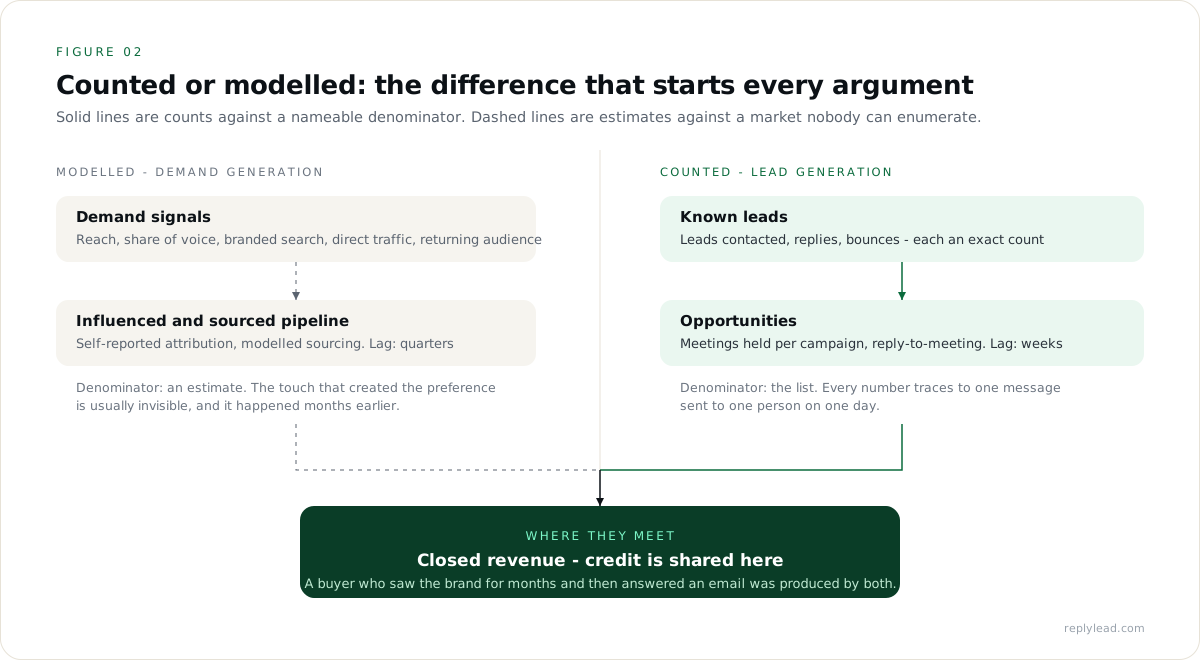
The two machines are not measured differently because one team is more rigorous. They are measured differently because one produces records and the other produces states of mind. A record can be counted with a stated denominator. A state of mind has to be modelled, and every model is an argument.
Signal explorer: counted or modelled?
Every signal either has a denominator you can name, or an estimate standing in for one. Filter by tier to see how the two machines report the same funnel.
Counted - lead generation
The denominator is a list you can open and read.
- LeadingLeads contactedDenominator: the list itself, to the exact record.
- LeadingReplies receivedDenominator: leads contacted, or emails sent - two different numbers, so the page states which.
- LeadingBounce and unsubscribe rateDenominator: sends and contacted leads. Infrastructure health, not list size.
- PipelineMeetings held per campaignEvery meeting traces to one message, one list, one day.
- PipelineReply-to-meeting conversionDenominator: replies. Exposes a vendor booking everything that breathes.
- PipelineMeeting-to-opportunity conversionDenominator: meetings held, not meetings booked.
- RevenueClosed revenue per campaignTraceable to a campaign, and still shares credit with whatever built the preference.
- RevenueCost per held meetingThe only figure that compares cleanly across pricing models.
No counted signals in this tier.
Modelled - demand generation
The denominator is an estimate of a market nobody can enumerate.
- LeadingReach and share of voiceDenominator: an estimate of the addressable audience.
- LeadingBranded search volumeThe closest thing to a demand receipt, and it still cannot name anyone.
- LeadingDirect traffic and returning audienceSessions, not people. One person can be several.
- LeadingEngaged accountsAccount-level, and inferred from signals rather than declared.
- PipelineSelf-reported attribution"How did you hear about us" - honest, and the buyer often does not know.
- PipelineSourced and influenced pipelineModelled. The touch that created the preference is usually invisible.
- RevenueClosed revenue, with the model statedReport it beside the model, never inside it.
No modelled signals in this tier.
The point of the split. A counted signal and a modelled signal can both be true and still cannot be added together. When a buyer saw your content for months and then answered an outreach email, both columns produced that deal - which is why the revenue row is the only one they share.
Leading signals
Demand generation: reach, share of voice, branded search volume, direct traffic, returning audience, engaged accounts. Every one is measured against an estimate of the market, because nobody can enumerate the market exactly. Lead generation: emails sent, leads contacted, replies, bounce rate, meetings booked. Every one is a count against a list you can open and read.
Pipeline signals
Demand generation reports self-reported attribution and modelled sourced or influenced pipeline, and the touch that actually created the preference is usually invisible - it happened months earlier, on a channel with no identity. Lead generation reports meetings held per campaign, reply-to-meeting conversion and meeting-to-opportunity conversion, and each one traces to a specific message sent to a specific person on a specific day.
Revenue signals
Both converge on closed revenue, and this is where the argument becomes structural rather than political. A buyer who saw your content for six months and then answered an outreach email was produced by both machines. Any single-touch model that awards that deal entirely to one of them is making a choice, not taking a measurement. The honest handling is to say so, keep the counted numbers counted, and stop asking a modelled number to behave like a receipt.
What "measurable" looks like on the lead generation side
This section is one-sided on purpose. We run outbound lead generation, so we can publish what that machine produces with the denominators attached. We do not sell demand generation and we hold no demand generation dataset, so there is no matching column below and we have not invented one. The point of the numbers is not that they are impressive; it is that they are countable, and that countability is the practical difference between the two machines.
First-party evidence - ReplyLead campaign book
115 campaigns, one operator, one four-month window
Outbound lead generation only. Every figure below is a count taken from our own campaign records against a denominator we can name, not an estimate of a market.
Method. 115 campaigns across seven anonymised programmes, five client and two internal, between 2026-04-05 and 2026-08-12. Distribution statistics use the 81 campaigns that contacted 500 or more leads. Pooled, the same book replied at 1.45% per email sent and 2.58% per contacted lead - two different numbers for one dataset, which is why a reply rate quoted without its denominator tells you nothing. Bounces ran 5,679 across all sends (1.32%) and unsubscribes 103 across contacted leads (0.04%). Full method, extraction timestamp and the whole distribution are on our cold email benchmarks; how we count anything is on the benchmark method.
Three things in that paragraph are impossible on the demand generation side, and they are the reason the two machines get budgeted differently:
- The denominator is nameable. 242,669 contacted leads is a list, not an estimate of a market. Demand generation's denominator is always an approximation of how many people could have seen something.
- The distribution is visible, and it is wide. The middle half of campaigns landed between 1.38% and 2.97% - the same operator, the same method, one four-month window. Anyone quoting a single benchmark reply rate is quoting a point from a distribution they have not shown you.
- The lag is weeks, not quarters. Every one of those replies has a send timestamp. That is what makes outbound auditable, and it is exactly what demand generation cannot provide, because familiarity does not carry a timestamp.
A sequence, not a choice: what twelve months can look like
Almost nobody should pick one machine forever. The useful question is what runs first and what the first one funds. Below is the sequence we see work for a B2B company with a defined ICP and a deal size that carries a per-conversation cost. Each step lists the condition that says you are ready for the next one, because a calendar is not a plan.
- Months 0-1build the capture machine, not the campaign Sending infrastructure separate from the company domain, mailboxes warmed, list built and verified, one message worth defending. Ready for the next step when the infrastructure is warm and the list is verified - not when the deck is finished.
- Months 1-3outbound produces conversations and, more importantly, evidence Volume inside per-mailbox limits, every reply read by a person. The output is meetings; the by-product is the first honest read on which value proposition earns an answer from a stranger. Ready when you can name the two or three messages that outperform, with the denominators.
- Months 3-6promote what already worked into demand generation The propositions that earned cold replies are the ones worth putting behind content, search and paid reach. This is the cheapest demand generation available, because the market has already voted on the message. Ready when branded search and direct traffic begin to move at all.
- Months 6-12the layers start to help each other Outreach lands on buyers who have now heard the name, and inbound hands begin to go up. Keep the machines measured separately even as they help each other, or the counted number and the modelled number will be averaged into something meaningless.
The mirror case. If the market is broad and horizontal, the buyer cannot be named, or one deal cannot fund many individual conversations, run it the other way: demand generation carries the first year, capture is built to catch the hands that go up, and outbound is reserved for the named accounts worth the cost. The sequence is decided by the ICP and the deal economics, not by preference.
They compound each other - in one direction more than the other
Run together, the machines trade information. Outbound feeds demand generation tested messaging: the value propositions that earn cold replies are the ones worth putting ad spend behind. Demand generation feeds outbound warmth: a prospect who has seen the brand answers cold email measurably better. But the dependency is asymmetric - outbound works from a cold start while demand generation needs quarters - which is why the practical sequence is usually outreach now, brand as the compounding layer, not either-or. Where cold email sits against the other outbound channels is covered in cold email vs cold calling and cold email vs LinkedIn.
How the industry defines the two terms
Vendors that sell each machine publish their own definitions, and they do not agree. The table quotes how five major marketing and sales software publishers define the two terms on their own pages, after this page's definitions.
| Publisher | Term | Definition, verbatim |
|---|---|---|
| ReplyLead (this page) | Demand generation | "Demand generation creates awareness and preference, so buyers understand the problem and remember you." |
| ReplyLead (this page) | Lead generation | "Lead generation creates or captures identifiable demand: it turns interest into a named person or account your team can work directly." |
| HubSpot | Demand generation | "Demand generation captures full funnel programs with an operating system that creates awareness, builds authority, and nurtures trust with your ideal customers, often before they're in the market." |
| HubSpot | Lead generation | "Lead generation is the process of attracting prospects and capturing their contact information so your sales and marketing teams can build relationships and convert them into customers." |
| Salesforce | Demand generation | "Demand generation is the full-funnel effort to build awareness, capture interest, and convert buyers into qualified pipeline, from the moment a prospect first hears about your brand to when they're sales-ready." |
| Salesforce | Lead generation | "Lead generation is the process of building interest in a product or service and then turning that interest into a sale." |
| Oracle | Demand generation | "Demand generation is defined as using targeted marketing programs to raise awareness and build interest in a brand and its products and services." |
| Oracle | Lead generation | "Lead generation, on the other hand, is when you identify and nurture prospects with the hopes of turning them into sales leads." |
| Demand generation | "Demand generation is an upper sales funnel B2B marketing strategy associated with inbound marketing." | |
| Lead generation | "Marketing lead generation is the strategic process of identifying, attracting and nurturing relationships with prospective customers to acquire new business." | |
| Microsoft | Demand generation | "Demand generation is a holistic approach to customer engagement that focuses on building long-term relationships with customers." |
| Microsoft | Lead generation | "Lead generation is the process of identifying potential customers for your business or service and guiding them into your sales pipeline." |
Read side by side, four of the five describe lead generation as identifying or capturing prospects (HubSpot, Oracle, LinkedIn and Microsoft); Salesforce's is the only one that names no such step: it runs from building interest to the sale. They split on how the two relate. Oracle and Microsoft file lead generation inside demand generation: Oracle writes "Lead generation is just one aspect of a broader, overall demand generation strategy.", and Microsoft writes "Lead generation is a specialized segment of a demand generation program". HubSpot instead writes "Lead generation picks up where demand generation leaves off", and its version is inbound only: "Unlike cold outreach, effective lead generation earns attention". This page treats them as separate machines because they are timed, priced and measured differently.
Outside research explains why demand generation's timeline is long. The LinkedIn B2B Institute's article on its 95-5 rule says "Understanding the long-lasting impression brand advertising makes is especially important given our research on The 95-5 rule, which shows that 95% of your potential buyers aren't ready to buy today." It concludes: "This is why the 95-5 Rule advises you advertise mostly to buyers who are not likely to buy from you today." That is demand generation's job. Lead generation does not wait for the 5%: it opens a conversation with a named account now, in market or not, which is why its results can be counted within weeks.
What this means when hiring
Hire for the machine you actually need. A demand generation agency is a marketing engagement: content, paid media, nurture - the fifth provider type in our provider map, priced as retainer plus spend. A lead generation company runs outreach: list, infrastructure, copy, execution, replies, booking - the shortlist is on best B2B lead generation companies. ReplyLead sits entirely on the lead-generation side, stated plainly: done-for-you outbound with meetings delivered, priced mostly as a share of revenue that closes. We do not sell demand generation, and a buyer who needs it should hire it as what it is.
When this comparison does not apply
- You sell to consumers, not businesses. The machines and figures on this page describe B2B selling; consumer marketing works differently.
- You want a demand generation benchmark. ReplyLead publishes no demand generation dataset of its own; the only ReplyLead figures here are its outbound campaign numbers.
- You need a definition for a contract. Publishers define both terms differently (see the definitions above); write the billable outcome into the agreement instead of the label.
- You are reading this months from now. The outside definitions were read on 24 September 2026, and publishers update these pages. Re-check the linked page before quoting it.
How this page was built and checked
The side-by-side comparison, the identification line and the prioritisation rules are ReplyLead's own framework, drawn from running outbound programmes. The evidence section counts ReplyLead's own campaigns (115 campaigns created 1 April-10 August 2026, counted 12 August 2026; distribution statistics use the 81 that contacted 500 or more leads) and states its method there. Outside definitions and findings are quoted word for word from each publisher's own page, read on 24 September 2026; the build re-checks every quote before the page is published. We publish no demand generation dataset of our own.
Common questions
What is demand generation?
Marketing that builds awareness, preference and demand for a problem and a brand. It mostly reaches an audience you cannot yet name, through content, search, paid media, PR, communities and events, and it also runs nurture, retargeting and account-based programmes for buyers you already know. It is judged with attribution models rather than counts.
What is lead generation?
Work that creates or captures an identifiable opportunity: choosing named, ICP-fit accounts and opening the conversation by cold email, calling or LinkedIn, or capturing the hand that goes up through forms, chat and gated assets. Every result is a named record, so it is judged with counts such as sends, replies and meetings.
What is the difference between demand generation and lead generation?
Direction of motion. Demand generation builds interest that comes to you - content, ads, brand and community that make buyers aware of the problem and your name. Lead generation goes to them - identifying named prospects who fit your ICP and opening conversations directly by cold email, calling or LinkedIn, whether or not they were looking. Different timelines, cost structures and measurement follow from that one difference.
Can lead generation work without demand generation?
Yes, and that is the practical reason the two are separate machines. Outreach does not require prior awareness; it requires a defined ICP and a deal size that carries the cost of a conversation. What it does require is that the message teaches, because it is carrying the education a brand would otherwise have done.
How long does demand generation take to produce pipeline?
Quarters, and the honest answer is that we publish no demand generation dataset of our own, so we will not put a figure on it. What we can say from our own outbound book is that the lag on the lead generation side is weeks, because every reply carries a send timestamp and familiarity does not.
Is lead generation part of demand generation?
Vocabulary varies by vendor, which is the confusion's engine. The workable distinction: demand generation creates interest, lead generation creates conversations with named prospects. Treat them as separate machines with separate budgets and metrics, whatever the org chart calls them.
Is cold email demand generation or lead generation?
Lead generation, unambiguously: named prospects, direct outreach, measurable replies. It also produces a demand-side echo - recipients who do not reply still saw the name - but nobody should buy cold email for the echo.
Which should a startup do first?
With a defined ICP and a deal size that carries outreach: lead generation first, because it is deterministic, fast and message-validating. Reinvest into demand generation once the pitch is proven and revenue funds the longer build.
Do you need both demand generation and lead generation?
At scale, yes - flow for this quarter, asset for next year, each feeding the other. The mistake is not choosing one first; it is buying one dressed as the other without noticing.
Sources and check dates
ReplyLead's own data behind the evidence section:
- ReplyLead cold email benchmarks: 429,763 sends, 242,669 contacted leads and 115 campaigns; 2.12% median campaign reply rate per contacted lead across the 81 campaigns that contacted 500 or more leads; 103 recorded unsubscribes.
- ReplyLead benchmark method: how the campaign figures are counted.
Outside definitions and findings, quoted from each publisher's own page on the date shown:
- HubSpot: What is demand generation: definition of demand generation. checked 24 September 2026; page updated 12 December 2025.
- HubSpot: Lead generation guide: definition of lead generation; lead generation picks up where demand generation leaves off; inbound-only framing of lead generation. checked 24 September 2026; page updated 17 September 2026.
- Salesforce: Demand generation: definition of demand generation. checked 24 September 2026.
- Salesforce: Lead generation guide: definition of lead generation. checked 24 September 2026.
- Oracle: What is demand generation: definition of demand generation; definition of lead generation; lead generation as part of demand generation. checked 24 September 2026.
- LinkedIn: Marketing terms: demand generation: definition of demand generation. checked 24 September 2026.
- LinkedIn: Marketing terms: lead generation: definition of lead generation. checked 24 September 2026.
- Microsoft: What is demand generation: definition of demand generation; lead generation as a segment of demand generation. checked 24 September 2026.
- Microsoft: What is lead generation: definition of lead generation. checked 24 September 2026.
- LinkedIn B2B Institute: The 95-5 rule: 95% of potential buyers are not ready to buy today; advertise mostly to buyers not buying today. checked 24 September 2026.
We run the lead generation half, end to end
ReplyLead is a revenue-share B2B lead generation agency running cold email and LinkedIn outbound: named prospects, opened conversations, qualified meetings on your calendar - with most of our pay a share of the revenue you close.
How the pilot works What lead generation services include See how pricing works